
Oklahoma’s assault on Black history has reached unprecedented levels, with former State Superintendent Ryan Walters implementing aggressive book-removal policies and House Bill 1775 restricting classroom discussions about race, leading to the removal of works by celebrated Black authors like Toni Morrison and Maya Angelou from school libraries. In this hostile environment, a Norman teacher lost her teaching certificate for providing students with information about accessing banned books, and districts have faced accreditation threats for keeping award-winning novels in their libraries.
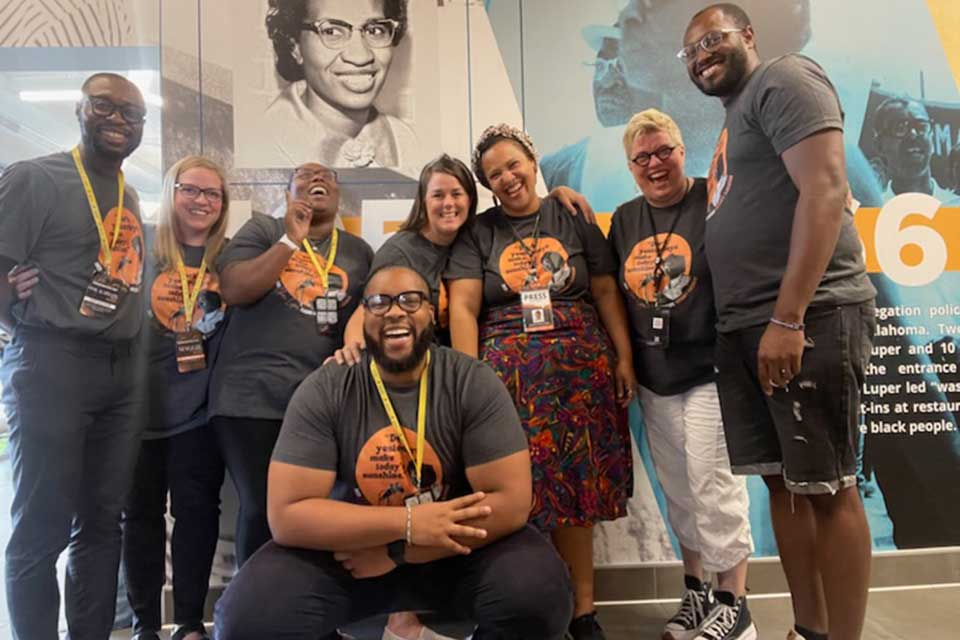
Amid this climate, two remarkable women are leading grassroots movements to heal their communities from the ground up. Kristi Williams, who is related to one of the 1921 Tulsa Race Massacre survivors, created Black History Saturdays to ensure that families can access the education being systematically stripped from schools. Celeste Lebak founded the Restorative Justice Institute of Oklahoma to transform how communities address harm and trauma.
Both women understand that lasting change requires community-controlled solutions that center the voices of those most impacted by injustice. By creating intergenerational spaces for learning, truth-telling, and healing, they have directly challenged Oklahoma’s increasingly punitive culture. Together, their work shows how education and restorative justice can address historical trauma while building a more equitable future.
Karlos Hill: You are the founder of the Restorative Justice Institute of Oklahoma. What can you tell us about the work that RJIOK is doing? Not everyone is familiar with the term “restorative justice,” so for starters, how would you explain the concept?
Celeste Lebak: I would say that our work encourages people to align their behaviors with their values and supports communities by encouraging connection through healing and authenticity. The idea is that restorative justice centers the person who’s experienced harm by prioritizing their needs and their healing, but it doesn’t cut them off from repair, which is something that our current system does. We believe that when harm happens between individuals, oftentimes it’s because their needs are not being met, and it happens in the context of structural oppression. So helping people unlearn the culture of punishment that this society has perpetuated since its inception is one of the things we’re trying to raise awareness about.
Helping people unlearn the culture of punishment that this society has perpetuated since its inception is one of the things we’re trying to raise awareness about.
Hill: What do you see as the needs of Oklahomans in relationship to restorative justice? Can you put the mission of the organization into context?
Lebak: We see a lot of ways in which power in our state is used inequitably, especially in our incarceration rates for people of color and women. The Land Runs, Native American genocide, and slavery, both of Native Americans and of people of color, left Oklahoma with a lot of unhealed trauma, which I think is still leaking into our culture today. So to sum up our mission in one sentence, I would say that RJIOK is seeking to build a restorative and equitable culture in Oklahoma. In addition to being the organization’s founder, I have the title of chief unlearning officer. We have a lot of healing to do, but we also have a lot of unlearning to do—especially those of us who experience the world in white bodies. We are working alongside and along with other nonprofits that are doing work in relationship with people who’ve experienced systemic harm.
So, the core of what we’re trying to instill is the idea that you’re not the worst thing you’ve ever done, and you’re also not the worst thing that’s ever happened to you; those are simply part of your experience. What sets us apart is that our restorative-justice model is both culturally competent and informed by trauma, and the trauma-informed component is grounded in the Internal Family Systems approach. We’re working toward change from the inside out.
A lot of our work involves teaching the foundations of restorative leadership. What does it look like to be a restorative leader? How do you unlearn the things you’ve learned in your family and in our current culture of punishment so that you can better align your behavior with your values? And how can you learn to choose your own values instead of continuing to live by the values that were passed on to you by others?
Hill: How would you explain the impact that this work has had, and the ways RJIOK has been able to effect change?
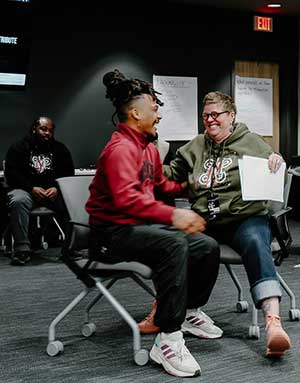
Lebak: I would say that the impact has been relational. We work inside communities and hold regular circles where people can get to know and learn about one another in a culturally contradictory way. People who don’t know each other are able to come together inside this container and explore a theme together with other members of their community in a way that is not about a sense of urgency.
What I experience at these community meetings is a sense of relationship. Even if the participants have radically different opinions about things that are shared, they leave with their hearts more open. They may leave with more questions, but they also leave with more curiosity and connection than they had when they first showed up. In a lot of ways the circles are also a place for an intervention in the community. They’re a place where everyone’s voice is heard, where silence is held, where reflection is honored, where people can speak for themselves. But there’s no talk-back, there’s no response. It’s really just about the group holding that space.
The circles are a place where everyone’s voice is heard, where silence is held, where reflection is honored, where people can speak for themselves.
I walk away from those experiences feeling reverent, and I would say the same thing about the work that we do inside organizations and with our restorative leaders. People leave our nine-week Foundations training program with a new understanding and clarity about their own values, and they come away feeling more curious, more calm, more clear, more connected, and more aware of other people’s complexity.
As a result, we’re seeing educators who are more patient, who are able to manage conflicts differently, and who understand that they have to own the power that they have in their relationships with their students. People who have power over others need to recognize that authority is something that has to be earned. It actually has to be given to them by the people they have authority over. If it is simply assumed, then it’s being wielded in a way that can be dehumanizing and can actually cause harm to the very people they’re in relationship with.
Hill: How is your approach here in Oklahoma different from what you see in other places across the country, or even across the world?
Lebak: Our particular model of restorative justice incorporates Internal Family Systems and the Intercultural Development Inventory for assessing cultural competence. It’s based on letting our being inform our doing, and bringing the concept of self-energy from Internal Family Systems into the restorative framework, with its emphasis on tapping into that place of healing and peace that exists inside all of us.
We also help people understand that when harm occurs, the ball tends to get passed from one level of the system to another, like a hot potato. We want people to recognize that it’s not about harm prevention, it’s about harm reduction, so that we can let go of the perfectionist idea that we should somehow be able to prevent harm from ever happening. We know that harm is going to happen, whether consciously or unconsciously, so how can we encourage repair without the person who transferred that harm going into a shame spiral? How can we help them own what they did in the moment? They need to know that they’re more than the mistake they just made, and we try to show them how to take accountability for the impact of that mistake.
We want them to understand that there are multiple ways to engage with difference, and if they’re engaging in a particular way, there’s a differentiated and developmental approach to help them move to the next stage. It helps them to be able to recognize that they are actually more culturally competent than someone who’s in denial. Once they realize that this is something they care about, and that we’re here to support them, we start to see them show a desire to align their values with their behaviors.
Hill: Can this idea be scaled up, so that it will have an impact beyond individual small groups?
Lebak: That’s a complicated question. I think the answer is yes, but only as long as those in power are in relationship with the people they have power over. As a leader, are you seeking out the voices of the people you aren’t hearing? And what is your relationship to resistance? Do you see it as a natural part of the process? But there’s also a part of me that wonders whether scalability is even the right question, because when I look at our culture’s definition of progress as being bigger, better, more, and when I look at people’s lack of involvement in voting and their lack of engagement with those who are supposed to represent us politically, I struggle with the thought that our democratic experiment has failed. More and more we’re seeing an authoritarian approach, characterized by high accountability and low support. And what happens when one person has power over another person? It creates shame and a sense of unworthiness that feeds into that lack of engagement.
I see this happening at larger scales all over the United States. There’s fear that if we don’t have stricter laws to control people’s behavior, we’ll go too far in the other direction and make it easier for people to do bad things, and that’s just not how I see humanity. When we’re able to engage with something, it creates trust, it creates connectedness, it creates increased empathy. When you take the time to listen to someone who’s caused harm, when you really hear them out, not only can it help you understand why, in their context, they might have made the choice they made, but that act of compassionate listening can in turn lead both parties to do some self-reflection and start to see others more compassionately in general, and therefore more humanly.
If you’re familiar with the framework called the Social Discipline Window, the authoritarian approach is in the “to” pane, and the permissive approach is in the “for” pane. But our work, the restorative approach, can be found in the “with” pane. We are looking to help people change their behaviors, not do things “to” them or “for” them. The restorative approach treats both the person who caused the harm and the person who experienced the harm as complex human beings.
The restorative approach treats both the person who caused the harm and the person who experienced the harm as complex human beings.
Hill: So perhaps scalability isn’t the right way to talk about what you’re doing. This is a movement, after all, and not an entity like a company.
Lebak: It’s a movement in that we really want to help people recognize that they’re not defined by either the worst thing they’ve done or the worst thing that’s happened to them. We want them to get curious about how they experience difference, how the culture influences their behavior and the choices they make. We want them to be able to articulate the “why” behind the decisions they make. It really does require a process of unlearning.
Hill: Let’s imagine Oklahoma, or even the world, as a place that emphasizes restorative justice in the ways you envision. What would that look like and feel like? What do you see as the promise of this kind of approach if we really could embrace it more widely?
Lebak: We all want to be able to live in safety as part of a community, to live our purpose and our values authentically. We want to heal what needs to be healed, and to have structures in place that will support people but also hold them accountable in a way that doesn’t perpetuate the current practice of exiling them and treating them as a money-making commodity. But how many systems would have to be dismantled in order for that to happen? Many of the systems that we currently have in place would have to be completely reimagined. Think about how much deconstruction it would take to be able to build what we’d need to build. We’ve given away our power of imagination and creativity so often and so regularly that we no longer believe that we’re capable of doing it ourselves. And sadly, I think that’s a big part of why we all feel stumped.
We’ve given away our power of imagination and creativity so often and so regularly that we no longer believe that we’re capable of doing it ourselves.
Hill: Your work here in Oklahoma reminds us that healing historical trauma—whether from racial violence, mass incarceration, or generations of unaddressed harm—requires what you call “unlearning.” The path forward is not through grand, systemic overhaul alone but through the patient, persistent practice of showing up differently in our daily relationships: in the classroom where an educator chooses curiosity over control, in the community circle where a neighbor chooses to listen rather than fix, in the moment when someone who has caused harm is met not with shame that isolates but with accountability that restores. The promise of restorative justice, as you’ve articulated it, is that we might yet learn to live in safety as part of community, to heal what needs healing, and to reimagine structures that support rather than merely punish. This is the work of generations, built one relationship at a time.
Editorial note: For more on restorative justice, see “Black Reparations and Restorative Justice: A Bearing Witness Portfolio,” curated by Karlos K. Hill, in the March 2025 issue of WLT.