
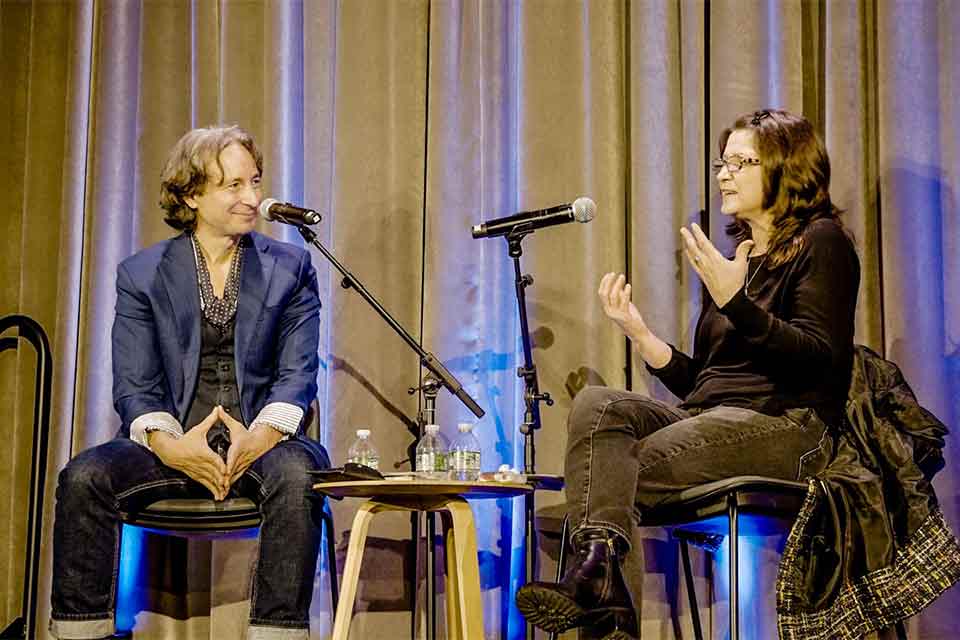
On November 14, 2025, I spoke with poet Luljeta Lleshanaku at the Stavros Niarchos Foundation Library in New York City as part of Limelight Poetry’s World Poetry Salon—a series founded by poet Wang Yin that invites outstanding poets and artists from around the world to share their work across languages and artistic disciplines.
Limelight Poetry is dedicated to showcasing poetry in underrepresented languages and creating opportunities for dialogue between poetry, music, and translation. Drawing on the city’s rich cultural life, the series fosters global exchange while welcoming audiences into a vibrant and intimate space of poetic encounter. (Editorial note: You can watch archived video of the event on YouTube here.)
Patricio Ferrari: Thank you all for being here tonight—those in the room and those joining us from afar. It’s an honor to return to the Stavros Niarchos Foundation Library, and a privilege to be in conversation with Luljeta this evening.
Over the past week, immersed in her work, I found myself thinking about the great passions—the ones that enter our lives with force, often in our teens, our twenties, our thirties. They happen; they mark us. But they grow rarer with time. People, cities, languages. And poets, too, can arrive in one’s life with that same intensity—as a form of great passion.
I can still recall—and I imagine many of us can—the first encounter: Whitman, Dickinson, Baudelaire, Vallejo, Pizarnik . . . perhaps even Frank Stanford, for those fortunate enough. This past week, I experienced that sensation again. As Wang Yin mentioned earlier, quoting Eliot Weinberger: “Luljeta is the real thing.” He wrote this when she was in her early thirties, in a blurb for her first book in English with New Directions, in 2002.
Listening to Wang, I found myself wondering what Eliot might have said about the books that followed. He is here tonight, so perhaps we’ll ask him later. For now, I want to stay with that phrase: the real thing.
Luljeta Lleshanaku: Perhaps he changed his mind after the third book.
Ferrari: Whether he has or not, I’d like to begin with this: there is history in your work, but without slogans; there is politics, but rendered obliquely—never declarative, never programmatic. These elements unfold across kitchens, ships, prison cells, and your native village—among people you knew, and others you encountered through reading and brought into voice.
You are the real thing—not why, but how? There is a wildness of heart in your work—something rare, almost inexplicable. A singular voice at once raw and lucid, and without fear: no fear of returning to childhood, again and again.
I’d like to begin with origins—not simply beginnings, but in the sense Edmond Jabès brings: “a writer writes origins when he writes the moment.”[i] Reading your most recent book with New Directions, Negative Space, especially the poem that gave the title to the collection: it opens in the late 1960s, during the Cultural Revolution, around the time you were born. It begins with punctured rice bags and mice—historical, but intimate. There is an arc backward, but also pulling us into the present.
So, I’d like to ask about that early confinement—how it shaped your ideas of freedom, as a person, of course, and as a poet.
Lleshanaku: In my opinion, freedom is never a topic in itself. We demonstrate freedom in the way we express ourselves—through gestures and actions. I would say the same even about love. But of course, you know, in almost every poem, you can find the different shapes or aspects of freedom—even in a love poem. But it reflects more boldly and directly in the long dramatic poems such as “Negative Space or “Water and Carbon.”
Freedom is never a topic in itself. We demonstrate freedom in the way we express ourselves—through gestures and actions.
I like very much something George Orwell said: “Freedom is the freedom to say that two plus two make four”—accepting reality.[ii] Where I demonstrated my freedom most was in poetry—in freedom of expression.
In one of my early poems titled “The Wanderings of the Freedom” (Child of Nature, 2010), I say: “Finally, I am free from the illusion of the freedom / finally I am free . . .” It seems that living under such a totalitarian regime as communist Albania encouraged us to create an idealistic model of what we didn’t have: freedom. And the postcommunist period disappointed our expectations. The bitter clarity, the disillusionment about freedom became an expression of freedom itself in my poetry; it replaced and challenged my vision of freedom, it pushed me toward a more analytical and critical perception of society and history, and toward a deeper understanding of human nature.
In the poem “Marked” (Child of Nature), for example, I interpret the postcommunist reality as a consequence of the transformation of collective consciousness, on how the long survival experience dismisses the concept of freedom: “And then there is one marked for survival / who will continue to eat his offspring like a polar bear / that never notices the warming climate.”
Freedom is accepting reality—and expressing it.
Ferrari: Across your books with New Directions—Fresco (2002), Child of Nature (2010), and Negative Space (2018)—there is this constant return.[iii] But it never feels nostalgic. It feels almost like a structural necessity. Why is that return so central to your work?
I’d also like you to tell us about the “Yellow Books,” which you take up in one of your poems in Child of Nature and which seem to be a crucial part of Albania’s history.
Lleshanaku: Yes, it’s important to understand Albania’s history. A big part of the audience tonight is Albanian, and there is nothing new for them. But for foreigners, it remains a mystery.
One major restriction was censorship—not only of literature, but of information. It was nearly impossible to access Western literature, especially after the 1960s. Even Russian classics were censored.
“Yellow Books,” in the plural, referred to banned books circulating secretly. They were called yellow books because they turned yellow from moisture and dust while being stored in hidden places.
“Yellow Books,” in the plural, referred to banned books circulating secretly. They were called yellow books because they turned yellow from moisture and dust while being stored in hidden places.
I read the books of Tolstoy, Chekhov, Turgenev, Sholokhov, and many other of my favorite books this way. . . . In one case, I remember how my cousin got very angry with me when I returned Anna Karenina back to him with some leaves fallen out due to failed adhesive. And he was right because it was impossible to replace it, to replace them. Of course, not all banned books were books worth risking for, but it was the “forbidden fruit effect” that intrigued us. It was especially their clandestine circulation that mystified them even more.
Before the fall of the regime, the libraries had a restricted section called the Rezervat—accessible only to trusted individuals. You could find some literature in French and Italian, but most of the books and magazines were in Russian, where you could find also translations from contemporary Western literature. So, can you imagine: the “father country” of communism, the Soviet Union, was much more liberal than Albania! For nearly fifteen years, Albania was among the most isolated countries—no travel, limited books, censored media.
Ferrari: Yes, absolutely.
Lleshanaku: The most liberal period in Albania was during the Khrushchev era from 1956 until 1961 when the Soviet–Albanian alliance was split. Then Albania became an ally of communist China, an alliance that lasted almost two decades (from 1960 to 1978). The Chinese influence was economic as well as ideological; the Cultural Revolution inspired by the Chinese model was a movement that caused a great regression in the country. In the name of the struggle against “old thoughts, old culture, old customs, and old habits,” the regime targeted the religion and intellectuals, destroying in this way every liberal tendency and the cultural/spiritual heritage that still remained intact.
Reading books—those few that existed, all under censorship—was the only way to survive. We had no access to any other information. Television was censored as well. At night, we built illegal antennas to intercept radio signals.
We had no access to other information. Television was censored as well. We’d build illegal antennas to intercept radio signals at night.
The collapse of the regime found us especially hungry for knowledge and information. A new generation of writers emerged—mine. We embraced everything irrationally. Our generation was very lucky. On one hand, we had what the previous generation did not. They lacked an art education because reading is an art education, and it wasn’t because censorship worked only in publications. Censorship was omnipresent. On the other, there was a kind of chaos in creativity. I mean, subconsciously, everybody tried to run after their idols or the writers they’d just discovered, and it was very difficult to find your way. It was a transitional period, and of course, some of us survived that chaos. Assimilation is probably the right word. But some did not.
Ferrari: This raises questions of influence, limitation, and protection.
I’d like to ask about objects in your work—those recurring, almost talismanic presences. There is a remarkable attentiveness to them, never moralizing, but deeply observant. I wonder to what extent that attention is rooted in material conditions—in scarcity, in the intimacy of daily life. And more broadly, did the relative lack of access to external literature allow you, as a young writer, to develop your voice more independently? What, if anything, was generative in that experience?
Lleshanaku: I think the way I write is shaped by that experience, where images, objects as images, or details play a crucial role. Of course, there is nothing special about it; this happens with many other poets. What is special in this case has to do with the uniqueness of these objects in themselves, the material environment that shaped my experience and identity. But I want to talk a little bit more about it.
The so-called “minimalism” in former socialist countries was dictated by the material shortages; it was just poverty. Living in Albania, nothing was thrown away. Several types of goods were very limited. So, probably most of the time we shared a comb among two or three people. Everything was used by everybody except a toothbrush.
Objects were irreplaceable. I remember that if you broke the milk bottle, it was also difficult to replace it. That’s why we paid so much attention to objects. They were expensive, and we couldn’t afford them. Another thing is that the market was very limited in supply; technology was very unproductive, it had immense deficits. So, there was a lack of very common products everywhere in markets across Albania. Many possessions were used in two or three generations. For example, I had a school bag that had been used by two previous generations. Almost nothing was private; every item possessed a special status, so every item was overloaded with history. And there are items that exceeded their function, like the Czechoslovak radio, which was the only window to the free world through the waves of the Voice of America or the BBC, becoming the only source of hope.
I remember that if you broke the milk bottle, it was also difficult to replace it. That’s why we paid so much attention to objects.
These objects outlived people. Can you imagine? Most of my family has already passed away, but the objects are there because we developed that connection. And if not physically, at least in our memory, these possessions are indelibly alive, connected inseparably to our lives. They are like souls, spirits, and witnesses. They have personality.
Ferrari: Some readers might think of Felisberto Hernández, who personifies objects—but your work avoids sentimentality. There is a wide range in your poems, yet the materials remain strikingly elemental—drawn from everyday life.
I’m thinking, for instance, of “Monday in Seven Days” in Child of Nature, where you give voice to members of your family. There is a beautiful moment when your uncle speaks of a fazzoletto—you retain the Italian, since he brings it from Italy—and it becomes almost talismanic, a point of intimacy between uncle and niece. There is closeness, but never excess.
Lleshanaku: My poetry is not confessional. That’s why I’m a very slow, lazy poet. A purely confessional poem feels unfinished to me.
One summer I went back to my hometown to write because the environment and everything is there, and it’s a good place to work. I remember my uncle, who read books, but he didn’t have any affection for poetry in general, asking me, “What do you say in your poems?” Not “what do you write,” but “what do you say.” That question stayed with me.
It’s not enough to tell a story, I think. I always ask: What is behind it? What does it mean? Although it may seem spontaneous and subjective, I always write with a preexisting idea, which comes as a result of an in-depth analysis of several experiences. It’s a very cerebral, slow, and “risky” process, but on the other side it can take you beyond the immediate to an abstract, shared human ground. Perhaps it was the life I had full of extreme experiences and exposures, from one extreme to the other, from “mountain to sea” and vice versa, that cultivated an analytical mindset in me. So, I ask for something that belongs to everybody, for something that isn’t stuck in one’s own personal history—that it can be read from everywhere.
But it’s mostly the technique of imagery, the language of objects and details, sentimental or not, that camouflages this preexisting idea. Their way of communicating is sensory, concrete, tangible, and credible, making the reader involved, experiencing the essence/idea of the poem as their own revelation.
Ferrari: At certain moments, I found myself thinking of Alberto Caeiro—Pessoa’s master. More precisely, of what he, as a sensationist poet, says about this or that aspect of nature. For instance, he insists that “stones are just stones”—not this or that particular kind.[iv] When he speaks of trees, he simply says “trees,” not naming a species. He doesn’t say poplar, for example—and I mention poplar because it appears in your work.
What’s remarkable is that, when we read you—or when we hear about a specific mountain—we could be anywhere. We’re not necessarily in Albania. The same could be said of the confinement. It doesn’t have to be 1968 or the Cultural Revolution in your country. I think the work truly succeeds on this level—and that leads me to a question. It succeeds in not limiting its geography, neither in space nor in time.
Do you feel that this kind of success comes naturally to you as a writer? As readers, it never feels forced. I wonder if this goes back to something in childhood—to its mystery, which is why I mentioned the wildness of the heart.
As I read your work, I keep thinking of Rilke’s Letters to a Young Poet—of his insistence that one remain faithful to the immediacy of everyday experience, to what one perceives almost as a child would. And, if I’m not mistaken, Baudelaire says something along similar lines: that genius is nothing more than childhood recaptured at will.[v]
Lleshanaku: Childhood is important for everyone. The further we move from it, the more preserved it becomes. Distance—whether in time or space—intensifies memory. It’s like a turtle’s shell—something you’re not aware of. When the turtle moves, it isn’t thinking about the shell; it simply carries it.
We keep going back to it, again and again. Not out of sentimentality, but because whenever we feel lost in life, we return there. It’s like getting lost in a forest: what do you do? You go back to where you began, and then you try a different direction. In that sense, all those regrets—or spiritual disorientations—bring us back, again and again, to that point of origin. You can interpret this in many ways, perhaps as a kind of emotional identity. But for me, at least, this is how the cycles of creativity repeat: every return to childhood experience corresponds to an inner transformation, and identity re-evaluation.
You might think it’s just about Albanian history, or my own childhood. But when you ask Americans, they often say, “Oh, that’s not interesting.” And yet, if you insist, they begin to tell their stories—and if you go further back, to their grandparents and great-grandparents, to how they came from Europe in different waves, something shifts. What seemed uninteresting becomes deeply compelling.
That’s what I mean. Every childhood is unique—and almost sacred to the individual.
Ferrari: I think of it, of course, as a kind of treasure house—not only of place and memory, but of language itself, of the mother tongue, of its very DNA. In your case, the DNA of the Albanian language.
I wonder, then: now that you’ve been living in the United States for some years—and have been coming here over the past two or three decades—has your relationship to Albanian shifted in any way? For instance, in one of your poems, thanks to the translation, I learned that in Albanian “autumn” is feminine.
Lleshanaku: Hmm, I never thought about it before . . .
Ferrari: Right? I became curious, because in the languages I know, “autumn” is masculine—certainly in German, and in most (though not all) of the Romance languages. And I began to wonder: What about the other seasons? What kind of imaginative or emotional shift does that create for someone within that language?
Of course, if you’re fully inside a language, without any distance from it, these things simply feel natural—they don’t really register. But you have had that distance, or . . .
Lleshanaku: It’s different. . . . As a poet, I never paid enough attention to language and form; my focus is the meaning, the content it conveys. But I understand what you are talking about: the inner temperament of languages.
Ferrari: Let’s stay with this for a moment—the DNA of Albanian. I mentioned, for instance, that “autumn” is feminine. For writers who remain entirely within one language, who are monolingual, this may never even arise as a question.
But in your case, you grew up alongside Italian, and now, for the past two decades, you’ve also been living with English. So, there’s a certain distance, perhaps—not to see Albanian as a second language, of course, not at all—but enough of a pause to notice: this is what Albanian does, and English does not do this.
Lleshanaku: Yes, of course—but let’s think about winter, since I was just considering that. Albania is, after all, a Mediterranean country; it’s relatively warm. So, the three warm seasons are feminine, you know . . . and winter is masculine.
Ferrari: Because winter is macho!
Lleshanaku: It makes sense—logically, it does. But we also have another old-fashioned word for spring, a borrowing one: bahar, which comes from Persian, via Turkish, I believe, and is neutral in gender.
There is a theory, known as linguistic relativity, which suggests that the language one speaks influences the way they think and perceive reality. Indeed, the opposite of that sounds more convincing to me: it’s more the way they think and perceive reality that influences the language, from national to individual language. Italian, for example, seems very musical and dramatic because of its pure and opened vowels that usually close words and the predictable rhythm. It fits perfectly to Italian people, their lyrical nature, their openness, directness, and their emotional expressiveness. And they consume more conversation than food in the dining table. Talking is of high importance for them; a living style. To speak their language, you should act like an Italian.
The German language always sounded determined to me, due to its high-pitched sounds, consonant clusters, and especially the placement of the verbs at the end of the sentence—a syntax element. For some unexplainable, subconscious reason, this is my favorite language. I feel it physically.
But even within the same language, individual speaking style means a lot. A very interesting case is that of airplane pilots, whose faces we almost never see, but we hear their voice through the cabin loudspeaker system during announcements. And intuitively, we know in the hands of whom we entrust our lives.
Whereas English seems to me the most flexible language of all, and as such without strict rules. An open language, rich in jargon that quickly turns into a norm. Very dynamic, I mean. Perhaps also because of the cultural mixing and overlaps. And without a doubt it’s a cerebral language.
Ferrari: Do you think—this brings me to another question—that the exophonic, or heterophonic, experience of writing in a language other than your mother tongue is something you’ve tried, or might want to try?
Lleshanaku: I speak English but don’t feel capable of judging how my poems sound in English. Maybe because of it, because I am not fully in or fully out of it. It means, I miss the right distance to it. This is what prevents me from writing my own poems in English.
Writing is primarily a process of thinking. Conceiving a poem can take me weeks, months, sometimes even years, while writing it down takes me very little time, just a few hours. And I’ve never quite understood the question, “In what language do you think?” heard from time to time. Do we really need a language to think, when thinking is much older than language?
Do we really need a language to think, when thinking is much older than language?
Honestly, if you saw my notes during the writing process, you would find a lot of lines and phrases in English mixed with those in Albanian. More than an attempt to translate my thoughts into English, it is a way to hide my insecurities behind another language, whose secrets, hints, strength, and weaknesses I do not know yet. It is precisely the mystery of the other language superimposed upon my text that makes it seem more interesting in my eyes.
But for sure my poems sound very different in Albanian. Albanian is a rich language, and many of its words have an onomatopoeic quality. Through them, you can form a vivid sense of natural phenomena—there’s something inherently poetic in that aspect of the language.
Our grammar, though, is less conducive to poetry than English. It’s closer to Latin, with longer, more elaborate forms. English, as you know, with its shorter grammatical structures, allows poetry to sound more . . .
Ferrari: So—will we have Luljeta poems . . .
Lleshanaku: . . . shorter . . .
Ferrari: . . . in English, at some point?
Lleshanaku: Yes. While in Italian, those grammatical forms give Albanian poetry a kind of ceremoniousness. I’m thinking of the Albanian versions: if you listen to my poems in Italian, the lines are longer, the words are longer. And so you begin to experience the effect of the sound itself. It’s actually easier when you don’t understand the language—you can simply enjoy that kind of blindness.
Ferrari: The music.
Lleshanaku: Yes, exactly. But to come back to your question—of course I would like to. Who wouldn’t? Some Albanian writers do write in the languages of the countries where they live—English, French, Italian—and I admire them for that.
The thing is, I’ve always struggled with foreign languages. I’m a very logical thinker, and languages are arbitrary—you simply have to take them as they are; logic doesn’t really help you memorize them. I’ve always had difficulty with that. I don’t really know anything by heart unless there’s some logic involved.
When you’re a child—or even just young—it’s easier to learn new languages. But later on, language becomes a system that’s already fully formed in your mind. So, by the time I felt ready, or wanted, to write my poems in English, it was already too late.
Ferrari: You live in New York City—you could absolutely begin writing in English, if you turned to it.
Lleshanaku: But you see, it’s not really about vocabulary—not about how many words you know. It’s about syntax, about the way a language thinks. And the language you inhabit isn’t so flexible that you can give your thoughts any shape you want. They’re already shaped—there’s a structure to them. So, it’s not something you can simply switch. I would need time . . .
Ferrari: This is a topic very dear to me—we’ll come back to it.
Lleshanaku: I mean . . . language reflects your personality. The vocabulary, the grammar, the idiomatic structure shape the way we think, our background, and our perspective on the world. You can change the language but can’t really change yourself as a person. It’s tied, at least in part, to your personality . . .
Ferrari: Of course. Of course.
Lleshanaku: For better or worse—with everything that I am.
Ferrari: A personality for each language.
Lleshanaku: Exactly—it’s a system already installed inside me. At my age, at this stage, I find it difficult to express myself fluently in another language in the way I might have if I would do that earlier when I was younger, and living here.
As a writer, this is much more difficult, because you need to know well the living language—the vivid, everyday English. Whatever I do, I feel I can’t quite reach that. Institutional English is something else entirely . . .
Ferrari: It’s another—another thing. But before . . .
Lleshanaku: Because it all depends on the environment, on the experiences you have in a country, on the people you live among . . .
Ferrari: With whom you live—of course. We only have two minutes left, and I have so many questions, so I’ll ask two and let you choose one. [Laughs]
I’d love to hear about “Homo Antarcticus”—it’s such an extraordinary poem, unlike anything I’ve read. It works through a kind of negative space, and you give voice to Frank Wild—I found myself thinking of Browning and the dramatic monologues. So: how did you come to Frank Wild, and what was the process behind the poem?
Or, if you prefer, you could speak about your relationship to images and cinema—Tarkovsky, Bertolucci, Hitchcock . . .
Lleshanaku: It’s better—this one.
Ferrari: All right.
Lleshanaku: You were asking about facts, about testimony and history, about the relationship between documented events and personal experience. With this poem—which was probably the greatest risk I’ve taken as a poet—I chose to write out of a documentary source. The story is well known, widely circulated . . .
Ferrari: Frank Wild—the British explorer . . .
Lleshanaku: Exactly. It’s a matter of record, a document. Everyone already knew it—there was nothing, it seemed, left to say. But what truly struck me was not simply the survival of the expedition crew for two years, there, in Antarctica . . .
Antarctica—almost nowhere. What began as a scientific expedition under Shackleton turned into a rescue mission. His only goal became how to bring those twenty-three—or twenty-five—men back home. And that’s where his leadership truly emerged; he’s studied everywhere now as a model of leadership, for what he did. But in a sense, there’s nothing new to add about that.
What really struck me—what pushed me to write the poem—was something else, a kind of turning point. When those men returned home, after surviving what seemed impossible in every sense—the cold, the hunger, the anxiety, the hopelessness—they couldn’t survive their ordinary lives. They became, in a way, like the walking dead. They were no longer capable of living as before. Only a few managed. Others returned again and again—Shackleton himself, twice . . .
When those men returned home, after surviving what seemed impossible in every sense—the cold, the hunger, the anxiety, the hopelessness—they couldn’t survive their ordinary lives.
Ferrari: Six times.
Lleshanaku: . . . until he died there. The question for me—the idea I wanted to explore—was this: What is it that modern civilization gives us, and what does it take away? What is wrong, somehow, with this balance?
We see the other extreme: those men, alone in the middle of nowhere, facing only the immense forces of nature—and they survived. And yet here, in ordinary life—paying rent, paying off loans, getting married, starting a family, all these everyday demands—they could not survive. “Once you’ve been to the white unknown, you can never escape the call of the little voices,” is how Frank Wild himself described the post-Antarctic drama.
Ferrari: In a way, yes—and this is precisely what feels so extraordinary, so powerful in your work. This poem, again, is so different from the rest, so unexpected, because it confronts what happens when we return. We see this already in your earlier books: those who lived in confinement and then found themselves, suddenly, in freedom. What happens when we return to a so-called . . .
Lleshanaku: So—where did your freedom go?
Ferrari: Exactly. Exactly. In a way, it becomes another way of exploring the human condition.
Lleshanaku: And the reason I chose Frank Wild as the lyrical voice—it was, at first, a tactical decision. We know so much about Shackleton, but Frank Wild was more of a . . .
Ferrari: The right-hand man.
Lleshanaku: In the shadows, let’s say—the forgotten man. That gave me a certain freedom to tell the story through him. And Frank Wild also came to symbolize friendship. He had ambitions of his own, of course, but for him it was more important to remain loyal, to be Shackleton’s right hand, than to pursue those ambitions. And in our time, these are values that are being lost—friendship, loyalty.
There was also something else, something I’ve never said before: He reminded me of my uncle, who lived, I could say, an epic life. He was executed at thirty-seven. He was part of the anticommunist resistance, fighting in guerrilla groups, living illegally with his unit. He was a very brave, determined man—quiet, reserved—but a man of action, and deeply enigmatic. He even resembled Frank Wild physically: his bearing, his face, his presence. This is the first time I’m saying that—that Frank Wild reminded me of my uncle.
And his end was tragic. He was captured, betrayed by the last person he trusted—his childhood friend. That was how it ended. So, all these elements . . . when you begin, you’re not entirely aware of them yourself. But gradually you understand what draws you to a figure, to a portrait like this. I read all the diaries, of course. There isn’t much written about Frank Wild, but that absence gave me space—space for imagination, for invention. Most of what is in the poem is imagined; only a few elements are drawn directly from the historical record, things I had, in a way, to “cook” from the available material.
Ferrari: What that poem ultimately does is carry even further what you had already been doing—it pushes it much further. By taking on someone outside your culture, outside your century, and placing him in a context of extreme hardship, you open something new.
And this is where, I think, by not falling into—or following—a confessional mode, your work arrives somewhere else. We read a poetry that, unlike so much of what we encounter in the twenty-first century—so many poets, or so-called poets, who lament or dwell on their own suffering—does something different.
In your work, there is a kind of affirmation. Not a naïve celebration of suffering, of course—not of sadness, nor of horror—but a deeper sense of belief in human beings, in humankind. And so, there is hope. It is, in that sense, a poetry of hope.
I keep coming back to the word I used at the beginning: “stubborn”—but in the best sense, a kind of stubborn freedom . . .
Lleshanaku: Yes.
Ferrari: . . . in your work, and in this poem in particular.
Lleshanaku: It’s directly connected to “Water and Carbon”—because this poem, perhaps more than anything, represents what we’re talking about. This is the only poem where I deal, somewhat directly, with politics—with the communist regime.
It’s also the only poem where I allow myself a certain grammatical playfulness, shifting between the first person, the second, the first-person plural—very deliberately, in order to expand the scope of the story.
But the question is: Why did I write for so long without approaching this subject directly, when communism was, in a way, in my bones? It’s because I was waiting—for a way in. No one can be moved anymore simply by accounts of suffering of this kind, not after the Holocaust, after the wars . . . And even communism has already been widely represented, through writers like Solzhenitsyn, Pasternak, and many others from eastern Europe.
So, I needed a different, more original perspective. And that perspective was this: If you remove all the elements that constitute a human identity—as communism did—what remains? Private property is taken away. Political freedom is taken away. Freedom of speech, religion—all of it removed.
If you strip all that away—thinking of Albania in particular—what is left? What remains is only the material, the biological substance: the human being reduced to chemistry. Water, carbon, and a few other elements. That is why the poem is called “Water and Carbon.”
Ferrari: Luljeta—grazie. And thank you all for being here, for staying with us—those joining us live and those here in person. There will be more next year, as Wang mentioned: more readings, more music. So, please stay tuned. And thank you again to the Stavros Foundation, to Wang Ying, and to everyone who made tonight possible. Thank you.
November 2025
Editorial note: Audio transcribed by Dana Sirois and Stephen Roberts.
[i] Edmond Jabès, A Foreigner Carrying in the Crook of His Arm a Tiny Book, trans. Rosmarie Waldrop (Wesleyan University Press, 1993), 57. The full quote reads: “A writer writes origins when he writes the moment. And the moment always remains to be lived in its disconcerting brevity and ratified eternity.”
[ii] The full quote reads: “Freedom is the freedom to say that two plus two make four. If that is granted, all else follows,” from Nineteen Eighty-Four (also published as 1984), first released in the United Kingdom in 1949.
[iii] Luljeta Lleshanaku, Negative Space, trans. Ani Gjika (New Directions, 2018). Other books referenced in this conversation include Fresco (2002), trans. Henry Israeli et al., and Child of Nature (2010), trans. Henry Israeli & Shpresa Qatipi; both published by New Directions.
[iv] Poem 28 in “The Keeper of Sheep,” in Fernando Pessoa, The Complete Works of Alberto Caeiro, ed. Jerónimo Pizarro & Patricio Ferrari, trans. Margaret Jull Costa & Patricio Ferrari (New Directions, 2020), 67.
[v] In his essay Le Peintre de la vie moderne (The painter of modern life), Baudelaire writes: “Le génie n’est que l’enfance retrouvée à volonté” (Genius is nothing less than childhood recaptured at will). Composed between 1859 and 1860 and first published in three installments in the French morning newspaper Le Figaro in 1863.
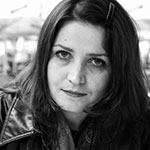
Luljeta Lleshanaku is the Poet Laureate of Albania (2023–2025). Born in 1968 in Elbasan, she grew up under house arrest during Enver Hoxha’s Stalinist regime. She has worked as a lecturer, literary magazine editor, television writer, and researcher. She is the author of nine poetry collections in Albanian and is regarded as one of the leading voices in contemporary Eastern European poetry. Her work has been translated and published internationally. Three collections appear in English with New Directions: Fresco (2002), Child of Nature (2010), and Negative Space (2018). Negative Space received an English PEN Award and was a finalist for both the Griffin International Poetry Prize and the PEN America Literary Awards (2019). Her German collection Die Stadt der Äpfel (Carl Hanser Verlag, 2021) was recommended by the Deutsche Akademie für Sprache und Dichtung (2022). She received the European Poet of Freedom Award in 2022.