

Photos by Yousef Khanfar
Some poems are born under oppression yet travel as sunlight, cross oceans, enter prisons, dispel darkness, ignite revolutions, and speak to every soul in the struggle for freedom and justice.
I had been invited to an exhibit, though I wondered why it was held in that particular place. When I arrived, my confusion deepened as I questioned how one of the most powerful Palestinian poems was wrongly attributed to one of the most powerful Black Panther leaders. I had no idea then that one of the rarest books in modern Arabic literature, which had ignited this curiosity, would be republished after fifty-five years, and that I would be gifted a signed copy by the very editor who revived it.
However, I soon realized what a beautiful story was waiting for me.
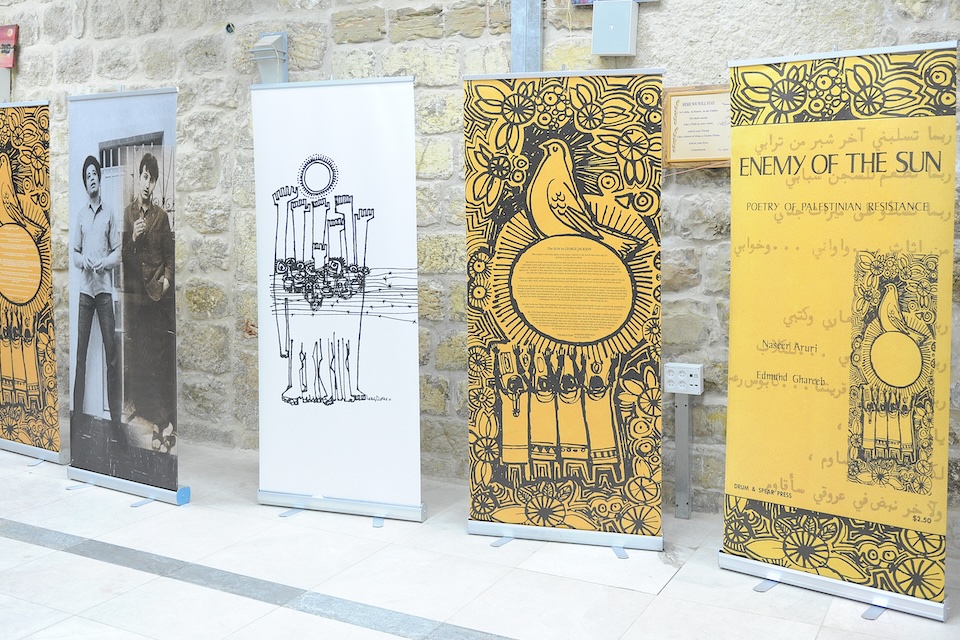
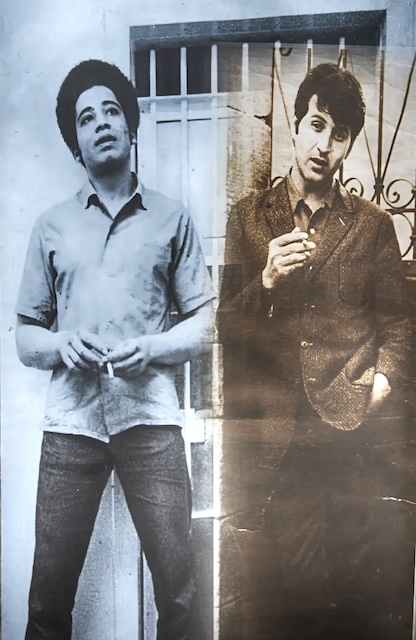
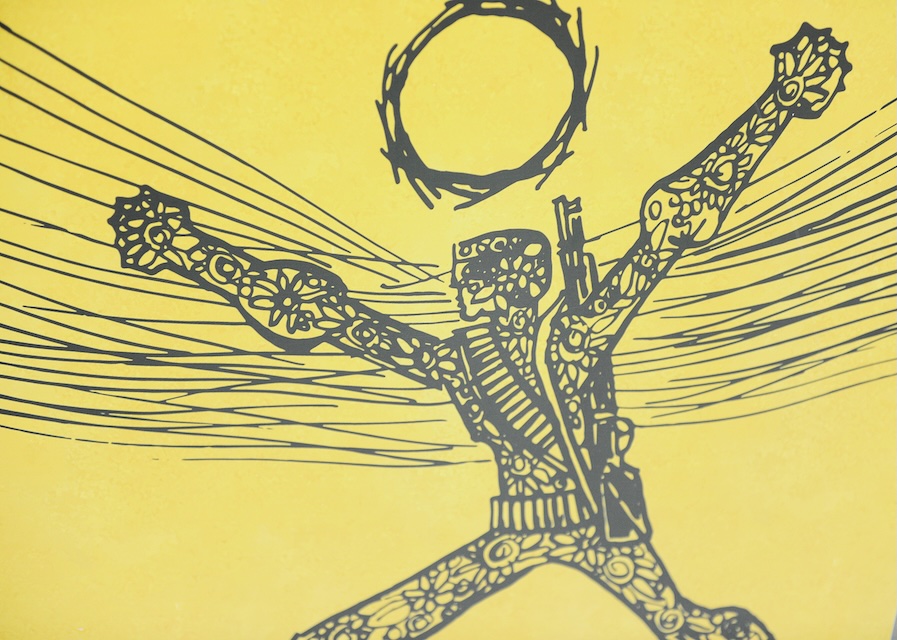
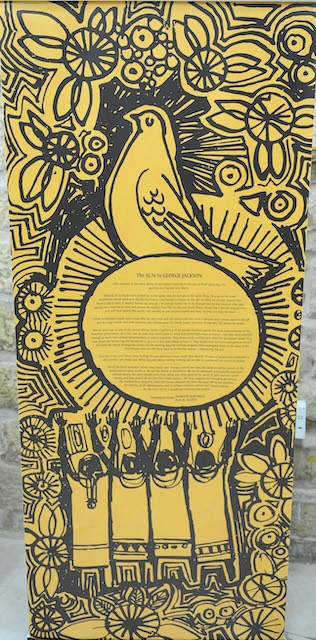
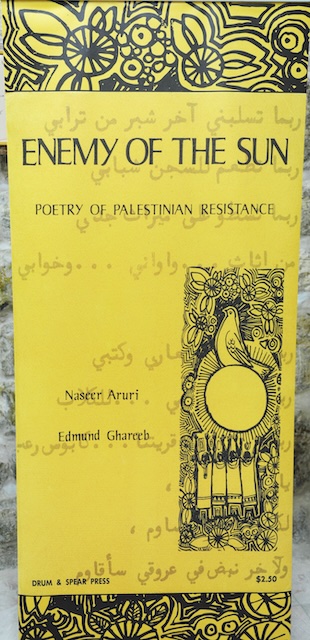
While visiting Jerusalem in November 2016, I was invited to an exhibit by Sheikh Mousa Qous (1962–2025), who served as executive director of the African-Palestinian Community in Jerusalem. The exhibit, George Jackson in the Sun of Palestine, was held in their civic center in the Old City of Jerusalem at the edge of Al-Aqsa.
What first appeared to be a simple mistake turned into a profound discovery about the hidden bridges of defiance that connect peoples across continents and histories. The exhibit centered on the book Enemy of the Sun and the American Black revolutionary George Jackson (1941–1971), the imprisoned writer whose letters and political reflections from San Quentin Prison became some of the most powerful narratives of the Black Liberation Movement in the United States.
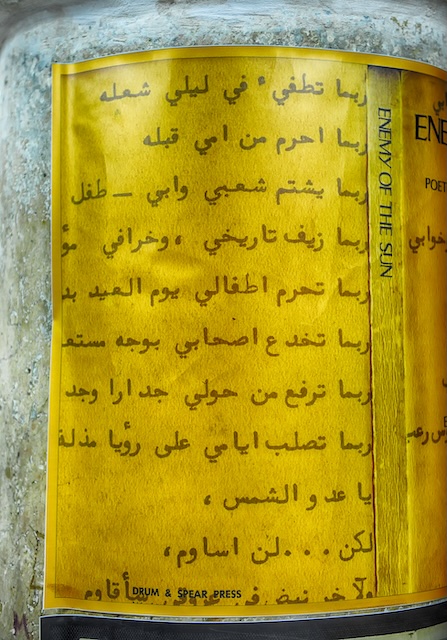
However, on the wall before me was a famous poem that I immediately recognized as belonging to the great Palestinian poet Samih Al-Qasim (1939–2014). The confusion was not simply a curatorial oversight; it was a window into a deeper intellectual and emotional exchange, one that scholars and activists have long sensed but rarely documented with clarity.
It was Greg Thomas, a scholar of Black studies and revolutionary thought, who carefully uncovered this remarkable connection. Thomas traced how Jackson, while imprisoned in the late 1960s and early 1970s, encountered the poetry of al-Qasim and other Palestinian writers whose voices emerged from a different, yet hauntingly parallel, condition of struggle.
While imprisoned, Jackson encountered the poetry of al-Qasim and other Palestinian writers whose voices emerged from a different, yet hauntingly parallel, condition of struggle.
Among the ninety-nine books recovered from Jackson’s prison cell after his assassination in 1971 was the book Enemy of the Sun, an anthology he had not only read but deeply devoured. Jackson copied al-Qasim’s poem in his own handwriting and shared it among fellow prisoners, carrying its words beyond the page and into lived resistance.
In a striking and almost mythical turn, the poem later appeared in the Black Panther Intercommunal News Service, wrongly attributed to Jackson, yet revealing something far deeper. It exposed a profound identification: the voice of a Palestinian poet living under colonization echoing through the words of a Black revolutionary confined within the American prison system.
In that moment, the prison cell in California and the colonized land of Palestine were no longer distant geographies; they became part of a shared language of dignity, defiance, and survival, where poetry was not simply read but lived.
Elegant in thought and powerful in purpose, Edmund Ghareeb stands among the most influential voices in bringing Palestinian voices, and the wider Arab world, into the global literary conscience. With quiet devotion and enduring vision, he returned to a work that once seemed lost to time and was once so scarce as to be nearly impossible to obtain.
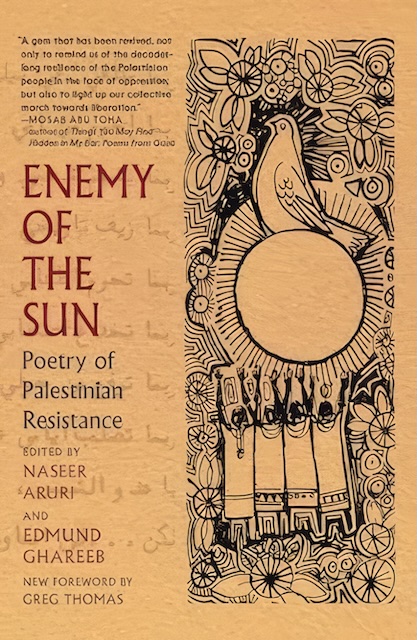
After fifty-five years, and in honor of his late friend and co-editor Naseer Aruri, he expanded and republished one of the rarest books. He gathered new voices of some of the most important Palestinian poets and others in the Arab region whose work emerged following the Nakba of 1948, with a new foreword by Greg Thomas. Enemy of the Sun (Seven Stories, 2025) is not only a literary anthology but a lasting document of cultural resistance, one that transforms grief into moral clarity and poetic strength.
At the heart of Enemy of the Sun stands Samih al-Qasim, whose voice defines the moral spine of the anthology. In the poem that gives the collection its title, he declares:
You may take the last strip of my land,
Feed my youth to prison cells.
O enemy of the sun,
But
I shall not compromise
And to the last pulse in my veins
I shall resist.
Around him gathers a chorus of voices shaped by exile, resistance, and an unbreakable bond to land. Mahmoud Darwish, in “Identity Card,” writes with stark clarity, “Record! / I am an Arab,” transforming identity into an act of defiance.
Tawfiq Zayyad’s voice rises from the land itself, asserting presence not as plea but as fact, rooted in a people who carry a past, a present, and a future deeply entrenched in the earth. He answers with collective permanence in “We Shall Remain”: “Here, we shall remain / A wall on your chests.”
Alongside these voices, Fadwa Tuqan brings the quiet intensity of lived struggle. Her voice does not shout; it endures, revealing a resistance carried within the soul. In “My Liberty,” she writes:
My liberty—my liberty—my liberty,
a sound I repeat
with angry lips
under the exchange of fire and flames,
I run after it
despite my chains.
Iliya Abu Chedid, in “The House,” captures the fragile afterlife of home, where the house becomes memory, erased in form yet enduring in presence:
They took a whole life with them
And what remains is
The shadow voice on the walls of distance.
Extending beyond Palestine, from the land of Lebanon, Nizar Qabbani, in “To the Poets of the Occupied Territories,” affirms that beauty itself can rise from destruction:
Poets of the occupied land,
You are the prettiest birds to fly out of captivity
Pure, like the prayers of the dawn
You are the roses growing from within the flame
You are the rain falling despite repression and defeat
You taught us how the drowned can sing
from the bottom of the sea
and how the grave can stand and walk
You taught us how to write poetry
In “Tent #50 (Song of a Refugee),” Rashid Hussein gives voice to exile, where it becomes not only displacement from land but an assault on memory itself where even dreams, wind, and rain refuse to forget:
Tent #50, on the left, that is my present,
But it is too cramped to contain a future!
And—“Forget!” they say, but how can I?
Teach the night to forget to bring
Dreams showing me my village,
And teach the wind to forget to carry to me
The aroma of apricots in my fields!
And teach the sky, too, to forget to rain.
Only then, I may forget my country.
This is only a glimpse, seven voices among over ninety poems in this anthology, each carrying the same majesty, power, and resilience. The anthology also includes poems that move between the intimate and the political with remarkable fluidity. Many of the poets write about olive trees, villages, and childhood memories, images that might seem pastoral at first glance. Yet within the Palestinian context, these images carry enormous symbolic weight that no colonization can erase.
Enemy of the Sun becomes not only a celebration of Palestinian literary brilliance but also a testament to the interconnected struggle for freedom, where words that sustained one people in crisis also nourished the spirit of another.
When Jackson read these poems in his prison cell, he was not encountering distant cultural artifacts but recognizing a shared struggle. The language of resistance spoken by Palestinian poets resonated with the realities of Black Americans confronting systemic racism and incarceration, reminding us that the fight for justice often unfolds in parallel across different societies. In this way, Enemy of the Sun becomes not only a celebration of Palestinian literary brilliance but also a testament to the interconnected struggle for freedom, where words that sustained one people in crisis also nourished the spirit of another.
Standing in that Jerusalem exhibit years ago, and now holding the republished book, looking at a poem whose author had been misidentified, I realized that history sometimes hides its most beautiful stories in unexpected places. What seemed like confusion turned out to be a revelation. A poem written in a Galilean village can find its way into an American prison. A line composed under colonization can inspire someone thousands of miles away who has never seen Palestine but understands oppression. These are the phantom borders and invisible networks that Enemy of the Sun reveals.
Edmond, Oklahoma