
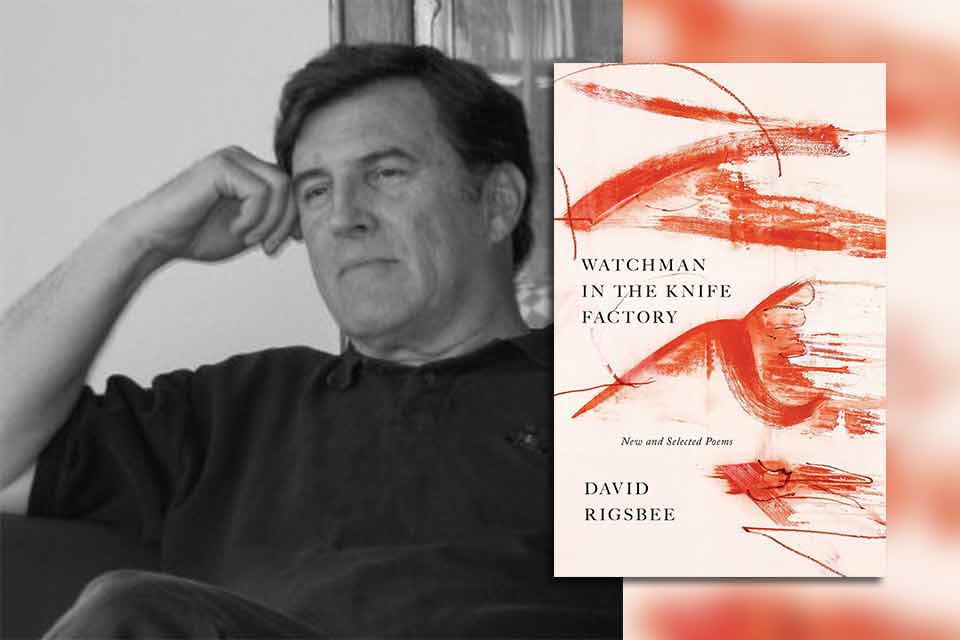
The first reason to read David Rigsbee’s Watchman in the Knife Factory: New and Selected Poems (Black Lawrence Press, 2024) is for its opening section of fourteen “New Poems.” “Joan,” the first of these, demonstrates why. It recounts a cruel childhood prank leading to the “jolt of the joke revealed,” which is to say (and the power comes from it not being explicitly said) the pain it caused—the actuality of the act. And then the poem’s full richness coming from its final line: “For she was a child and we were children,” which both underscores the guilt the speaker still feels while also problematizing it and expanding its implications. These new poems combine the “jolt” of things deeply experienced with a deepened awareness that opens the jolt for reflection without lessening the visceral, jarring impact. These are poems that compel us and force us to question.
This points to the second reason to read Watchman in the Knife Factory. This is Rigsbee’s second volume of selected poems, updating and expanding The Red Tower from 2010. This alone would establish its value, since Rigsbee’s work has continued to grow in richness and range in the two substantial collections—This Much I Can Tell You from 2017 and School of the Americas from 2012—since The Red Tower. But Watchman does more than bring the story up to date. It tells the story of Rigsbee’s work in a different way. Red Tower presents the poems without regard for chronology and with no indication of which poems appeared in which collection. This foregrounds their thematic interplay, but it also obscures Rigsbee’s journey as a poet and how that has led to the complexity and impact of the “New Poems,” such as “Joan,” that open Watchman. In Watchman, the poems are divided into sections, each gathering poems from a single collection and sequenced book by book back to The Hopper Light (1988). The chronology this offers allows us to see how the work has developed from a particular structure of attention evident in his earliest poems while expanding, collection by collection, what is engaged and explored.
The chronology allows us to see how the work has developed from a particular structure of attention evident in his earliest poems while expanding, collection by collection, what is engaged and explored.
In “The Peacocks at Winter Park,” the next-to-last poem in the collection and presumably one of the earliest, the initial stanza concludes: “Grand clouds / drift over, apportioning the sky into spars / of light, as if the season were under sail.” The scene is both precisely observed and richly figural. The perceived “spars” of light elicit the metaphorical transformation through which the season becomes a ship “under sail” with the light its spars and the clouds its rigging. It’s a move that demonstrates Rigsbee’s imaginative power, but its significance for understanding its implications for the arc of his project as a poet is the easily overlooked “as if,” which both occasions the figural expansion of the moment while simultaneously reasserting the scene’s literal or actual nature, so what is perceived and what is imaged from what is perceived remain in dialogue with each other. In Wallace Stevens’s “Thirteen Ways of Looking at a Blackbird,” the dilemma is whether to “prefer / The beauty of inflections / Or the beauty of innuendos.” The challenge, the necessity, in Rigsbee’s work is to engage the liminal space between them—the as and the as if—and this is a matter of acknowledging the actual as something that cannot be imagined away while also allowing for the play and desire of metaphorical transformation as a necessary counterpoint.
The challenge, the necessity, in Rigsbee’s work is to engage the liminal space between them—the as and the as if.
In Rigsbee’s poems, as and as if are (as if) dance partners and the poems their dance. And across the poems gathered in Watchman, the implications of this dance grow in reach and implication. In “End User” from A Skeptic’s Notebook (1996), for instance, we glimpse the epistemological and ethical dimensions of the dance:
Let’s suppose there is a use
to sight—not to seeing, but to the things
seen. You have to account for
the coincidence of the imagined
superimposed onto the real.
And you have to account, likewise,
For the meanings you invest in clouds,
how their golden striations concur
in that mood that was only a moment
ago buried and forgotten.
And in the sequence “Sonnets to Hamlet” from Cloud Journal (2008), the dance of as/if expands to place the self in dialogue with the political. The 1991 fire in a chicken processing plant in Hamlet, North Carolina, is the occasion for the sequence. In the fire, “twenty-five people, predominately single, black females” died because the “doors at the plant had been padlocked to prevent theft.” In these sonnets there is the twinned actuality of the event that must be confronted and how the event challenges the self to perceive through imagination to move beyond memorializing in order to confront the event and assess both its political implications and its implications for the self:
There is no inwardness like this:
floor after human floor collapsing,
pipes and fittings, miles of artifice
melted into the original mash of being,
selves exiled into the surrounding wood
like stuttered jokes, revenants with no more
ability to nourish than perishable goods
miles from the hungry. The locked door
stands guarantee to the role of matter.
Smoke like an idea’s shadow occupying
all the room, shelves sway and shatter.
Wind going after is like the body’s dying
into the body of a growing text,
each story pressing rapidly over the next.
In Rigsbee’s poetry, the desire for metaphorical transformation is evident, but so is the recognition of the actual as a problematizing, limiting, humanizing reality. In these poems, inflections and innuendos are not the either/or problematic of Stevens but instead a dialogue with each other—the interplay of as and if. In the chronology Watchman in the Knife Factory makes evident, we can see that this dialogue is there in Rigsbee’s earliest work and how it develops, expanding in range and implication. While some selected poems function as a handy digest of poems we might want to read, Watchman challenges us to read the career.
Normal, Illinois