
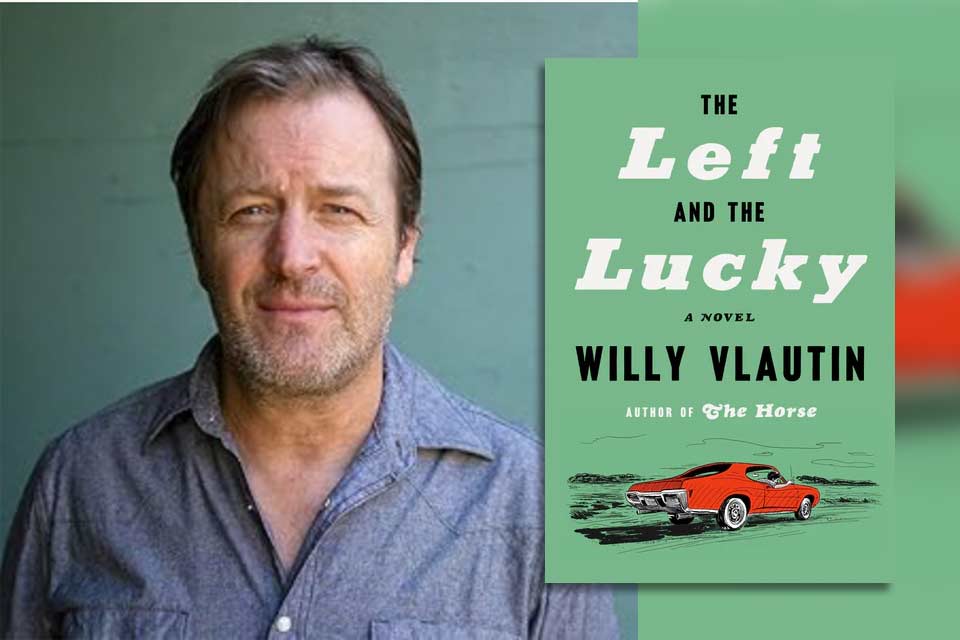
Across a career spanning nearly three decades, Willy Vlautin (b. 1967) has always focused on characters that live on the margins—socially, financially, and emotionally. Both his novels and his songwriting for the bands Richmond Fontaine and The Delines draw their force from local stories of vulnerable, broken people who reveal themselves in spite of themselves; narratives that take readers through a gritty portrait of the darker side of life. His latest novel, The Left and the Lucky (HarperCollins, forthcoming April 14, 2026), follows a similar path yet this time with a subtle tonal shift, highlighting characters that linger in quiet devastation but seek refuge in friends and reach for resilience, grace, and a possible brighter future.
Set in Portland, Oregon, The Left and the Lucky follows the intersecting lives of Russell, a sensitive and vulnerable eight-year-old boy and Eddie, a forty-two-year-old house painter burdened by loss and a complicated marriage. Small in stature and constantly bullied by his troublemaking older brother, Russell is left to fend for himself while his mother is often absent, working as a stripper; Russell finds solace and safety in his grandmother and, increasingly, Eddie. Eddie spends his days painting houses with his alcoholic friend Houston and an aging house painter named Cordarrel, while carrying the weight of a complex past shaped by the loss of his sister and his failed relationship with Marlene, the love of his life. As Russell and Eddie navigate their days, an unlikely but deep friendship develops between them, while they face their own personal traumas and the pressures of ordinary life.
Vlautin’s characters are lost souls struggling to confront their demons, deal with their traumas, and simply survive.
Similar to Vlautin’s previous works, the characters of the novel are far from perfect. They are lost souls struggling to confront their demons, deal with their traumas, and simply survive, and they find themselves relapsing once again, whether into alcohol, unhealthy lifestyles, or an inability to let go of failed relationships. This sense of defeat is reflected in what Houston confesses to Russell: “we're in a ditch,” later elaborating on his situation, admitting: “I can’t cut it anymore. My knife is dull. I’m a butter knife now, Russell,” which results in a moment of raw self-loathing: “I’m just a weed. A lowlife weed, man.” Even a tough man such as Cordarrel, who constantly reminisces about his “glorious” past in Chicago and the painting company he once owned, eventually reaches a point where he confesses to Russell what life has become for him, simply saying: “my numbers are up.” Russell himself is bullied, beaten, and humiliated, yet at the same time he represents the only promise of a future, as someone who needs to be protected but also someone who gives them hope. This is best represented by his friendship with Eddie and how Eddie thinks of him as someone to take care of, akin to his own deceased sister who never had anyone to stand by her side.
This vulnerability—a quiet cry for help—is reflected brilliantly in what can be considered the most important chapter of the book. The fourth chapter, “The Kill Switch,” was previously published under the same title as a stand-alone short story in the anthology The Highway Kind: Tales of Fast Cars, Desperate Drivers, and Dark Roads (2016), edited by Patrick Millikin. This chapter functions as the central piece of the novel, as it establishes the narrative’s thematic concerns while foregrounding the metaphorical use of cars, a motif extended throughout the book. One day, Eddie spots “an old red two-door Pontiac LeMans” parked near a house he and Houston are painting, and he soon decides to buy the rusty car and transform it into a usable vehicle. Cars in Vlautin’s novel are almost always old and damaged—like the Pontiac LeMans—and can be read as a metaphor for the characters themselves: almost broken, barely functional and in need of great care. Eddie’s enthusiasm and persistence in fixing and maintaining the car mirrors his attempts to protect Russell from his brother and to keep Houston sober and working. When he says, “I like dents,” the statement extends beyond the vehicle and applies to all those around him, including Marlene, who is always depicted, over the phone, as a complete mess.
Related to the motif of old cars in the novel, it becomes clear that for these characters, anything good exists only in an unknown, once-glorious past, while the present is merely its aftermath, its shadow. For Cordarrel, that past is Chicago and his house-painting company; for Houston, it was his youth, his younger self; and for Eddie, it lies in the days spent with his sister and his long-gone days with Marlene. This longing is embodied in the characters’ attachment to old cars, which evoke a better time, whether it is the LeMans or Houston’s memories of a 1967 Mercury Cougar or 1975 Cadillac Eldorado.
The best moments in the book are when Russell is having a conversation with Eddie and/or Houston; it is in these scenes that the reader feels the closest to the characters and where they express themselves most fully and honestly. Vlautin has always shown a particular talent for writing dialogue, and this novel is no exception. The conversations flow naturally, feeling unforced yet emotionally charged, shaped by all the pauses, repetitions, and half-expressed thoughts. At times, they even become confessional, having a strong sense of presence through the exchanges. This is most evident in the voices of Houston and Marlene, whose dialogues expose the self-defeating ways in which they see themselves. As a result, the reader feels like they are sitting beside the characters, quietly listening to their conversations. The novel’s most affecting moments emerge from such exchanges, extending to those between Russell and Eddie, where their true feelings about the world gradually emerge through the words and what is left unsaid.
Despite the novel’s cynical portrayal of the harsh reality of everyday life in Portland, there remains a dim light, a flickering gleam of hope, buried deep within.
Despite the novel’s cynical portrayal of the harsh reality of everyday life in Portland, there remains a dim light, a flickering gleam of hope, buried deep within the pages of The Left and the Lucky. Far from offering simplistic positivity, Vlautin paints an ever-so-slightly brighter vision of the future for his characters, particularly in the trajectories of Houston and LaDawn, and in the way the story unfolds for Russell and Eddie. Nothing is fixed, no one is healed, and they still have a long way to go, yet they find reasons to keep moving forward. This growing sense of fragile optimism was present in Vlautin’s previous novel, The Horse (2024), in the form of caring for an aging half-blind horse. Ultimately, what sustains The Left and the Lucky is not only a promise of change but also the act of watching over those who cannot stand on their own, and choosing not to walk away even if nothing is guaranteed.
Sapienza Università di Roma