
I have nothing else to offer, dear Life—
words are what I breathe and eat, the clothes I wear,
dreams that sing me to sleep, silence that greets me awake:
words are the wealth I possess—my truth, my love.
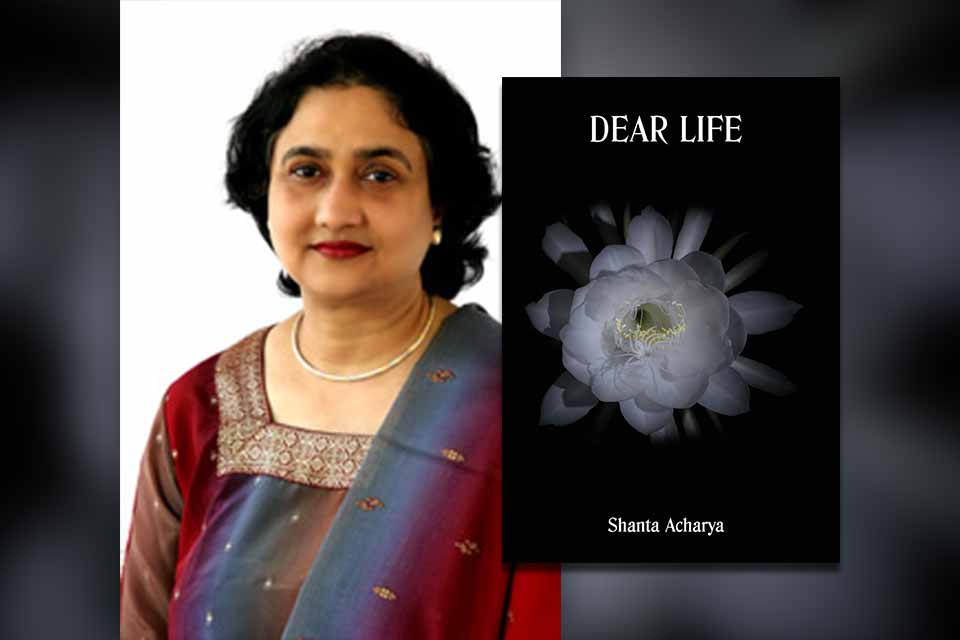
These lines from the title poem of Dear Life (LWL Books, 2025), Shanta Acharya’s eighth collection, showcase a poet’s true vocation and echo W. B. Yeats’s rhetorical question, “How can we know the dancer from the dance?” One of India’s foremost poets, Acharya lives in London. Born and raised in Cuttack in Orissa, India, she pursued her higher studies from Worcester College, Oxford, and Harvard.
Her contribution to contemporary literature is not limited to creative and critical writing. She founded and hosted the “Poetry in the House” readings at Lauderdale House, Highgate, London, from 1996 to 2015. She was associated with the Poetry Society and the Poetry School as a member of the board of trustees.
Having navigated life between continents, Acharya’s poetry comprises themes of nostalgia, culture, and identity in the transnational flow of existence.
Having navigated life between continents, her poetry comprises themes of nostalgia, culture, and identity in the transnational flow of existence. Several poems in Dear Life such as “No Land, No Home,” “Exile,” “Going Home,” and “Going Nowhere” address these themes, elaborating on alienation, acculturation, and acceptance of changes from an immigrant’s point of view. “Going Nowhere” explores in lyrical poetic prose the labyrinthine roads—physical and psychological—traveled by the poet. Here, she reflects:
In my dream, I am lost, unable to return home. The way back, which is also the way forward, is no longer the same—not the way flowers change the look of a tree and trees alter the neighbourhood. Home is a tree spreading her roots everywhere, going nowhere.
Trees, plants, and flowers feature as recurrent images and symbols in this volume, elucidating the violence perpetrated on nature, society, men, and women by power-hungry autocrats. Acharya historizes the latter’s interventions and the philanthropists’ resistances to them from the preindustrial time to the present age of eco-cosmopolitanism. In the rhythmic tones of a ballad, she eulogizes the courage of women of the Bishnoi community in eighteenth-century Rajasthan (India), who sacrificed their lives to the ruler’s tyranny when the king’s men came to cut down the trees and collect wood for building the Maharaja’s palace:
Holding on to courage and compassion,
each embraced a tree, humming and singing together,
refusing to let go until one by one,
they were beheaded by the Maharaja’s soldiers.
(“The Tree Huggers”)
Acharya reinterprets the horrors of war by comparing the past with the present and feels that the devastated Ukrainian cities are but ghosts of Srebrenica, Grozny, and Aleppo.
In her empathy-filled rejoinder to the recent media images of Russian atrocities in Ukraine, she recalls the vulnerability of life in other war-broken countries such as Bosnia, Syria, Yemen, and Afghanistan. Insightfully, she reinterprets the horrors of war by comparing the past with the present and feels that the devastated Ukrainian cities are but ghosts of Srebrenica, Grozny, and Aleppo. In her creative vision, the loss, precarity, and helplessness of the war victims in Ukraine coalesces into the organic image of a seed, which suggests regeneration amid death and destruction:
Knowing how it feels when left with no choice,
I accept vulnerability like a seed,
Believe in life when buried in a black hole—
cannot stop thinking of sunflower seeds
an old lady gifted a young soldier defending her street.
(“Sunflower Seeds”)
With her sensitive soul, Acharya rediscovers herself in the gloomy eyes of an orphaned child refugee and in the bones of an old woman trapped in rubble. Sharing the anguish of the unheard voices that either died or went missing in the carnage, she writes: “In stories buried in the bones of exiles, / forgotten in the annals of history’s lies, find me” (“Find Me”).
The present volume is dedicated to her brother Susanta Acharya, who died of cancer in 2024. The poet travels across time and space by contemplating the travails inherent in physiological ailments, medical treatment, loneliness, longing, grief, and faith. Her experiences of betrayal, police brutality, racism, and the pandemic—personal and vicarious—contribute to her spiritual maturity. This spiritual anchorage is free of ostentatiousness, and she, like an honest pilgrim, is not ashamed to reveal the tattered robe covering her skeptic soul. In the memoriam poem for her brother, the grief-stricken poet walks a tightrope while seeking relief in spiritual apotheca:
Were you blessed with faith, not struck with uncertainty,
faced with the nature and existence of God?
Doubting is one way of believing—
we doubt so we may walk in hope, live in possibility.
(“We Are All Returning”)
The poem follows the triadic structure of an elegy, manifesting an initial shock that is followed by stoic acceptance of the harsh reality and resilience to the fragility of human life. The resilience, however, is marked by serenity and transcendence. In this context, Janet Wilson’s appreciation of the poet’s “capacity to wonder at the unexpected and embrace what is irrefutably human and of this world, are sources of hope and renewal in the face of loss” seems significant.
K. Satchidanandan rightly observes that Acharya’s “poetry quarrels with power in all its incarnations, divine and human, without ever being loud, and her emotional range is wide.” As suggested by the title, Dear Life is an ode to our existence on Earth. Deeply meditative and philosophical, the collection sketches the tree of life with all its simple yet enigmatic nuances. Though the volume embodies a diseased and wounded world, pain and the efforts to heal it are attuned to the affective sensibilities of all and sundry. Even the intrapersonal musings of the poet reverberate with the dread and angst of many who witness and encounter the calamities of modern life in different parts of the world.
Durgapur Women’s College