
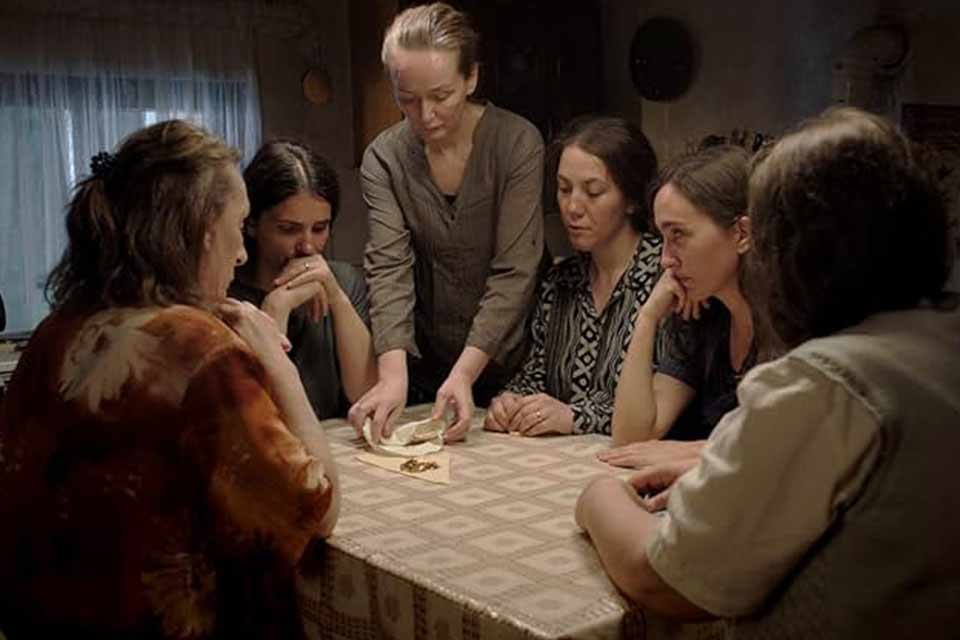
Kosovar filmmakers craft films that speak not only through the visual image and what is seen but perhaps even more powerfully through what remains unseen and unsaid. Eralda L. Lameborshi watches the films of Kosova and finds that this resistance to closure is a form of honesty about a society that is still living with unresolved loss.
My first introduction to the cinema of Kosova was in 2021 when I came across an article about Hive (Zgjoi, 2021), Blerta Basholli’s film inspired by true events in the village of Krushë e Madhe. It tells the story of a woman and her family awaiting news on her disappeared husband in the years following the war of 1998–99. The film’s broader tableau is postwar Kosova: the trauma of the war and the reconstruction efforts, providing crucial context for the intimate drama of a widow seeking to support her family in her husband’s absence.
After watching Hive, I felt compelled to discover what else the cinema of Kosova offered and to better understand a country whose history extended beyond 1912, when the borders were drawn that made Kosova part of Yugoslavia while Albania took the shape we know today. Growing up in Albania under the Enver Hoxha regime (1944–85), works by Albanians of Kosova were often absent from our curricula. Generations of Albanians grew up aware of how the borders were drawn in 1912, conscious of our northern kin, yet not fully aware of the historical conditions that shaped their lives. When Albanian refugees from Kosova began crossing the border en masse, fleeing the violence and ethnic cleansing during the war, Albanians opened their homes, offering comfort and protection for people whose lives were torn by virulent political rhetoric and devastating repression and violence. It was in this moment of contact between the Albanians of Kosova and those of Albania that we grasped how profoundly history had left an indelible mark on all of us, and how its currents had taken us in directions we could not have anticipated.
Hive was just the introduction to the impressive work of Kosovar filmmakers. My research transported me through the haunted dreamscape and unfinished grief in Antoneta Kastrati’s Zana (2019), into the Odyssean journey of Fatos Berisha’s The Flying Circus (Cirku Fluturues, 2019), which through realism and dark humor depicts the impossible choices characters make as war approaches, into the innovative film language of Norika Sefa’s Looking for Venera (Në kërkim të Venerës, 2021), and through the witnessing of displacement and family trauma in Visar Morina’s Father (Babai, 2015). I found resilience and courage in Ismet Sijarina’s Cold November (Nëntori i Ftohtë, 2018), rich and layered portraits of women’s lives in Kaltrina Krasniqi’s Vera Dreams of the Sea (Vera Andrron Detin, 2021), and intimate explorations of postwar villages grappling with tradition in Isa Qosja’s Three Windows and a Hanging (Tri Dritare dhe një Varje, 2014), among many others. In the span of two decades, the cinema of Kosova has emerged as one of the most compelling national cinemas and film movements in contemporary European cinema. Delving into themes of war and postreconstruction, while simultaneously developing context-specific film language to describe these realities, Kosovar filmmakers craft films that speak not only through the visual image and what is seen but perhaps even more powerfully through what remains unseen and unsaid in what I call an architecture of absence.
During the war of 1998–99, an estimated eight hundred thousand Albanians from Kosova fled the country, and by the time the war ended, thousands were dead or missing. This mass displacement, violent ethnic cleansing, and wartime rape created a profound trauma in the country and is the subject matter for many of the films produced. Starting with Isa Qosja’s The Kukumi (Kukumi, 2005), Kosovar films tell stories of ordinary people caught within historical waves beyond their control. They ask hard questions about tradition: When does it protect? When does it harm? And they document the quiet strength of those who survived war and rebuilt their lives.
Kosova’s historically precarious position was exacerbated at the onset of Yugoslavia’s disintegration when Slobodan Milošević’s government revoked its autonomy, dismantled its political institutions, shuttered Albanian-language media and schools, and expelled Albanian workers from their posts. This turbulent period informs several landmark films, including Ismet Sijarina’s Cold November, set in 1991–92, which follows Fadil, an archivist forced to choose between continuing his work under Serbian control or resigning and giving up his family’s livelihood. While the film is an intimate portrait of a man and his family, this story serves as the foundation around which we witness the profound political changes that led to the 1998–99 war. Also set during this decade, Fatos Berisha’s The Flying Circus tracks four actors attempting to stage a play inspired by Monty Python’s Flying Circus after their Prishtinë theater, Dodona, is closed along with numerous other Albanian institutions. The troupe’s journey south to perform at a theater festival in neighboring Albania unfolds through dark humor, danger, and the ominous shadow of approaching war. Visar Morina’s Babai examines this era through a child’s perspective, exploring the father-son relationship between Nori and his father as it fractures under political instability and forced migration. Rather than depicting the spectacle of warfare, these films illuminate individual lives shattered by conflict, the gradual dissolution of family bonds, the severance of human connections, and the enduring trauma of separation that systematically eroded the fabric of once-strong communities.
Perhaps the most distinctive feature of the postwar Kosovar cinema is its focus on women’s stories related to war trauma and its aftermath.
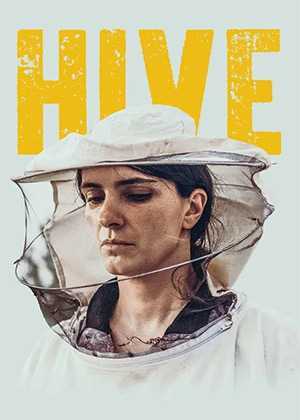
Perhaps the most distinctive feature of the postwar Kosovar cinema is its focus on women’s stories related to war’s trauma and its aftermath, foregrounding previously silent voices and filmmakers. Basholli’s Hive, based on Fahrije Hoti’s true story, chronicles a woman who starts a successful ajvar business with other war widows in her village. A good number of men in the community are either missing or dead, and those who remain are psychologically shattered, while women must navigate economic survival and reconstruction under intense social stigma. Hive swept awards at Sundance, winning the Grand Jury Prize, an audience award, and a directing award, an unprecedented and signal event that announced the cinema of Kosova as an important voice on the global stage. Qosja’s Three Windows and a Hanging and Edon Rizvanolli’s Unwanted confront perhaps the most painful legacy of the war: wartime sexual violence, where victims first must grapple with violence on their bodies and, second, with the social rejection that follows. These films perform important cultural work to challenge beliefs that view rape as a source of family shame rather than a crime against the victim.
Other films not explicitly about the war still engage with important social issues. Blerta Zeqiri’s The Marriage (Martesa, 2017), for example, examines how tradition does not constrain women only but also members of the LGBTQ community. It is an unflinching and courageous story about two men in love in a society that has no spaces where their relationship can flourish. Krasniqi’s Vera Dreams of the Sea grapples with the issue of women and property, following a widow and her dispossession in an increasingly cosmopolitan Prishtinë that is developing at breakneck speed. Sefa’s Looking for Venera follows a teenager and her desire to find herself, which represents the struggle of a whole generation growing up in the postwar and reconstruction period.
These films, different as they are in aesthetic and tone, share something fundamental: an architecture of absence where absence itself becomes a structuring principle, shaping narratives, aesthetics, and meaning-making in profound ways. In architectural terms, absence creates negative space: the void around which structures take shape. In a similar way, I view these narratives as built around what is missing: the ones who died in the war, the disappeared and yet to be found, the missing men in Hive, the unborn children in Zana, the inaccessible sea in Vera Dreams of the Sea, the missing self in Looking for Venera, etc. These absences are not mere background; rather, they are load-bearing walls for the stories themselves.
The missing and their absence prevent both grief and moving forward, keeping characters in a painful liminal space.
This architecture operates on several levels. First, there is the literal absence of approximately 1,600 people still missing from the war. Their bodies have never been found, and their fates are still unknown. Film after film is haunted by this absence, giving shape to an unfinished story, to the impossibility of mourning or closure. The missing and their absence prevent both grief and moving forward, keeping characters in a painful liminal space. Second, there is a symbolic absence: the missing postwar infrastructure, institutions, and economic opportunities. Third, there is psychological absence: dissociation, numbness, and the emotional scars that trauma produces. Fourth, there is historical absence: the erasure of Albanian language, culture, and political autonomy during Yugoslav rule.
This architecture helps us understand the aesthetic strategies in many of the films. The long takes that allow absence to register temporally and visually; the careful framing that often places characters against vast landscapes or sparse interiors; the restrained performances that convey emotional numbness and overwhelm; the frequent use of silence or minimal dialogue. These are not merely stylistic choices but rather aesthetic responses to the problem of how to represent what is not there: how to make absence and silence itself visible and meaningful. Consider Zana’s visual language where the protagonist often appears small within the frame, dwarfed by the space that surrounds her. Similarly, in Three Windows and a Hanging, characters are framed with powerful mountains in the background, foregrounding their small individual lives within a larger tableau, the camera maintaining a certain distance that mirrors the social dissociation from the trauma of wartime rape. These compositional choices create a poetics of absence, training viewers to see and feel what’s missing.
The architecture of absence also illuminates why so many of these films resist conventional narrative closure. Hive ends with a small economic victory but no resolution to Fahrije’s husband’s status; Looking for Venera remains, in its very title, in the state of searching rather than finding; Three Windows also does not allow the viewer to see whether Lushe’s husband accepts her after learning she was raped during the war, opting instead to take the viewer back to the beginning and the conversation between three old men by the old oak tree, which emphasizes the persistence of traditional ideologies that harm. This resistance to closure is a form of honesty about a society that is still living with unresolved loss. The missing cannot be recovered narratively; they are still absent. The only honest storytelling, these films suggest, is storytelling that preserves that absence rather than covering it up with false resolution. In this sense, the cinema of Kosova practices what might be called an ethics of absence: a commitment to not prematurely fill in what history has left empty.
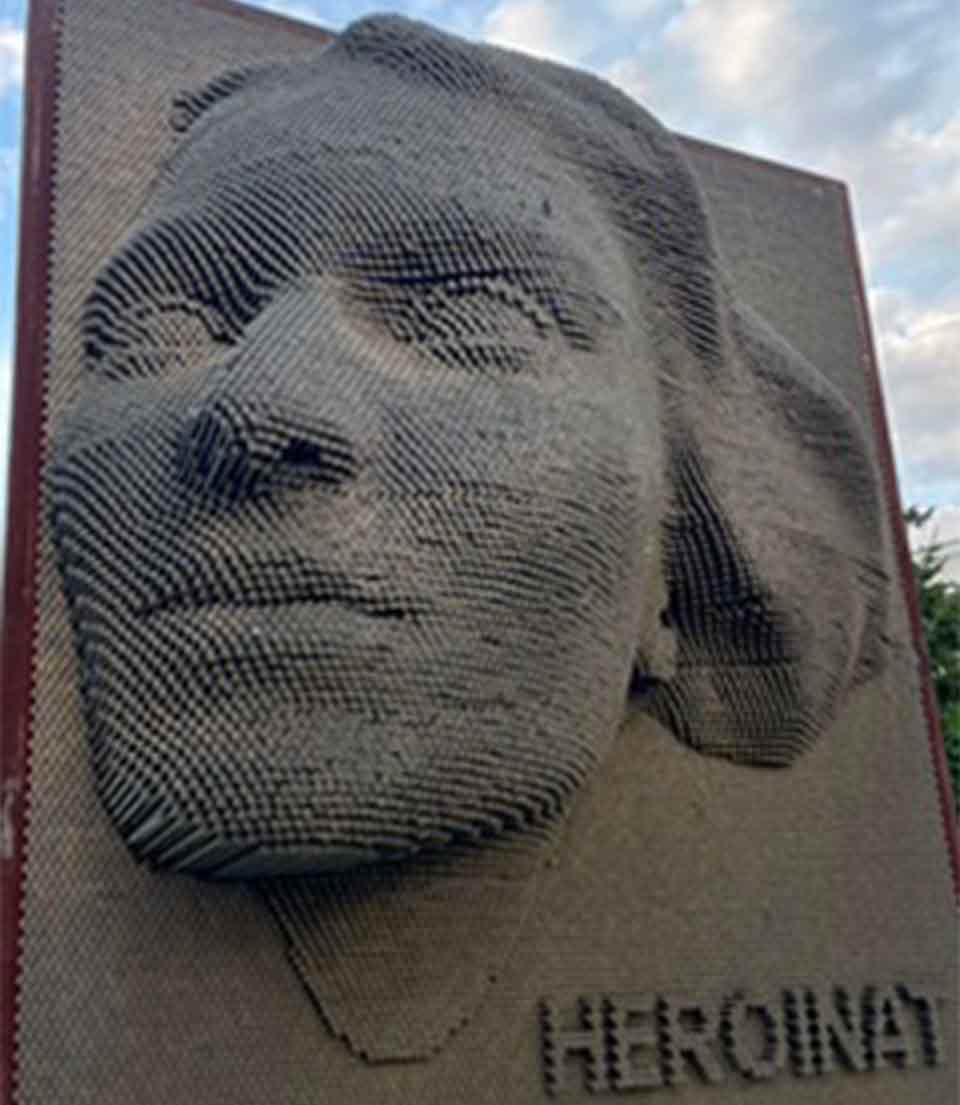
In 2025 I had the profound privilege of living in Prishtinë for eight months, researching Kosovar cinema; meeting directors, actors, and writers; and walking the streets of a city whose every corner pulses with generous and dynamic cultural life. Luan Haradinaj Road holds particular significance because three important cultural landmarks line its sides. On one side stands the Adem Jashari Palace of Youth and Sports, a Yugoslav-era building and striking example of brutalist architecture, before which rises the Newborn monument commemorating resilience and restoration. Across from these sits the Heroinat Memorial (Heroines Memorial), a monument honoring the twenty thousand Kosovar women who were raped during the war.
The memorial depicts a woman’s face through twenty thousand medals mounted on rods of varying heights, creating a three-dimensional portrait. From a distance, one sees a unified face, its features emphasized by the interplay of light and shadow cast by the medals at different lengths. Up close, however, one sees the individual medals and the spaces between them: an absence representing the voices and stories that the artist has recuperated and shaped into this powerful memorial.
As with the films, the memorial engages in an architecture of absence, a generative framework that makes meaning from loss, building presence from what is gone. In this sense, Kosovar cinema offers not just a record of suffering but a model for survival and reconstruction—and a mode of living with unresolved absence that is neither denial nor paralysis. Perhaps that is the most powerful architecture of all: not one that fills in every void, but one that learns to live and create within the spaces that remain.
Commerce, Texas
Editorial note: Albanian writer Ismail Kadare won the 2020 Neustadt International Prize for Literature and was the subject of WLT’s Winter 2021 cover feature.