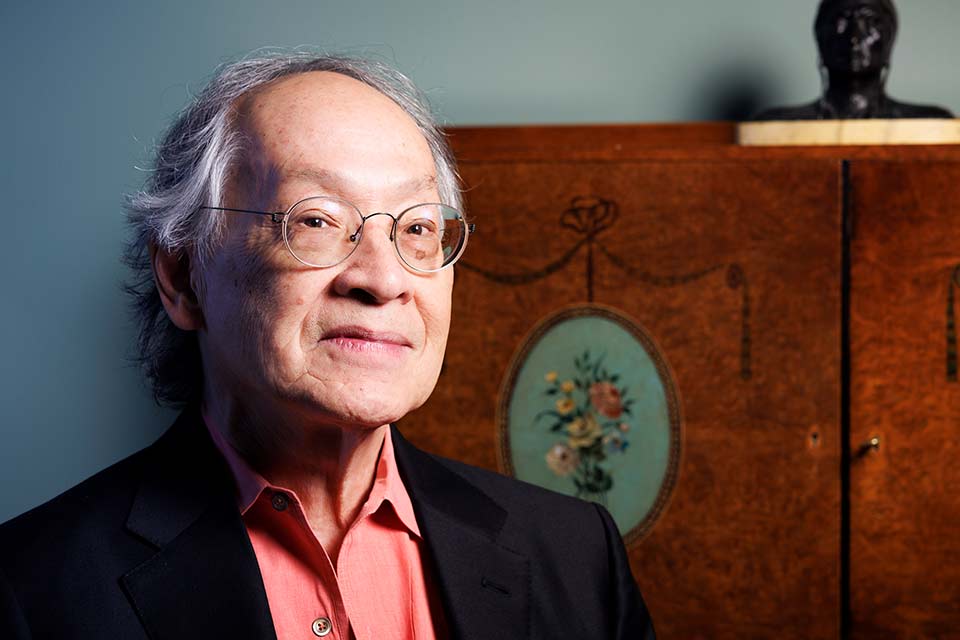
On December 11, 2025, Arthur Sze delivered his inaugural reading as the twenty-fifth Poet Laureate of the United States (the reading can be viewed on the Library of Congress website). The following is an excerpt from Sze’s latest book, Transient Worlds: On Translating Poetry, forthcoming in April 2026 from Copper Canyon.
I have long reflected on the question, How can we deepen our understanding of poetry? In each of my twelve poetry collections, in each poem and each line, I have explored the malleability of language—writing in and adopting words from English, Chinese, Japanese, Hopi, and Spanish. This exploration was furthered through my translation work as I carried meaning from classical Chinese poets to today’s readers of English-language poetry. Then, in the classroom setting, I discovered how this meaning-making within and across languages can spark the creativity of students. In over two decades of teaching at the Institute of American Indian Arts in Santa Fe, New Mexico, I developed a class called “The Poetic Image.” There, I walked students through classical Chinese poems, character by character, line by line, included several translations in English of the same poem, and invited Native students to translate ancient Chinese poems into English and sometimes into their own Native languages. The translation work and ensuing discussions were crucial in helping students develop their own voices and visions as poets writing in English.
Transient Worlds has been fashioned as a guide for widening and deepening the appreciation of poetry through the lens of poetry-in-translation. In this book are poems from Arabic, Braj Bhasha, Chinese, Danish, French, German, Greek, Hebrew, Japanese, Navajo, Russian, Spanish, and Tzeltal, along with accompanying translations and discussions. When I first started translating poems from classical Chinese into English for The Silk Dragon, I wrote out each poem character by character, stroke by stroke, so that I could personalize the process of creation inside each poem and carefully consider how one character was selected and then juxtaposed to another. I discovered that translation is the deepest form of reading. I had to slow down and discover that this work involves exegesis, and that step is only the beginning. A good translation draws on cross-cultural understanding, and the language has to come alive. If you write a translation and it sounds like a translation, you have failed in your effort. A good translation appeals to our ears, eyes, and heart; it is a singular endeavor and is a humanizing act that makes the ancient contemporary, the foreign accessible, and the emotional, intellectual, and spiritual music of the human interior universal.
A good translation appeals to our ears, eyes, and heart; it is a singular endeavor and is a humanizing act.
Transient Worlds is not organized as a linear narrative with a beginning, middle, and ending; instead, it is organized into zones. Each zone is a creative exploration of translation and is rooted in a particular poem or poems. If you read through the zones consecutively, you will discover the conversations are interconnecting, and you can single out particular zones of interest to return to. If you have an interest in surrealism, you can start with Pablo Neruda in Zone 8, jump to Aimé Césaire in Zone 11, and go on from there. If you are interested in classical Greek poetry, you can start with Sappho in Zone 7, then go to The Iliad in Zone 5. If you are interested in visual poetry, you can start with Apollinaire in Zone 4 then go to Orlando White in Zone 2. And if you are interested in Asian poetry, you can start with Tao Qian in Zone 1, go to the opening chapter of the Tao Te Ching in Zone 3, then move on to Issa’s haikus in Zone 6. I have designed the zones to be interpollinating: moving through this book in any sequence, you will see the manifold possibilities of translation emerge, and our understanding of what translation is and can be will deepen.
Translation, indeed, is everywhere; and English, a composite and growing language, has been enriched and strengthened over time by accruals from languages across the world. The word translate comes from Old French, which itself comes from the Latin translatus, meaning “to bring over, carry over.” So, we might find the process of literary translation to be a process of carrying over all the sound and sense of an original poem into a new language. But then the Italian phrase traduttore, traditore comes to mind. This cliché—“translator, traitor”—suggests that a translation is an inferior version of the original, that because it cannot carry all of the original, it is unfaithful to it. Now, if a translator attempts the impossible task of bringing a poem from one language into another without loss, they might well betray the meaning and intention of the original poem; but if the translator recognizes the many possibilities for meaning that this carrying-over affords them, they will embrace the process of transformation and renewal that is translation and, in this way, better reflect the original’s networks of meaning.
As language is always evolving, speech patterns, syntax, and vocabulary always shifting, translations are by nature ephemeral. A good translation of a poem finds a voice and shape of language that is fresh and invigorating. This book begins by looking at a poem by Tao Qian (Tao Yuanming) who lived in China from 365 to 427 ce, presented in its original Chinese characters, with pinyin phonetic spellings and words in English under each character. Three different translations of the poem are presented, and the discussion shows how the translators worked in English to create their effects. At the end of this zone of study, readers are invited to make their own translation.
Each subsequent zone takes a different approach to translation and presents a poem—in a different language and written or translated in a different era—for discussion. For example, in Zone 5, we examine a famous passage from Homer’s Iliad. How is an ancient Greek epic translated and transfigured when a poet treats the original poem as source material to excavate and write through? We will juxtapose Robert Fagles’s translation with Alice Oswald’s opening of her book-length poem, Memorial. Oswald’s creative translation presents us with a catalog of Greek warriors who died in the Trojan War within the Iliad’s timeline and goes on to employ many Homeric and oral-tradition techniques that give life to the warriors named, killed, and passed by in the original work. Oswald’s poem is an act of reclamation, founded on translation but not bound by it, and her expansive vision is a translation of the highest order.
In Zone 9, we will watch the poet with the magical pseudonym Buffalo Conde channel the voice, spontaneity, and tone of poems written over two thousand years earlier in another language. We’ll see what happens when a biblical source, the Song of Songs, written in Hebrew, finds its way into Spanish, then into the Mayan Tzeltal language, and then again into English. Isn’t this evidence that the pathways through translation are surprising and endlessly pollinating?
In Zone 10, a poem by Marina Tsvetaeva is translated from Russian by Elaine Feinstein and by Carol Moldaw. Moldaw does not know Russian, but she reached out to a friend who read the poem aloud, and together they worked through the poem. Their translation process is spelled out in detail in this zone, and, at the end, readers are invited to reach out to someone—a relative, a teacher, a friend—who might help them make a translation from a language they have little knowledge of.
Translation practice is a vehicle to develop our own poetry; and to write poetry, with its sonnets and sestinas, its haikus and ghazals all carried over into English from other languages, is to awaken to the possibilities—and expand the resources—of our shared language. Translation, after all, builds bridges and makes connections. The more we give, the more everyone has. Great poetry ignites and reignites our shared humanity over time, and the transient worlds of poetry in translation play a vital role in bringing us together.
I hope this book, by including so many varied approaches to literary translation, can widen and deepen our experience and pleasure in reading poetry. To support the use of this book in classrooms and for individual study, an appendix is included with supplemental translation- and poetry-writing prompts. What is more, I hope Transient Worlds will circulate through our communities a recognition of our shared, intertwined cultural history. I invite you readers, poets, translators, and all students of language to revel in the power of words: to craft your own translations and to write poems inspired by the creative act of translation.
Santa Fe, New Mexico
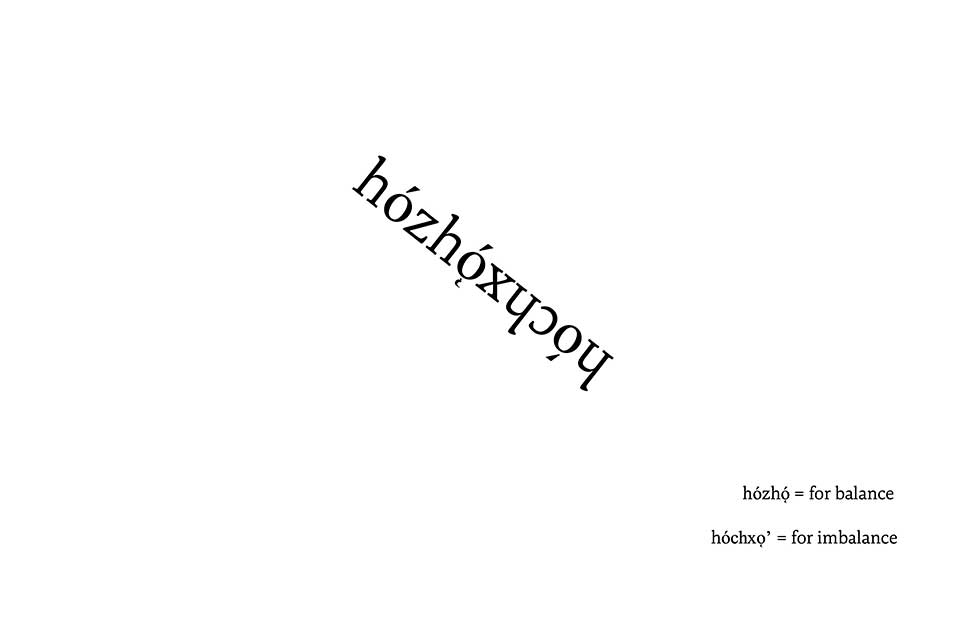
“Duality” by Orlando White
hózhǫ́ = for balance
hóchxǫ́’ = for imbalance
Here is a poem in Navajo (Diné) by Orlando White. Rather than call “Duality” a one-word poem, I prefer to call it a visual, compound-word poem. The poem is written with two Diné words, where the second word is inverted, and the two words pivot around the letter ǫ́. The acts of translation occur in the gloss, and what a different language and culture the Diné world is from the European world! The Diné have a ceremony for celebrating a child’s first laugh. What would our society be like if we had something similar? Where European languages tend to center around the verb “to be,” the Diné language centers around the verb “to go.”
In any language, a single word may have so many meanings that it is untranslatable, and that is certainly the case with hózhǫ́. Hózhǫ́ is frequently translated as beauty, balance, or harmony, but it means so much more. Harry Walters, who served as director of the Diné College Museum from 1973 to 2008, says that hózhǫ́ involves a state of beauty, where everything is good, and where everything interconnects. By including interconnection, Harry Walters shows that hózhǫ́ embodies a vision of the cosmos, of all that exists, and that the spiritual world and physical world are interconnected and even one and the same. And yet, as we know that disruption in life, in the world, occurs again and again, so Orlando White’s poem presents that truth by tipping the compound-word. Hózhǫ́ is right side up, and hóchxǫ́ is inverted. The visual poem shows a world atilt, a world in flux, and some of the power of this visual poem is that the microcosm of a word becomes a macrocosm.
Note: Many Americans know the Navajo people for their work as code-talkers during the Second World War, where they aided American troops by communicating in a language the Japanese could not understand. Diné means “the people,” and I have used “Diné” when referring to the language and culture and “Navajo” when looking from the outside.
by Allison Adelle Hedge Coke
 Allison Adelle Hedge Coke: In the introduction to Transient Worlds: On Translating Poetry, you speak toward your discovery that “meaning-making within and across languages can spark the creativity of students.” How has this discovery influenced your commitment to the making of this book, and how does it dovetail with your project as the twenty-fifth US Poet Laureate?
Arthur Sze: When I taught undergraduate students at the Institute of American Indian Arts, I created a class, “The Poetic Image,” where I walked Native students through classical Chinese poems and used the discussions to foster their creative use of language. Students translated Chinese poetry into English and sometimes into Native languages as well. The class became a crucial vehicle for them to develop their own voices and visions as poets writing in English. As US Poet Laureate, my project is a natural outgrowth of this class. With poetry drawn from thirteen languages, including Spanish, French, German, and Arabic, this book can be of use to a wide audience. Also, by including multiple translations of the same poem, I show there is no such thing as a definitive translation. This book can be a vehicle to widen and deepen the appreciation of poetry through the lens of poetry in translation, and it takes a hands-on approach and invites readers to make their own translations.
Hedge Coke: Can you speak toward your own poetic principles in the development of a nonlinear approach toward accessing and reading the contents?
Sze: As a poet, one issue I am interested in is the tension between “succession” and “simultaneity.” We live in a world that is interconnected in so many ways we don’t immediately see or understand. Contemporary physics supports this worldview in its articulation of “entanglement,” where some event that happens near at hand affects something far away not in succession but simultaneously. As a poet, I like to explore simultaneity and synchronicity (meaningful acausal connection) and actively employ juxtaposition. This kind of juxtaposition happens in such simple and fundamental Chinese characters, where the character “bright” is composed, nonhierarchically, of “sun” juxtaposed to “moon.” Although many people view juxtaposition as artistic device, I believe juxtaposition is far more: it’s a vision of our contemporary world.
In structuring this book, I don’t title the sections chapters, because I believe the use of titles like chapter 1 and chapter 2 would create a false sense of progression. Instead, I call the sections zones—in honor of Apollinaire’s great poem that moves across space and time—because each section is rooted in one or more source texts and uses those texts as an arena for exploration, discovery, and discussion. With this open-ended structure, a reader fluent in Spanish can go immediately to Zone 8 to read Pablo Neruda’s poem, along with two contrasting translations, and think about the poetic issues raised there. A reader fluent in German can start with Rilke’s poem in the last zone, read the two translations, and consider the discussion there. Each reader, by following their own interests, can hopscotch through the book and create their own meaningful pathway; each reader is empowered and can also go through the book in the order that is laid out.
In the end, I hope readers come to see that many themes and approaches are interrelated. There are no definitive answers, and I hope this collection can become a sourcebook for poetry in translation and even poetry itself.
Hedge Coke: As the inclusions in Zone 2 and Zone 4 convey, specifically the poems “Duality,” by Orlando White, and “The Carnation,” by Guillaume Apollinaire, what nuances of meaning-making might be more readily available through visual poetics?
Sze: These visual poems depict meaning in ways that supplement the text. Orlando White’s poem depicts balance and imbalance forever locked and interconnected. Apollinaire’s poem shows that wordplay has an essential role in writing and creating a poem. Some readers might find Apollinaire’s words in the shape of a carnation a cheap trick, while others might find it provocative and exciting. Both poems point to the materiality of language and show that poems are made out of words.
Hedge Coke: Zone 10 presents a Cyrillic Russian poem by Marina Tsvetaeva as translated by Elaine Feinstein and also by Carol Moldaw. Their process follows and leaves the audience with a participatory invitation that’s quite evocative of building relationships through sharing experience in language, including someone who has great interest in and limited ability within a particular language reaching out to “a family member, a teacher, or a friend” and trying to translate a poem from a language you do not know. Can you speak to the aspects of cultural, community, and familial bridging that the process of translation might offer?
Issues of translating poetry from one language into another offer unexpected insights into creating one’s own poetry.
Sze: Translation builds bridges and makes community. Even for someone fluent in another language, there is always more to consider, more to learn when translating a poem. For someone who has some knowledge of another language, as I do of classical Chinese, it is necessary and also exciting to discuss the experience and intricacies of a poem with someone else. Over decades, my aunt recorded poems so that I could hear them, and she often clarified passages I was struggling with. Translating a poem with the aid of a fluent speaker builds trust and emotional connection; it forms a bridge where insight and understanding go back and forth. And issues of translating poetry from one language into another offer unexpected insights into creating one’s own poetry. Instead of a materialist worldview where you gain at someone else’s expense, translating poetry shows that the more you give, the more everyone has. As the twenty-fifth US Poet Laureate, I send Transient Worlds as my offering out into the world.
Allison Adelle Hedge Coke’s honors include the Thomas Wolfe Prize, AWP’s George Garrett Award, a Fulbright Scholar Award, the First Jade Nurtured Sihui Female International Poetry Award, and induction into the Texas Institute of Letters. She has written or edited eighteen books, including Look at This Blue (2022), finalist for the National Book Award for Poetry and winner of the 2022–23 Emory Elliott Award. She came from cropping tobacco and working in fields, waters, and factories.