
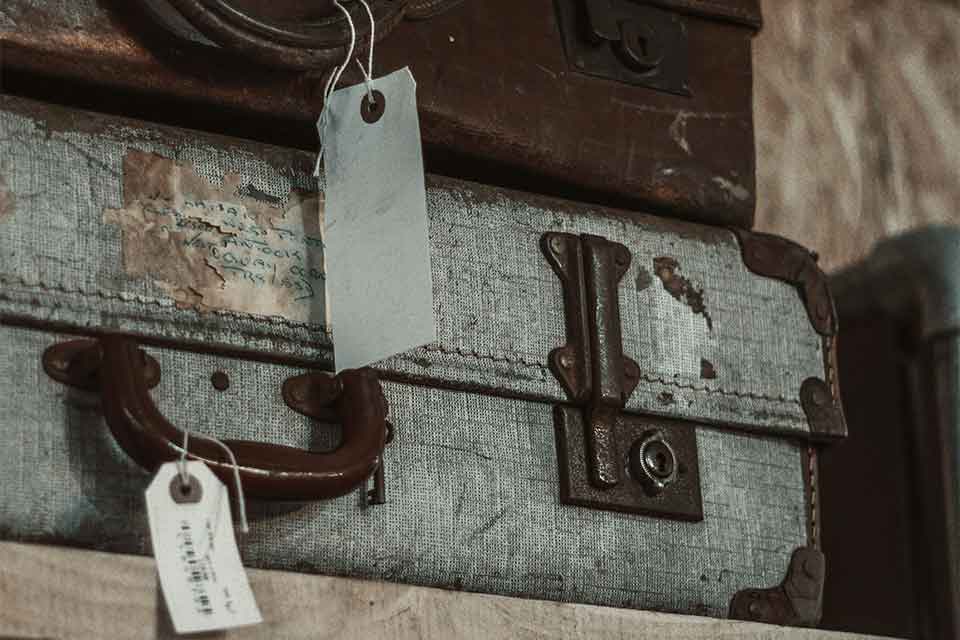
As the Bosnian War comes knocking on their doorstep, the Mandal family must flee their home. They’re allowed to bring only two suitcases with them. How will they fit their whole life into a combined weight of thirty kilos?
In the Mandal family photo, Milan is holding seven-year-old Jasmin (whose big smile exposes a missing front tooth) in his lap. Alma, sitting next to Milan, is holding five-year-old Mirela (whose braids cascade down to her waist) in her lap. On the glossy white back of the photo, the bottom left corner to be more exact, there’s a code and date stamp printed in ghostly gray: 044 12+00 nnnnn+04au 0191 sep91 009 0215 nnnn.
The Mandals had to flee Foča on a chilly but beautiful September day in 1992. Their fate in this respect was not unlike that of their family, friends, and neighbors. Except, of course, for those who had been taken away, tortured, raped, or executed, or all of the above, by the Chetniks. Alma’s two uncles, universally disliked and rather dishonest sons of bitches, were grotesquely cut to pieces with a chainsaw, half of the body parts thrown into the Drina, the other half buried in the surrounding forests.
Many, many years later, long after their flight from Foča, Alma will write these words in one of her innumerable notebooks (without mentioning her uncles, an omission she won’t be conscious of):
How many creation myths across the world go something like this: the angry gods took a god, one of their own kind, and ripped him or her apart so that one part became the earth, one part became the sky, one part became the water, and then one part became the first humans, carrying the originary trauma of creation. A whole mythology seems to be laid down, seems to repeat itself, in some of our acts of violence.
On the bus that would drive them out of town and out of the country, the Mandals were allowed to bring with them two small suitcases with a maximum combined weight of thirty kilograms. But how could they even begin to go through everything they owned and choose only thirty kilograms worth of their history, a history that surely weighed far more than thirty kilograms!
Take, for instance, their books. Alma and Milan were bibliophiles. Their neighbors collected rare liquors; they collected books. They had a Qur’an, a Bible, and they held in their possession two especially cherished books: a signed copy of Edvard Kardelj’s Sećanja – Borba za priznanje i nezavisnost Nove Jugoslavije 1944–1957 (Milan’s precious) and a signed copy of Simone de Beauvoir’s Drugi pol (Alma’s precious).
Which book or books would they bring with them? It would clearly have to be the book of books, literary or philosophical or religious crème de la crème, exceptionally nourishing to mind and soul, to warrant its place alongside humans escaping death, to warrant escaping the easy-to-predict possible fates of books left behind.
Both the Qur’an and the Bible they could dispense with, they quickly agreed, because there would be Qur’ans and Bibles wherever they ended up.
It was, of course, the Kardelj and the Beauvoir that occasioned a fierce fight. Alma and Milan debated the value and merits of each book in exhaustive detail. They even drew up a list on a piece of paper of the pros and cons of each book. The kids found the whole thing hilarious.
In the end, given that each book weighed over a kilogram, Alma and Milan had to condemn books in general, including her beloved notebooks, as utterly worthless in the present moment, highly unusual as it was. They broke down, hugged each other, kissed each other, and let themselves be sad with their books, already grieving their fate. The kids started crying, too, but mostly because they were allowed to bring only one small toy each. “Jebiga, jebiga, jebiga!” Mirela screamed. Her parents told her to watch her language.
After a series of putting stuff out and putting stuff back, neurotic internal deliberations, back-and-forth selections, hesitations, arguments, assessments, and enough tears to fill up the bathtub, this is what the Mandals decided to take with them: 343 photographs visually documenting their individual and family lives from 1952 to 1992 (births, wedding, family photos, moments by the river and by national monuments, photos taken in Sarajevo and in Split, individual portraits, birthday photos, New Year’s Eve photos, Milan’s JNA photos, Alma’s photo with Simone, and so on); twenty-three pieces of jewelry (mostly family heirlooms, and one gold pendant lock with photos of the kids inside); two small toys; birth certificates; passport of each family member; marriage certificate; three changes of clothes per family member; one work ID, because Milan, his usual absent-minded self, had misplaced his.
As the bus left the town, their two suitcases were filled with belongings and sad regrets over everything they had to leave behind.
As the town receded from their field of vision, the nostalgia kicked in. Alma and Milan let their gazes wander outside the window. The weight of separation from their ancestral home crushed their chests and made them feel dizzy, almost weightless. They held hands.
At least they and their two suitcases made it out, they told themselves.
In Kristianstad, Alma continued to put down her thoughts and observations in notebooks, a new series, of course. In one notebook, a brown Moleskine as it so happens, nestled among other notes on matters philosophical, she wrote these words three years after the family’s arrival to Sweden:
Sentimental personal belongings may be, objectively speaking, junk, but they’re marked with our existential scent (like a dog marks his territory, maybe), that is to say with choices, whims, idiosyncratic likes, mistakes, impulses, loves, compulsions, desires, memories, affections, traumas, relations to one’s culture at large—all this is deposited in belongings as a store of deeply personal meaning, comfort, and belonging, deceptive and illusory as it may be in the scheme of total existence. One has an almost religious, familial, perhaps fetishistic relationship with such objects, and one cultivates relationships with them as if they were living embodiments of oneself and others. From a moral viewpoint, choosing which to keep and which to discard, as in a situation of flight, is like choosing whether to save your mother or your husband, because you don’t have time or space to save both. You save one, either one, and you’ll agonize that you couldn’t save the other. What am I trying to say with this?
Consider a widespread belief: revolutions, coups, conquests dismantle and shun the old regime’s norms, customs, beliefs, practices, material expressions, institutions, all of which we may lump under the term “collective belongings” or “objects.” What was once meaningful becomes meaningless and inapplicable—the old regime’s constitution and laws, for example. What once held value becomes worthless—the old regime’s currency, stamps, titles, ranks, propaganda narratives, and so on.
People believe this. Many professional historians swear by it. Dismantlers of old institutions, social relationships, and states certainly proclaim it as the truth. But let’s throw some facts at this belief and observe the effects:
The Bolsheviks seized power with the overt promise to smash the Tsarist state, yet Lenin had to admit, as late as 1923, that the new state “represents in the highest degree a hangover of the old one.”
In the US, as historian David Cannadine writes, “regal presumptions and monarchical pretension are almost as old as the American republic itself”—regal presumptions presumably taken from the immediate predecessor of the republic, the form of power the American republicans sought to dismantle: the British monarchy.
Nazi Germany may have utterly fucked up the Weimar Republic, but the Nazis never formally abolished the Weimar Constitution (perhaps to give at least some semblance of unbroken apostolic political succession and the widespread claim among Nazis and Fascists of the 1920s and the 1930s that they were the “true” democrats, because they, apparently, embodied the real spirit of the “people” and promised all kinds of solutions: a national community, government efficiency, a common and glorious fate for a glorious people, which of course necessitated all kinds of “cleansing,” war, and expansion).
It was a common practice of the Army of the Republic of Bosnia and Herzegovina (arbih) to use a variety of regulations and instructions of the former Yugoslav National Army (jna).
A number of streets and squares in Bosnia (the Bosniak parts, at any rate) retain their Yugoslav names: Marshall Tito Street, for example.
New political powers are motivated by all kinds of reasons to continue holding on to the historical objects that they want to erase: laziness; a lack of resources to totally liquidate the undesirable past; an inability to escape the power of past institutions, beliefs, and social formations; the practical utility of past objects, and so on.
These new powers, as much they hate the past order, cannibalize some of the old order’s belongings.
These new powers, as much they hate the past order, cannibalize some of the old order’s belongings.
On a lesser scale of power, something similar happened to the belongings left behind by the Mandals. You see, a Chetnik family, their close neighbors in fact, the ones who collected rare liquors, took their apartment and all that it held: a new TV and VHS player set; Milan’s beloved video camera; a Teenage Mutant Ninja Turtles plastic poster that was put up on the living room wall days before fleeing; a džezva for making Bosnian coffee and matching fildžans, which have been in Alma’s family for generations; and so on.
All of it, the apartment included, weighed tons.
These Chetniks, who suddenly felt the insatiable need to destroy all that had to do with the Bosnian Muslims, found themselves continuing to sip on their neighbor-turned-enemy’s coffee, reminiscing about the time they valiantly used the chainsaw to kill those bloodthirsty Turks and about the good times when they used to hang out with the Mandals, who maybe weren’t so bad at times.
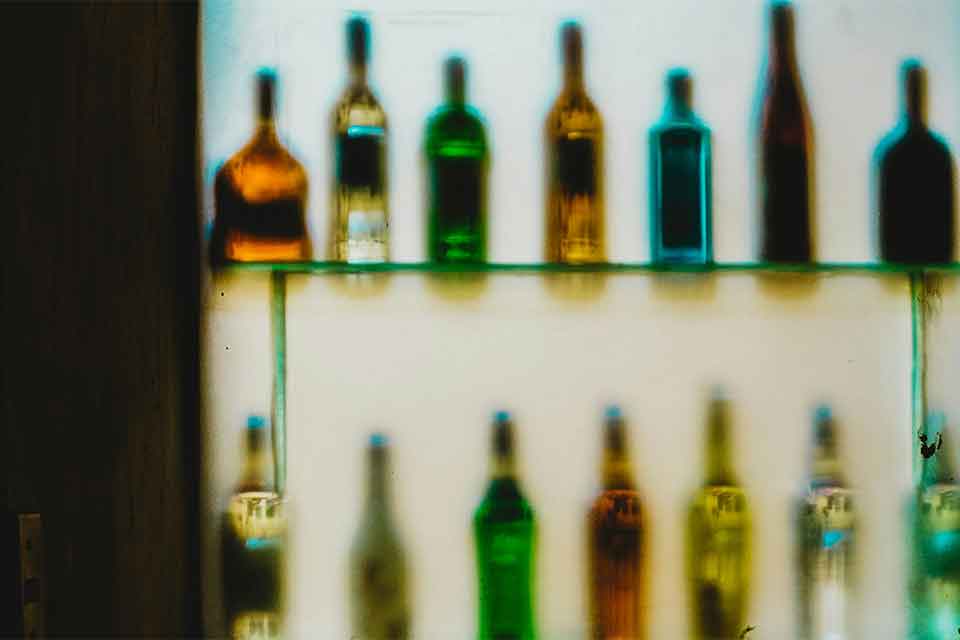
Alma and Milan were bibliophiles. Their neighbors collected rare liquors; they collected books.
Danilo Kiš believed that any object is always in a chance encounter with any other object. Which means that not only is juxtaposition possible and can yield fruitful insights as an analytical procedure, as the philosopher Susan Buck-Morss argues, but that juxtaposition is the ontological condition of human existence, perhaps all of existence. One can, accordingly, juxtapose historical temporalities, ideologies, memories, beliefs, events, emotions, personalities, conditions, belongings, and what’ll come out is meaning, truth. It’ll work. It’ll be real.
Since this is a bold statement, consider other clear expressions of this ontological state of affairs: Hieronymus Bosch paintings; Swedish grocery store freezers where you find, neatly placed next to each other, Swedish meatballs, pytt i panna, ćevapi, fiskgratäng, burek; the US Senate’s unironic recognition that “the original framers of the Constitution, including most notably, George Washington and Benjamin Franklin, are known to have greatly admired the concepts, principles, and governmental practices of the Six Nations of the Iroquois Confederacy. Whereas the confederation of the original Thirteen Colonies into one republic was explicitly modeled upon the Iroquois Confederacy as were many of the democratic principles which were incorporated into the Constitution itself.”
The Mandals hated their life in Kristianstad. It was too provincial for them. They left after four years of living there. They moved to Lund, which they found much more enjoyable and stimulating. Alma, who took up a position at the university, kept writing in her notebooks. She wrote the following shortly after they moved into an apartment in central Lund, not far from the university library, but also not far from the cemetery:
What if I attempted a total description of the belongings we chose to bring with us from Foča on September 9, 1992?
Mandal family chronicle, 1952–1992.
A list of personal belongings.
A collection of personal items.
A set of historical artifacts.
A set of keys. Some keys open doors to memory; some open doors to survival, asylum, etc.; some open doors that require payment, etc.
Disconnected nodal points in an incomplete schematic of a whole social, political, cultural, and familial order.
Indisputable proof that any human life can be reduced to any number of external objects, which is to say that it can be objectified to approximate close to zero objects. It is perhaps possible, then, to shave off the physical expressions of meaning to the point where there does not seem to be any anchoring point whatsoever (but, perhaps, only a final punchline).
Indisputable proof that historical objects, too, struggle to survive (this applies, needless to add, to objects of toppled states and demolished social orders).
Inside and between our belongings there is [which word is right?] silence, absence, gap, void. Danilo Kiš said that in writing, naming amounts to diminishing, while concealing amounts to the closest thing to a total showing that we could ever hope to achieve. So, if I pay attention to these hole-like spaces in between our few belongings, I am bound to pick up patterns that lead me back to the core of life. Because these whole/hole-like spaces are simply our de-objectified history, our materially vanishing history, our history being eaten away or dissolved. As soon as I fathom that the void points to the imperceptible signal of the life process, I desperately want to reach for it, hear it, touch it, merge with it, enter it, and the anxiety is insufferable in the face of this immense formlessness.
This is why I think every one of us that has gone through something like we did in 1992 will, at some unpredictable and utterly absurd point, while surrounded by a comforting ecosystem of new belongings, burst into tears and anxiety and not have the slightest clue why. But I know why: because we’re reaching for the void constantly roping our life in by putting out the objects of our life, like putting out the lights in a house, one by one, then the electricity in the city, then the national grid, then . . .
Kiš believed that pretty much all history is a history of violence. Violence is a kind of means of production with human life as its most precious raw material and end product. Unleashed on humans, violence produces a new state of affairs that is equivalent garbage, waste, wreckage with a human form. The writer’s task: rummage through and reassemble the garbage, save the wrecks.
Well, these pretty notebooks of mine have one destiny: the fire.
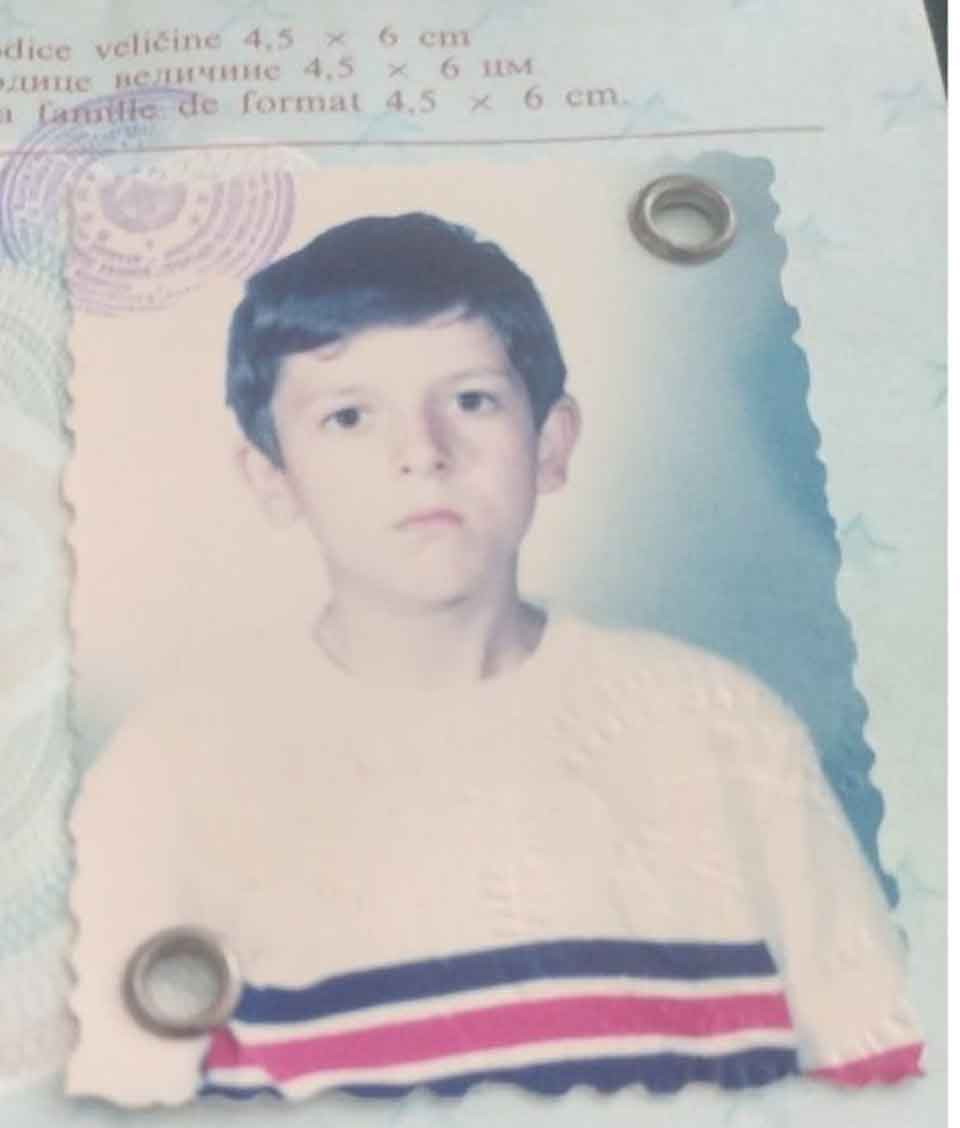
The writer’s task: rummage through and reassemble the garbage, save the wrecks.
The Mandal family’s belongings, if they find their way into any archive upon their death, will find it impossible to take up residence in the Swedish state archives, where information about native-born Swedish citizens is deposited for the benefit of historians, administrators, authorities, genealogists, posterity, and so on.
Their belongings will be segregated under a different archival regime, one reserved for foreigners. Their certificates, for example, are already housed under a foreigner file in the Migration Agency archives in Norrköping. The file bears the name: ma_avdsyd_asylär_0992-34668_iddok.
In the end, it won’t really matter, because all belongings are destined for the fire.
Brussels, Belgium