One time, I texted my close friends and family to ask what they’d been reading recently and their thoughts about that book. It was a completely random question, but thankfully, no one was annoyed. Some asked for a few days to mull it over, but everyone responded with sincerity.
B wrote me a long reply, yet at the same time apologizing for not being of much help. She told me she had recently read Alain de Botton’s The Course of Love. “I’ve been struggling with balancing my identity as a mother of two and wanting to be wholly myself again. Sometimes it feels like I’m fading away while motherhood takes over my entire identity. But I feel so guilty for having these thoughts. I keep asking myself: Am I being an irresponsible mother? You can’t imagine my relief when I read the book. It’s as if it knew exactly what I was going through. I felt understood. I’m not the only one who thinks this way. My feelings are valid.”
“You can’t imagine my relief when I read the book. It’s as if it knew exactly what I was going through.”—B
Friend C, who is a mum of three and organizes a monthly book club, said she had read Kim Jiyoung, Born 1982, by Cho Nam-joo. “It helps me take a step back to objectively look at what I had thought were my ‘responsibilities.’ All the things I was supposed to do just because I’m a woman. How is it that I readily accept everything as my obligation? Now, I’m no longer sure. What does it mean to be a woman?”
D, who is constantly worrying about something, shared her thoughts on The Lady with the Dog, by Anton Chekhov. “It’s a gripping collection; we see the dark side of humanity, the raw anxiety. The characters make me realize that perhaps I don’t have to put up a perfect façade in life. Life doesn’t have to be a bed of roses. It’s a good reminder that each of us is a unique individual. And these days, I’ve been thinking about how to live my life.”
D, who is constantly worrying about something, shared her thoughts on The Lady with the Dog, by Anton Chekhov.
E, who is busy preparing for the ancestor rites ceremony, sent her husband’s answer instead. I’ve met her husband, an affable man with a deep voice who likes to crack jokes. He said he recently read Kim Ho-dong’s historical atlas series—the volume on Central Eurasia. “Seeing how people in the past used to travel great distances makes me think that perhaps life isn’t just about staying put in one spot for the rest of our lives.”
F, who is a documentary director, recently read Voices from Chernobyl, by Svetlana Alexievich. “It narrates a truly horrifying incident. There was so much I hadn’t known. I respect the author; she risked her life to bring these stories to the world. And it gets me thinking about how to tell someone’s stories and to capture their voices.”
G, who is a generous soul and always has something for us when we meet, said she just read Kim Seonju’s Etiquettes in Parting. “I love the self-reflections in this one. Instead of blaming materialism, we need to look into ourselves instead.”
H, who quit her job to spend some time on Jeju Island, enjoyed Jean-Jacques Sempé’s Sincères amitiés. “Friendship is more challenging than love. It’s all in the details, yet many things aren’t spelled out. Friendship demands care, but also distance. The book makes me realize that I’m not the only one who finds it hard. But despite the doubt and uncertainty, all of us still crave genuine friendship.”
J, who’s always fun to chat with, read Paul Kalanithi’s When Breath Becomes Air. “We live as though life will go on forever, but death is always hovering. Kalanithi gave it his all in life, and when he was diagnosed with final-stage cancer at a young age, he faced death bravely. He knew what he wanted and what was important to him, so he lived with passion until his last breath. It makes me wonder how I should live my life, so that when the moment of death comes, I can say that I’ve lived a good life.”
K, who always faces life’s challenges head-on and writes poetry, told me that the following book was a huge inspiration. “In Study of Science, Kim Sangwook points out that we think of Shakespeare or Socrates as general knowledge, and asks why we don’t view scientific discoveries in the same way. For someone who is more of an ‘arts person,’ this book teaches useful nuggets of basic science.”
L, who is about to return to work after a year of maternity leave, said she learned a lot from Venerable Pomnyun Sunim’s Lessons for Mothers.
M, who is juggling motherhood and her career, and doesn’t want to quit the job she loves even though we think she has lost quite a bit of weight recently, said a book that had helped her a lot was Gong Ji- young’s I Was Alone Like a Raindrop. “When I went on a business trip to San Diego, I was having a hard time mentally. The stories in the book made me feel less lonely.”
I asked my family the same question. My sister told me about a book that her bibliophile friend lent her—Mari Yonehara’s The Deep Red Truth of Anya the Liar, which goes by the title of Prague’s Girls’ Generation in the Korean edition. “The book tells the stories of people who lived in the communist system. The author, who was Japanese, was searching for classmates she’d studied with in Prague forty years before. All three friends had parents who were communists. Anya, her friend from Romania, claims to believe in communism, where everyone lives equally, but she herself is living a bourgeois life. It’s so frustrating that she doesn’t realize how different her words and actions are. She only sees what she wants to see, and it’s hard to root for someone like that.” My brother-in-law also sent his response through my sister. While he didn’t read it recently, he really liked Nanami Shiono’s stories of the Romans. “The battle scenes are good.”
My mum recently read Lee Kwang-sik’s Stories of the Universe for Insomniac Nights. She’d been raving about the book, but when I asked her what it was that made the deepest impression, her answer was surprisingly short. “Besides hydrogen, the elements that make up our bodies were created when a star exploded. Same for stones, leaves, and birds. Isn’t that cool?” My dad visited the Shin Dong-yeop House and Museum in Buyeo County not long ago. After coming home, he reread The Complete Works of Shin Dong-yeop. “In his poem “Go Away, Shell,” he speaks of his intense desire for the pretense and falsehood that pervade society to disappear, leaving behind purity in knowledge-seeking. I’m already in my midsixties and it makes me wonder if I’ve managed to live a life free from façades and empty formalities.”
The last person who replied to me was N. She said when she got my question, she spent a few days thinking about Primo Levi, a Jewish Italian chemist and Holocaust survivor, and asking herself, “Why did Levi leave such a deep impression on me?” N said that for a period of time, she used Levi’s prisoner number, 174517, as her password, and each time she typed it out, she’d think of Levi. “From him, I learned that to carelessly judge a person and their situation is violence. I think it’s rare to meet someone like Levi, who makes the effort to really understand the complexities of humanity. That’s why I love his writing. I bashfully recommend it to everyone around me, as if I’m confessing my love. When I got your question, I was thinking about The Drowned and the Saved in particular, because it was Levi’s last work before his death. But if you ask me again today, I’ll want to tell you about The Periodic Table. You get it, don’t you? It’s impossible to pick one.”
To me, N was like Levi. I’ve never seen her talk carelessly about anyone, and even if she’s trying to change the mood, she never cracks jokes at the expense of others. There are some books we meet in life that feel like falling in love; we think of them all the time, just like N with Levi. And when such books touch something deep inside our hearts, it feels like we’re reading them afresh each day.
There are some books we meet in life that feel like falling in love; we think of them all the time, just like N with Levi.
The question “What have you been reading?” seems to have the power to open a latch in our hearts. The moment we welcome books into ourselves, we’re bravely opening the door to our hearts. We confess our loneliness, our weaknesses, uncertainties, and worries as we open up about the values and worldviews that each of us hold close to our hearts. The doorway to self-reflection that’s hidden inside us opens, and we grow to become a person who understands introspection. When everyone else is asking “What movie did you watch recently?” and “What drama are you watching now?,” I want to ask, “What book have you been reading?” I hope to make a space, however small, for books in our conversations. I want to open the latch in my heart when I’m with you.
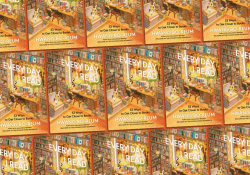
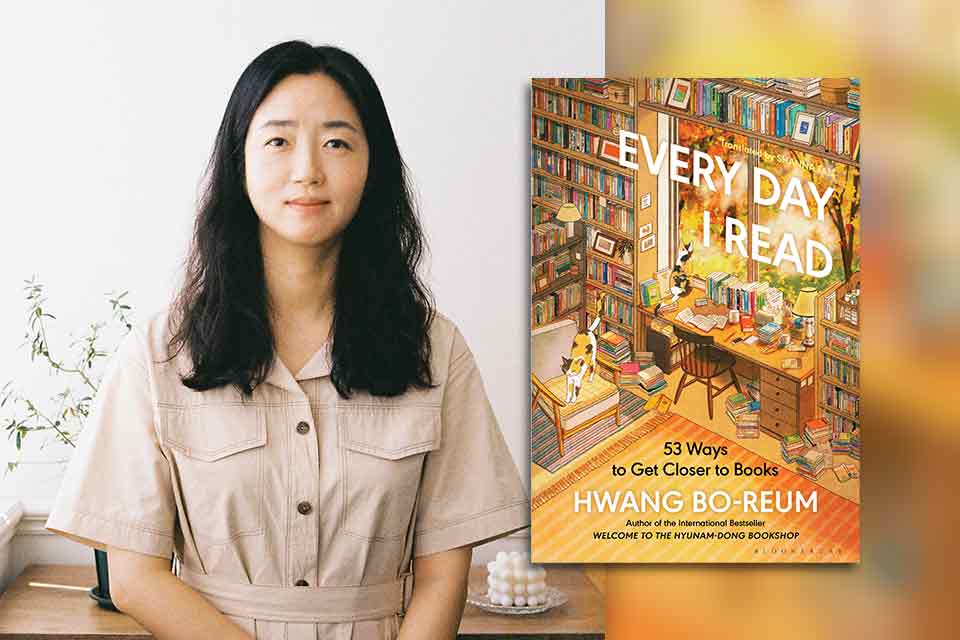
Editorial note: From Every Day I Read: 53 Ways to Get Closer to Books, by Hwang Bo-reum, translated to English by Shanna Tan, on sale December 2 from Bloomsbury Publishing. Copyright © 2025 by Hwang Bo-reum. All rights reserved.
You can read Michelle Johnson’s 2024 interview of Hwang Bo-reum, translated by Shanna Tan, on WLT’s website.