
In a world dictated by mechanical rhythms, how can we rediscover our natural rhythms? What do literature and cinema, past or contemporary, teach us about human liberation from slavery to machines?
I am reading May Sarton’s Journal of a Solitude (1973) and come across a fleeting episode, almost an afterthought. A young girl has sent over some poems for feedback on the prompting of her mother. Willing as she is to offer encouragement, Sarton cannot help remarking at the growing human tendency to expect instant appreciation and success without first learning the craft of the trade. She reflects, “I wonder whether this is not part of our corruption by machines. Machines do things very quickly and outside the natural rhythm of life, and we are indignant if a car doesn’t start at the first try. So the few things that we still do, such as cooking . . . knitting, gardening, anything at all that cannot be hurried, have a very particular value.”
 I pause over these sentences, mulling over how machines “corrupt” the rhythms of our lives today, fifty years after Sarton’s musings. How do we resist this “corruption,” in search of all that restores our natural rhythms?
These questions stay with me throughout the year, coloring much of what I read and watch, think, feel, and remember.
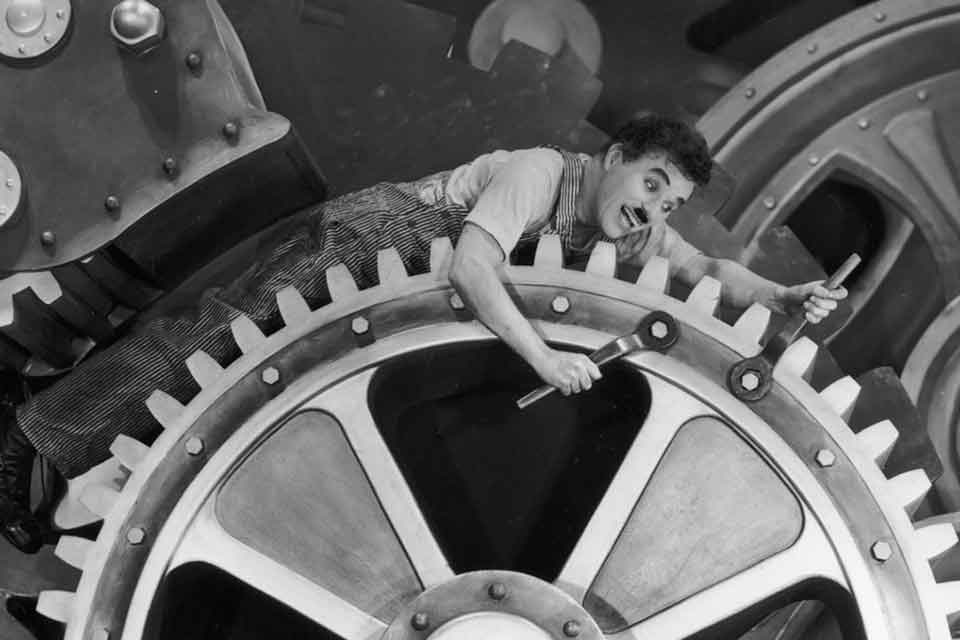
I am designing the syllabus for a course on modern literature, and my mind wanders to Charlie Chaplin’s Modern Times. The ultimate modern nightmare (or for some, a dream): to be swallowed by a machine. What an iconic sequence it is—the tramp protagonist trying so desperately to keep up with the frenetic pace of assembly-line manufacture that he finally enters the machine. He glides along its gears like a wave swirling in an ocean and, in a brief moment of surreal harmony, becomes one with it. When the machine finally spits him out, he emerges transfixed and soon plunges the factory into chaos.
His bodily rhythms are overridden by a machine’s, his hands twitch involuntarily, and his eyes are glazed over. The world around him has transformed into one giant factory where everything and everyone is mechanical, and everything round is a bolt that needs screwing. Earlier, he has been the guinea pig of a new invention—a feeding machine designed to minimize lunchtime and maximize human labor. For a while it works, but it soon breaks down, foreshadowing the breakdown of the man with his mechanized instincts. The tramp is eventually taken away to recover and later undergoes a series of misadventures in his search for fresh employment.
In many ways, the film is about a working-class man caught between different kinds of rhythms and trying to create his own harmony of a dignified, human existence. Modern urban life seems so chaotic to him that at one point, he even yearns for prison life with its regimented routine and tries to get sent back there. It takes the companionship of a hungry, vagrant girl to help him dream of another life and find his true calling in the rhythms of dancing, singing, and entertainment. The staccato rhythm of the factory machine is replaced by the allegro harmony of the pantomime; for however brief a joyous interlude, art triumphs.
I return to Sarton. If machines “corrupt” our experience of time, how can art transform it?
An artist is struck down by pneumonia and given a slim chance of survival by the doctor. She lies in her bed, weakly gazing out of the window, counting the leaves shed by the gnarly ivy outside. She is convinced that her own last breath will coincide with the last leaf’s fall. She is resolved to measuring her body’s rhythm by that of nature. She keeps watch and waits, but miraculously the last leaf hangs resolutely all night, then the next morning, and all day. Slowly, she emerges from her despair, heals, and regains her will to live and dream.
Eventually, she discovers that the last leaf had, in fact, been drawn there by her neighbor, a withering artist who had waited all his life to paint his masterpiece and had finally done so—a solitary leaf on a dying woman’s window. Following this grand flourish, he succumbs to pneumonia for his pains.
O. Henry’s classic short story has long been recognized as a testament to the vitalizing power of art. It is also a story in which the fall of leaves becomes a marker of two kinds of timekeeping, for two artists, in two different seasons of their lives. The elderly man, with a few strokes of his brush re-creating the likeness of a leaf, gifts the young woman his art, her life, and his own. The young woman learns that whereas a confined imagination can take a leaf out of its cyclical seasonal rhythm and implant it into despairingly linear time, an artistic imagination can capture the memory of that same leaf, bestowing upon it a permanent lastness—or lastingness. There are two last leaves in the story, neither of which is truer or falser than the other. The difference lies in the gaze that looks upon them and assesses their possibilities for shrinking or arresting time.
What is it about leaves and time, I wonder.
Samay dekhne ke liye bahut samay lagta hai. Ek sookha patta girta hai, jaise ek second hai. It takes too much time to see the time. A dry leaf falls, like a second. Lines from a Hindi poem by Vinod Kumar Shukla, a poet I read frequently these days. The poet stands before a tree, marking the passage of time to the beat of the leaves that glide down, one by one, like seconds. The tree is his clock. So, when he is asked by an “officer-looking gentleman” for the time by his watch, he flinches, snaps that he doesn’t know how to read it. His reasoning? Ghadi dekhne se gardan jhukani padti hai. Chahe saamne ek sheesham ka badaa ped hi ho. You have to bend your head to glance at your watch. Even if a mighty rosewood tree stood before you. The indignant anger of being asked to read a machine instead of a tree, to be expected to bend one’s neck obediently to attend to the banal when it is stretched up in wonder before the majestic. Poetic time in defiance of bureaucratic time. Ek ek sookha patta / theher-theherkar girta hai. One by one the dry leaves fall, haltingly. Before a poetic gaze, each second of time curls into a distinct shape, like each falling leaf.
Fallen Leaves. Aki Kaurismäki’s Finnish-language film about a working-class couple’s tentative attempts at a love story. Holappa works at a construction site and Ansa at a supermarket, each living their lives to the oppressive beat of a giant, invisible clock. They speak in clipped tones that bear the stamp of the mechanical pace of their work lives. One can hear the spirit of Chaplin’s tramp speaking through them. Both Holappa and Ansa are acutely conscious of the time they owe to their employers, at the cost of their health and safety. Both become unemployed and hop from one job to another, struggling to make ends meet and keep their dignity. All this against the recurrent backdrop of radio commentary on escalating Russian aggression against Ukraine. This is the most precise reference in the film about the story’s temporal location.
They meet by chance in a karaoke bar and are silently drawn to each other, perhaps each recognizing in the other a quietly rebellious spirit. They engage in their courtship to the beat of a shy playfulness punctuated by companionable silences but keep coming up against the rhythm of an unknown force: fate. They struggle to find and hold on to a rhythm of mutual love that could wrench them out of industrial rhythms.
In a world where time is a precious commodity meant to be spent sparingly, they choose to lavish it on each other in ways that defy the logic of capital.
In a world where time is a precious commodity meant to be spent sparingly, they choose to lavish it on each other in ways that defy the logic of capital. They offer each other gifts of attention, care, trust, and, above all, patience. Between lost phone numbers and disastrous dates, train accidents and hospitalizations, they wait for each other. This time that they spend in wait is measured in several ways—through cigarette butts gathered outside a cinema hall while waiting in hopes of a chance encounter, through phones that don’t ring and windows that don’t offer glimpses of awaited arrival, through magazines read out to a comatose patient, and through falling leaves that mark the changing seasons.
The charmingly awkward finale, where they walk and hobble together toward the setting sun—along with a scampering dog named Chaplin—is a larger triumph. The time that now lies before them may be indefinite and unpredictable, but it is more securely anchored in emotional sustenance of the kind that is gradually eroded in lives dictated by machines. Much like the characters in Modern Times, they too have discovered labor that is more valuable than the soul-numbing labor of the factory and other such prisons, which is the soul-vitalizing labor of loving, dreaming, living. So they set off on their new, uncertain journey, walking on a carpet of autumn leaves.
A man wakes up early each day to the sound of dry leaves being swept off the streets outside his home. Leaves and their shadows sway and rustle in his dreams. He sits under the same tree each day and photographs it during his lunch break. When his visiting niece asks if this is his tree friend, he nods in smiling agreement, with his neck stretched up in wonder like in Shukla’s poem.
In some ways, Wim Wenders’s Japanese-language film Perfect Days is the obverse of Fallen Leaves. A middle-aged toilet cleaner in Tokyo, Hirayama, follows the same modest routine of leaving for work and returning from it, every day, without frustration or ennui. An intriguing man who lives out his days to his own precise rhythm, in perfect contentment. Is he the ideal worker, then—dedicated to service, diligent and content? What else could explain his unwavering eagerness for a thankless job like toilet cleaning? Who is this man without ambition, who looks like he misses nothing from his life and feels no urge for human company? Who bows before trees and leaves his watch behind at home when he steps out for work?
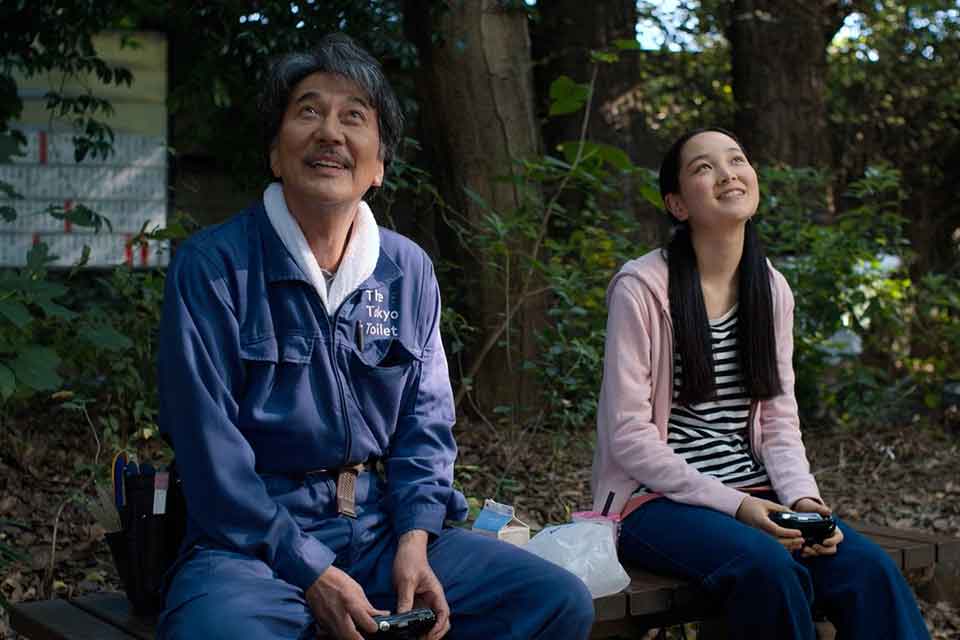
Hirayama lives alone and frugally, except for a thriving personal library, a rich audio cassette collection, and boxes of photographs he has taken and neatly cataloged over the years. Even though he appears to be a man who seeks no human witness to his life, there are witnesses whose company he seeks (and gives witness to) every day, without fail. The sky, which attracts his admiring gaze and radiant smile as he steps out for the day. The canopy of trees in the park under which he has his lunch every day. The plants at home he waters and gazes at fondly. He is tuned into all these life-sustaining natural rhythms around him.
He may be living out his days in quiet solitude, but this is not the quiet of resignation or despair. It is the serenity of a man who cultivates a rich inner life nourished with nature, music, and art. We feel the delight with which he takes in the world around him, even as he wordlessly goes about his daily routine, his eyes lighting up with spontaneous joy every now and then. We marvel at his fetching ignorance of technology and the material limitations of his world. We wonder if any dramatic shift will sully his enchanted gaze and break his perfectly sealed solitude.
And his rhythm does keep getting interrupted by others—people he meets, situations he finds himself in, a slice of his past that comes up before him. Yet, each time, the ripples on the surface of his calm life gently dissolve. By the end of the film, we learn very little about his past, except just enough to know that this life of simplicity is born, not of necessity, but choice and sacrifice. Next time is next time; now is now, he chants like a mantra with his niece, as they wind their way through the streets on their cycles.
We comprehend very little of his inscrutable motivations, but we do feel his soul expanding in tearful bliss in the beautiful last sequence where he drives off into the early-morning sun in his van, his face a canvas of fleeting emotions as he surrenders himself to Nina Simone’s “Feeling Good.” A man perfectly in tune with the world within himself.
Hirayama, then, is the antithesis of the tramp at the factory in Modern Times. His pace dictated not by machine but nature and art, he is able to inhabit each moment in the present as a witness to the miracle of life. And unlike the object of Sarton’s frustration, he shows us that perfection lies not in the instant eruption of victory but in the low-humming rhythm of simplicity, carefully searched for each day, till we become one with the world’s grace. In such a life, the humblest of tasks transforms into an act of attentive service and solitude bringing not loneliness but liberation.
Perfection lies not in the instant eruption of victory but in the low-humming rhythm of simplicity, carefully searched for each day, till we become one with the world’s grace.
How free he is—this quiet, solitary man who cleans toilets in Tokyo.
As I wind up writing this essay, there is a new year on the calendar. A new Wallace and Gromit film is out, addressing our enduring cultural anxieties of wicked machines taking over unsuspecting humans. But by the end of the film, robots gone rogue have been reprogrammed for their proper use—maintaining a garden—while their human inventor has rediscovered the simple pleasures of enjoying breakfast with his dog in the garden, instead of having machines bathe–clothe–feed him and pat his dog. How the ghosts of the machines in Modern Times continue to haunt us.

Last year, Oxford University Press declared the word of the year to be brain rot.
Last year, Oxford University Press declared the word of the year to be brain rot, a phrase that captures the sense of mental decay resulting from habitual and indiscriminate consumption of online content. It is typical Gen-Z slang, bursting with cheeky self-awareness. As machines keep replacing human labor, humans increasingly get immersed in a mechanized stupor. The obsession with mechanical speed has transformed our lives profoundly. We increasingly rely on machines to perform the most basic forms of labor, which leaves us feeling empty, diffident, and purposeless. In an age of hyperconnectivity, we feel an anxious loneliness and an unrelenting impatience with the slowness of the human condition. Having embraced all things artificial, we feel the weight of our detachment from the natural world and from human creativity. And the throbbing despair of feeling out of sync with one another and the world. Our inability to concentrate on the present and the brittleness of our leisure make us feel like we are always running out of time.
But there are just as many ways of making moments linger. There are ways to rediscover our human vitality by returning to the gentler, slower rhythms of loving and living, waiting and witnessing, embracing nature and art. Under the soft light of these patient pursuits, time takes on a different dimension, helping our souls to ripen instead of our minds to disintegrate. And sometimes all it takes it as simple an act as sitting under a tree and watching the leaves glide down, one by one.
Haryana, India