
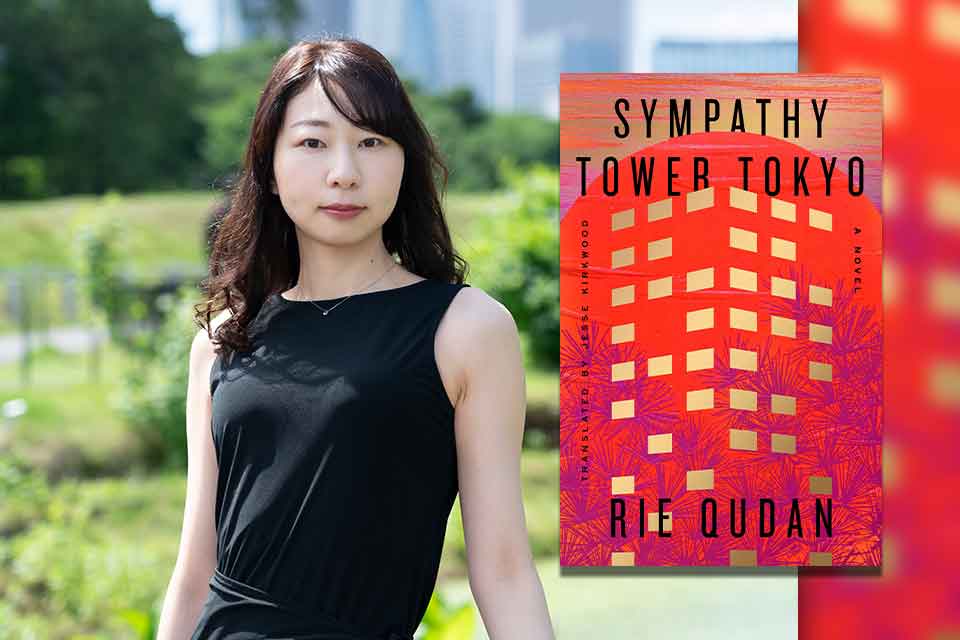
In Rie Qudan’s novel Sympathy Tower Tokyo (Summit Books, 2025), translated into English by Jesse Kirkwood, an architect named Sara Machina designs a controversial skyscraper to house persons convicted of crimes while struggling with her own doubts. The novel won the Akutagawa Prize, Japan’s most prestigious literary award.
When I bought Sympathy Tower Tokyo, I anticipated a book centered on a penal system—a law-and-lit book—but if someone asked me now what the book is about, my first response would be language—its limits, its abuse, how it defines reality, the gaps between it and reality, its abandonment, its policing, and more. This was evident to me by page 5 and held my attention throughout. What inspired this direction?
I originally thought that this would be a book about the criminal justice system or law. Once I settled upon an architect as the protagonist, however, and started reading books by architects as source material, it became a tale of language. I believe my decision to become a professional writer in 2021 deeply influenced the direction this work ultimately took. Since becoming an author, I have been troubled by the disconnect between my personal feelings and my statements made in my official capacity as an author. The fact that my words now have some degree of influence over others leaves me feeling as if I am confining myself in a prison of language. I usually feel pressure to say the right thing. I have been freed by words; yet, at the same time, I am constrained by them. The contradictions and conflicts faced by the protagonist-architect reflect, in some measure, my own experiences.
Is there some movement in Japan toward a more sympathetic penal system, or perhaps some movement to change the language used to speak of persons convicted of crimes, that provides the grain of this novel’s imaginative extrapolation in which convicted persons are provided a luxurious home of sympathy?
There is. After this novel was published, an article with the following comment appeared in a newspaper dated February 2024: “The Ministry of Justice has clarified that it will revise its practices to refer to all individuals held in prisons and detention centers by their surnames followed by the honorific ‘-san’.” The rising awareness of human rights and the movement toward tolerance of others in Japanese society now have influenced my novel. When one hears of a luxurious prison tower, one might take it as some fantastic fictional dystopia; yet I believe that such a concept is entirely within the realm of the possible. I am not constructing tales out of thin air. I want to use a distinctive kind of light to bring to the fore the contours of shadows that already exist in reality but have yet to be illuminated.
Jesse Kirkwood’s English translation opens with a helpful translator’s note explaining the difference between kanji and katakana, two of three Japanese writing systems. Kirkwood explains that katakana is used to approximate the sound of foreign words, scientific terms, names, and onomatopoeia. In the novel, the architect says, “I wouldn’t want to share a drink with whoever invented katakana.” How is the use of katakana viewed in Japan?
It seems that younger people more often go out of their way to use katakana, and that the more katakana there is, the more refined the impression. Most names of newly constructed apartments and commercial buildings are in katakana, and the number of train stations and district names that are a mix of katakana and kanji is on the increase. Until some point in time, I feel that there were many Japanese who, like Sara Machina, resisted using katakana. I no longer see that as much, now. On the contrary, I think using katakana has become more natural, more “Japanese.”
The book is also about architecture, and the Olympic Stadium looms large in this Tokyo in which Zaha Hadid’s futuristic design was built rather than scrapped. At one point, Sara reflects of the stadium: “She had a will of her own, one that was guiding this motley metropolis into the future. This wasn’t just a metaphor, I realized; it was what architecture must always do. It should show cities where to go.” What architecture in Tokyo is influencing the direction of the city? What does Tokyo’s architecture say about the city?
Tokyo is an extremely diverse and complex city. The emotions of the people living in Tokyo toward their city are complicated because each resident has their own unique perspective on the city. The number of ideal Tokyo landscapes—individual “Tokyo Stories,” in other words—are as numerous as there are Japanese people. Thus, confrontations arise when large buildings are constructed. I feel that rarely is there a single will leading the whole city. The city continues to be rejuvenated through urban renewal, but much of that is in cumulative response to realistic demands such as economic rationality and expediency, or considerations for disaster risks like earthquakes. Because of this, Tokyo appears, at first glance, to lack a sense of unity. I feel that Tokyo possesses a dynamic structure: it chose in advance an ambiguous state in which some areas are falling apart and some areas are renewed all the time.
What trend in culture has recently captured your attention?
I have an interest broadly in cutting-edge technologies, but after watching the Netflix documentary on Brian Johnson, I have been drawn to immortality and rejuvenation. Advances in medicine mean that immortality is on the cusp of becoming a reality, but if humans were to truly obtain everlasting life, the world and day-to-day living would completely change. Literature has been said to provide universal value, but if the value of life and death change, then I predict that the worth of literature will also change. I am interested in what kind of literature would be written in a world in which death does not exist. I am also interested in the psychological condition of humanity when the fundamental premise that “everyone dies eventually” crumbles. I have written several novels that take death as their theme. I find death an unceasingly interesting topic.
I am interested in what kind of literature would be written in a world in which death does not exist.
What is reading life like in Japan? Are brick-and-mortar bookstores thriving? Are translations popular? Do you have influencers, like we do here in the US, who drive selections with their book club picks?
The book Why Working Makes It Difficult to Read Books, by literary critic Kaho Miyake, became a best-seller in Japan last year. Apparently, readership is down overall and there is a sense of crisis over this situation. Many think that reducing the amount of time on social media or watching movies and increasing the time spent reading would be good, but not everyone is going to be able to make that a reality because fundamentally, they cannot put down their smartphones. Translated works are popular among a subset of readers, but overall, I do not believe that they are that popular among the general reading population. Books by Nobel Prize laureates like Kazuo Ishiguro and Han Kang, as well as books by Yuval Noah Harari, are plentiful on bookstore shelves. In Japan, as elsewhere, social media “influencers” have a noticeable impact on book sales.
What do the best stories do?
Something that makes you love the world more than before you read it.
Who or what has influenced you most as a writer?
Yukio Mishima. He was the first author to teach me the beauty of words themselves, a beauty that extended beyond mere utility.
What are you most excited about reading at the moment?
Tanka. These are short, traditional Japanese poems of thirty-one syllables in a 5-7-5-7-7 pattern, which have existed for over a thousand years. It is very difficult to translate the depth of the Japanese language contained within these thirty-one syllables into a foreign language, but I love discovering the cosmic vastness within that economy of language. I am truly moved that an expansive universe exists within a single human being, and I feel the absence of limits on language in the continued appearance of poems in new styles across the ages.
Translation from the Japanese
Rie Qudan was born in Saitama, Japan. Sympathy Tower Tokyo, her third novel, was awarded the Akutagawa Prize, Japan’s most prestigious literary award. She lives in Japan.