
All belongings are destined for the fire.
—Admir Skodo
More by serendipity than design, multiple suitcases appear and reappear in the following pages. In the Bosnian Muslim writer Admir Skodo’s “The Mandal Family and Their Belongings,” the Mandals attempt to winnow their family’s entire existence into dva kofera totaling thirty-five kilos, which means having to jettison all but the essential, indispensable items that give meaning to their lives. In Sonja Srinivasan’s “The Suitcase,” the author cannot relinquish a dilapidated cūṭkēs once used by her Tamil immigrant father. Weighing whether or not to get rid of the suitcase before embarking on a cross-country trip, she ultimately realizes that, even if she leaves the object itself behind, “we can pay tribute to that which we have lost through the word, keeping beloved objects eternal, immutable, immortal,” just as Shakespeare’s sonnets speak to the power of poetry “to outlive that which was mortal.”
Coincidentally, the etymology of the “case” part of suitcase winds its way back to French and Latin with various meanings—casket, reliquary, shrine—and, since the mid-sixteenth century in English, to “shallow trays divided into compartments in order to hold a compositor’s printing type” (oed), from whence we get uppercase, lowercase, and similar terms. Words, like suitcases, both conceal what they contain and reveal what they purport to hide. As small caskets, words concede mortality’s game; as shrines or reliquaries, through them we approach, and hope to touch, the holy.
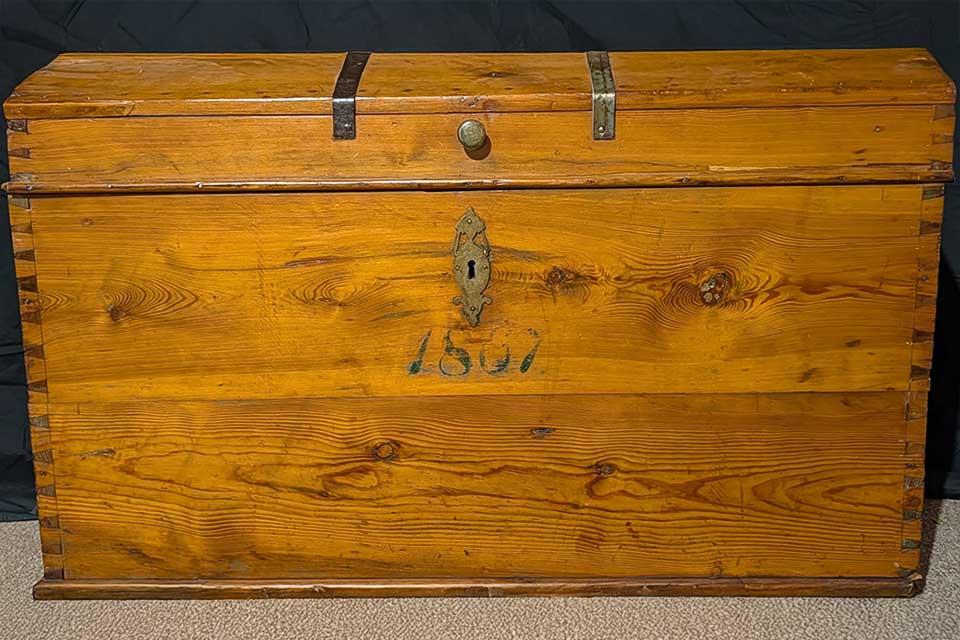
Suitcases embody the Penelope work of trying to capture evanescence at each stage of life’s journey—whether packing and unpacking objects or memories, as in Wiesław Myśliwski’s Needle’s Eye; in anticipation of embarking upon a pleasurable journey; or frantically trying to flee a life-threatening situation. In 1921, at the age of twenty-one, my Czech grandmother, Františka (Frances) Škoda, packed a steamer trunk full of what she imagined might be useful in America, took a train from the Bohemian village of Radostín to the port of Bremerhaven, Germany, bought a ticket in steerage on a decommissioned World War I troop ship, and spent the next two weeks in a ten-by-ten-foot compartment crossing the Atlantic. Four years after arriving in Omaha, she met and married Václav (James) Šimon, another Czech immigrant, who would load produce onto a four-by-eight-foot horse-drawn wagon, drive it to the Old Market downtown, and then fall asleep in the back of the empty wagon (so the story goes) while the horses found their way back to the farm. In addition to transporting cucumbers and potatoes, it’s not difficult to imagine such wagons doing double-duty as hearses carrying pinewood coffins to a cemetery.
Against such cycles of mortality, writers employ words to encapsulate what otherwise would be lost to time. For Shakespeare, even though the traditional sonnet form policed the length of the poem to fit within fourteen lines, he managed to outfox death by immortalizing his subjects. Alma, the mother in Skodo’s “The Mandal Family,” writes the following in a journal after escaping Bosnia and moving with her family into an apartment in Sweden, “not far from the university library, but also not far from the cemetery”: “The writer’s task: rummage through and reassemble the garbage, save the wrecks” (page 49).
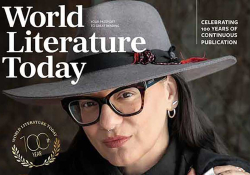
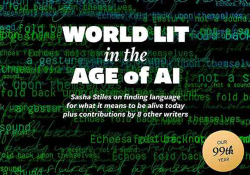
Since 1927, WLT has published more than 400 issues, each one a little suitcase of literary keepsakes. (At the current rate, issue 500 will come out in 2039, long after I’ve packed my final bag—editorially, at least.) Within the confines of two covers, the constraints imposed by the magazine form force WLT’s editorial team to make hard choices about what to include, what to bump to the next issue, and what to leave on the cutting-room floor. If we had to set some of those issues ablaze to keep warm, the paper would go up in smoke and ash; if any words remain, some forward-thinking writers and editors will gather them up and ferry them—across the Styx—to readers of the future.
Daniel Simon