

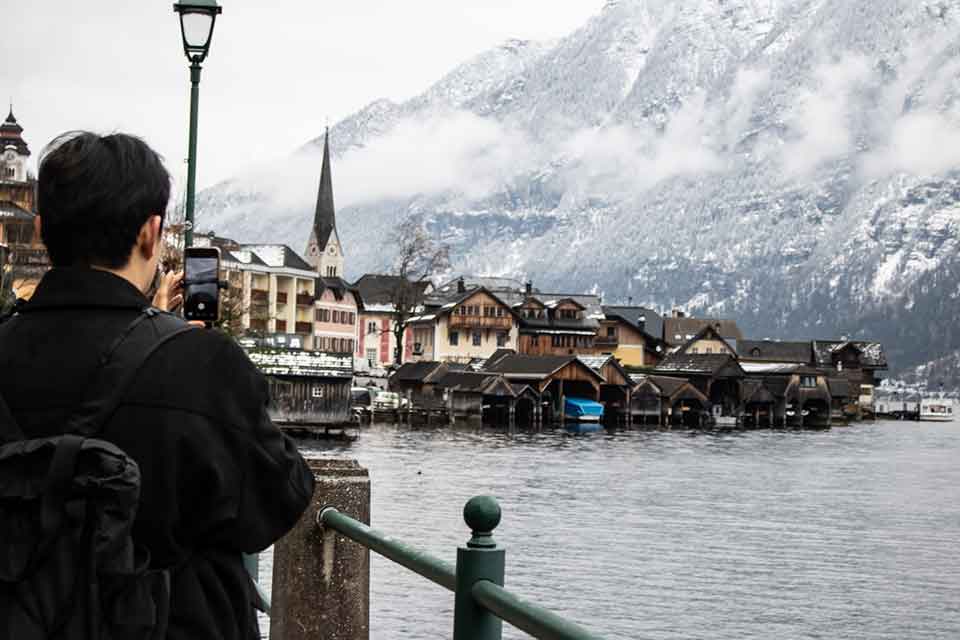
What do algorithmically boosted photographs do to places, or to the people who live in these places? Does fiction and mimesis merely create false expectations, or does it have the power to fundamentally alter reality? And how does a theme-park representation of a place change the real deal? Ruminating on these questions, Chelsy Lyons looks at Hallstatt, Austria, a place where the “Alpine peaks covered in snow look like clouds of cocaine and glitter,” a place where you can buy aluminum cans of authentic Hallstatt air “so you can take that Hallmark smell back home with you.”
If Disney fantasy were to become a living, breathing place, that place would be Hallstatt, Austria. Located seventy-five kilometers to the southeast of Salzburg, Hallstatt is a small mountain village of postcard pulchritude that kind of makes you want to sell your kidney for the chance to visit. Alpine peaks covered in snow look like clouds of cocaine and glitter. The lake, Hallstätter See, isn’t just blue—it’s the sapphire-meets-glacier blue of a raspberry ring pop. There are stone cafés and quaint churches with spinning-wheel sharp steeples. At night they glow like Yankee candles with the soft yellow light of Gwyneth Paltrow’s hair, reflecting off the ring-pop lake. The air smells like expensive hot chocolate.
At least I think it does. The pictures on Instagram—the over nine hundred thousand of them that tag Hallstatt—sure look like the kind of place that smells like whatever a Hallmark movie would; and sitting on my couch, scrolling through these photos certainly made me want a cinnamon roll and a train ticket to Hallstatt.
I’m not in Hallstatt. I’m experiencing it through the lens of algorithms, iPhones, filters, more filters. I’m seeing a Hallstatt altered through the alchemy of Lightroom and an app that knows it can tempt me with the allure of luxury travel. The Hallstatt I am seeing may or may not be ontologically sound, but that cloud of glitter and blow exists in the same way Disney or pornography does: a fiction crafted just well enough to reshape reality for its voyeurs.
In On Photography, Susan Sontag described the art medium as a coping mechanism for anxiety, especially within spaces where individuals felt insecure. Photography, according to Sontag, violated the individual because it reduced them to an object to be used or collected. If this were true for Sontag in 1977 before the invention of social media and AI, how hyper-real has it become in the tech age? What do algorithmically boosted photographs do to places, or to the people who live in these places? Does fiction and mimesis merely create false expectations, or does it have the power to fundamentally alter reality?
Photography, according to Sontag, violated the individual because it reduced them to an object to be used or collected.
I’m not the first to ask these questions. A 2017 study out of the University of Amsterdam examined how Instagram redefines how the Dutch city gets represented and used, and who has the socioeconomic power to compose these new definitions. The researchers conducted in-depth interviews with prominent account users and analyzed over one million posts with geotags in the Amsterdam municipal area over twelve weeks. What they concluded was that social media used curated and highly edited images to represent only a fraction of the city that just so happened to highlight areas of high-end consumption and beautiful bodies. Because these images influenced which neighborhoods, businesses, and demographics receive attention and patronage, inequalities between the haves and have-nots within the city became exacerbated over time.
In other words, only some images are good for the gram, and those images are taken by those with enough affluence to frequent trendy rooftop bars in Balenciaga. Representation belongs to those who impact what gets seen in places like Amsterdam.
Or Hallstatt.
The idea that fiction through mimesis can bend reality in real time is also not new. Anthropologists call this sympathetic or imitative magic; if you copy something you can alter its existence. Think of a voodoo doll. You create a representation of something, and what you do to the imitation affects the real deal.
As I inundate my brain with images of a fictionalized Hallstatt, I can’t help but wonder if its reality lives up to the photos of it, or if the alchemy of algorithms have forever blurred the lines between what it once was and the square grid of fairy pixels that it has become.
But I’m getting ahead of myself with the existential, Kantian whatnots.
What is Hallstatt in the most concrete of terms? Hallstatt sits in Austria’s Salzkammergut district with somewhere around 737 residents and 1 million annual visitors (10,000 daily in peak season). Many of these tourists are Chinese nationals, and actually, China is one of the reasons why Hallstatt is famous to begin with. In 2012 the state-owned corporation China Minmetals build a theme park replica of Hallstatt in the Guangdong Province. But like the woo-woo sympathetic magic thing I mentioned earlier, the imitation of Hallstatt changed the genuine article.
“Since then, many Asian guests have come to us, but the world is a guest here,” said Michelle Knoll, sitting behind her desk at the Hallstatt tourism office, tossing her brunette hair over her shoulders. But Knoll doesn’t literally mean us; she lives in the neighboring town of Bad Goisern, where her family has lived for at least three generations. Since our interview, she and her family have left the area altogether.
Coinciding with the copy of Hallstatt, Disney released Frozen in 2013, and shit, it was all over then. Rumors of ambiguous origin spread online that Hallstatt was the inspiration for the film’s fictional Arendelle, and boom: Hallstatt became the new hotness for women all over the world who would stop at nothing to get that cocaine mountain as the backdrop for a base selfie. The town became the theme park. Are you seeing the sympathetic magic thing now?
Truth be told, I would never have known that Hallstatt existed if it weren’t for Instagram, but square after square made me very aware of it. I imagined the type of girl who vacationed there. She appears in many of the #Hallstatt images. She’s wearing a cozy but boutique sweater and a Hermès scarf. She never faces the camera. She’s facing the lake with her head tilted to look back at us, her expression whispering: “Aren’t I casually yet impossibly attractive?” She is. At least she is with a Retro and Tan filter. It’s impossible to know anymore. Her lips are sticky-wet and perpetually pursed. Winged liner contrast eyes the color of Jolene’s—like, “please don’t take my man” Jolene. She’s a digital storyteller. She’s manifesting goals.
Growing up, I experienced places like Hallstatt through the lens of people like her. I didn’t take vacations to Europe. My family took trips to Saint Louis to see my Ozark-born grandparents where I felt fancy and cultured because my hotel had a Starbucks in the lobby. Instagram girls ate tartare de boeuf. I ate pop-in-the-oven burritos from Sam’s Club.
Instagram girls ate tartare de boeuf. I ate pop-in-the-oven burritos from Sam’s Club.
Then I imagined the people who live in Hallstatt. The families and business owners. I envisioned a forty-five-year-old Austrian woman who runs a café. In a time now long gone she used to go to work and see her neighbors and friends. Now she goes to work to serve Instagram Girl. She might not eat tartare either, but her town is now curated for those who do or those who wish they did, and home is now a sort of fictionalized version of itself.
For the seven-hundred-and-something residents of Hallstatt, what was it like to live in a postcard?
The first thing I noticed when I arrived in Hallstatt (for real this time) was that the lake was not the color of a blue Ring Pop. I mean, it was blue but not sell-my-kidney-blue. It was July, so there wasn’t snow on the mountains, and if they did glisten, it was more likely to be from the salt that is mined from the mountain that put Hallstatt on the map. The colors were just slightly more muted, less contrasted, less Disney. There were gas stations, parking lots, and trash cans. Signs warning about pickpockets were written in English, German, and Chinese. It was about 9:00 on a Saturday, and businesses were just starting to open.
The tourist-trap souvenirs were on point. Cheap plastic hangers held cheaper child-size dirndls. There were key chains, magnets, fuzzy socks—all with “Hallstatt” stitched or printed on them. There were aluminum cans of authentic air from Hallstatt so you could take that Hallmark smell back home with you.
As a commodity, Hallstatt was doing damn good. As a community, I had doubts. I passed a tin sign screwed to a wall that read: “Hallstatt is no museum. Please show respect to the people living here during your visit/stay: Do not enter private property, keep your voice low and use public rubbish bins for your waste. Thank you for your understanding.” What kind of place has to remind people that it’s real and not an interactive museum?
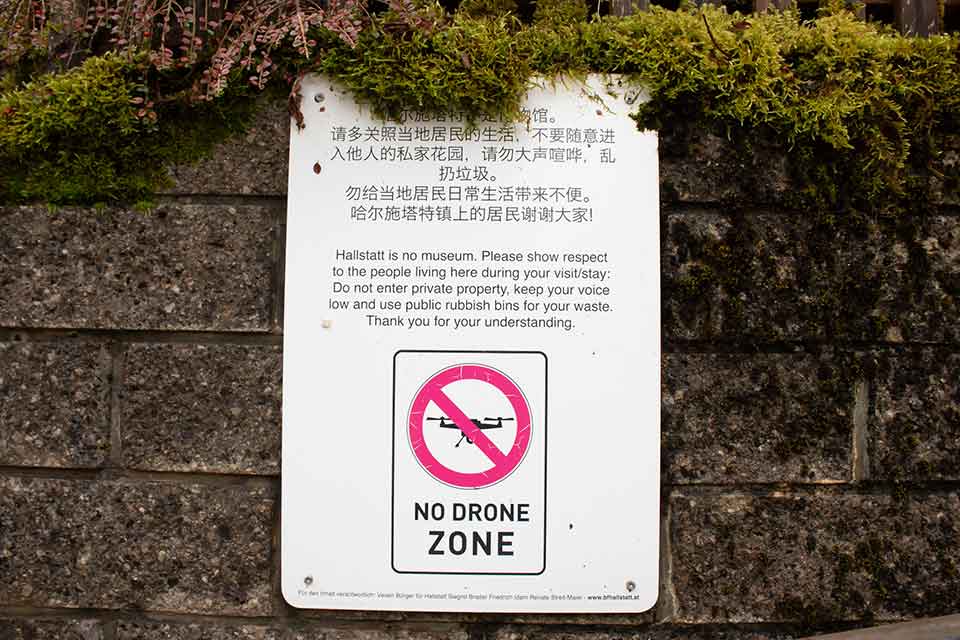
What kind of place has to remind people that it’s real and not an interactive museum?
The streets quickly filled up, and lines formed at coffee shops within minutes of opening. Boyfriends sheepishly took photo after photo of their posing girlfriends outside churches famous for Protestant Reformation history, which I’m sure they totally knew.
I was getting caught up in the spectacle of it all when I saw her: standing about fifty feet in front of me was Instagram Girl in the flesh. She was wearing black booty shorts and a yellow sweatshirt with “Los Angeles” printed on the front. Her hair was brown and princess-long. She had a boyfriend in a matching LA getup. When I stopped to talk to them, the boyfriend declined an interview, saying he was hungry, but then asked me for my recommendation on Hallstatt restaurants. I simply shrugged with a “just got here” and moved on.
There was no shortage of Instagram Girls. They multiplied through the streets like ants to croissant crumbs. Nineteen-year-old Park Subeen traveled thirteen hours from Korea to Hallstatt with her two friends and mother. I asked her and her friends how they heard of the destination, and she gesticulated her fingers in an up-and-down motion as if she were typing.
“The internet,” she said.
These girls were Gucci. Designer head to toe. Even their eyeglasses were couture. I asked them what they knew about Hallstatt and its history, and they all shook their heads in synchrony.
“No,” they giggled.
“Why did you travel thirteen hours to get here?” I asked.
“It’s pretty,” Subeen said.
Duh.
While I asked them questions about their visit, I noticed Subeen’s mother in my peripheral. She had an iPhone attached to a selfie stick and was recording me while I interviewed the younger girls. She moved from angle to angle like she was filming a documentary, and I became awkwardly aware that I was now a prop in their vacation reel.
I walked up the hill past the numerous guesthouses and cafés from Market Square to Das Salzhaus Hallstatt, the salt house. The building dated back to 1751 and used to be the home of the local salt merchant. The shop smelled like a pantry full of unidentified spices and herbs. Shelves and shelves had various salt blends and home goods and were lit with, you guessed it, salt lamps.
A middle-aged woman with midlength gray hair clipped back out of her face stepped behind the cash register and introduced herself as Martina. She lives in the next town over, Obertraun, and has worked at Das Salzhaus for eleven years.
I asked for her last name.
“No, no, just Martina,” she said holding her hands out in a halting gesture in front of her red T-shirt that read, “Love what you do.”
I asked the cashier formerly known as Martina if Hallstatt was a good place to live.
“It’s not good for the people who live here if you make a family or children,” she said in a thick Austrian accent. “It’s good for the tourists.”
Martina explained that there are so few children in Hallstatt that the town does not have a school past first grade. The few children who live in the town take a train or bus every morning to the next village over, which was Obertraun in one direction and Bad Goisern in the other.
Martina isn’t the only local with some disdain for the amount of tourism that packs Hallstatt every summer and Christmas season. In May 2023 the Hallstatt Board of Tourism erected a temporary wooden wall in front of one of the most popular selfie spots in the town to see if it made an impact on the estimated ten thousand daily visitors. The wall was taken down after multitudes of Instagram Girls protested with the passion of Ronald Reagan in West Berlin.
But not everyone shares in the cynicism, I guess.
Tom Pilz loves tourists. The middle-aged owner of Hotel I Da Mitt, which translates to “in the middle” (in reference to its geographical location in Hallstatt and Austria within Europe), converted his childhood home into a four-bedroom guesthouse that rents out for about €290 a night in the summer. The A-framed, mint-green structure hosts a coffee bar downstairs where Pilz was wiping down counters for the lunch crowd.
“For me, it’s a perfect place to live,” he said explaining his excitement for welcoming guests from all over the world every day from May to December.
“Why do so many people want to come to Hallstatt?” I asked.
“Because it’s beautiful,” Pilz said flatly with an expression that indicated I had just asked the most obvious question he had heard in his life; a gleam of Does this woman even know where she is? in his aged, cloudy eyes.
I wasn’t sure I did. I thanked Pilz for his time.
“You’re as welcome as anybody,” he said with a laugh as I closed my notebook.
Johanas Janu didn’t seem to mind the invasion either. Janu is a local business owner whose family has lived in Hallstatt for multiple generations. Wearing an ’80s-style red Adidas sweatshirt and bright, blue-rimmed glasses that framed a long nose and a wild red-blonde bowl cut, Janu looked like a combination of Vincent van Gogh and Andy Warhol. When I say that he is a business owner, I don’t mean one business. Janu, like Pilz, owns a local café and guesthouse as well as a woodworking and schnapps store and the town’s main sporting goods destination, Dachsteinsport Janu. Janu is doing pretty well for himself off of those global hordes of tourists, and he’ll tell you as much himself.
The entrepreneur sat outside his café with me explaining how the entire town of Hallstatt would collapse without that tourist cash.
“Any of these businesses that tell you that they don’t need the tourists are lying,” he said, waving his arms in a matter-of-fact motion.
Some objective facts support Janu’s thesis, at least at first glance. Unlike most Austrian villages of similar populations, Hallstatt has a local doctor, a bank, and a supermarket. Back at the tourist office, Heather Knoll explained how this is possible for the Instagram wonderland.
“The infrastructure here is pretty good for a small town, and I think that’s because of the tourism,” she said, touting what a great place Hallstatt was for families.
“Is it expensive to live here?” I asked.
She nods. “Yes. It’s not really possible to buy a house here because many of them are saved as a heritage site.” She explained further how many residents often go into the next larger town to buy groceries because food is significantly more expensive in Hallstatt.
“So unless you have a house that’s been in your family for generations and generations you probably can’t live here.”
“Yes, that’s right.”
A perfect place for families that doesn’t have a viable housing market or enough children for a school. But at least it has a supermarket where you can’t afford groceries.
I left the tourist office and walked along the lake for a while, staring at the shit-by-comparison shade of blue water and swan-shaped boats that were crammed with tourists. I took a selfie with a Retro and Tan filter for a little irony. It was my face but upgraded to the gold package; my pores were invisible and my nose was a little straighter. Stickier lips, too. It was me but, like, a me that definitely ate tartare de boeuf.
It was a me that grew up being able to experience places like Hallstatt that were only accessible to those who had lived here for generations or could afford Gucci eyewear. It was a copy of me that maybe wasn’t so bitter toward girls who wore yellow LA sweatshirts and black booty shorts. A me that was more like one of the generational homeowners and not at all confused about my placement here now as someone who could afford it after all. I was as welcome as anybody, right?
Because let’s take off the filter here for a minute: a part of me wanted the postcard. A part of me resented years of pop-in-the-oven burritos even if I wore them like a badge of virtue that shouts: “Aren’t I casually, yet impossibly authentic?” I wasn’t sure that I was.
It was impossible to tell anymore with algorithms so sophisticated that it knows me better than I know myself. An algorithm that for years now has tracked what photos catch my eye, what I linger on, and where my insecurities and desires lurk under the dusty corners of my subconscious. It’s a techno web of the images of wealth and Botox beauty that I’ve envied at a distance and the cynical memes I’ve double-tapped to cover up class insecurity. It wasn’t an accident that nine hundred thousand images of Hallstatt made their way to my Instagram feed. Before I was a prop in Hallstatt, I was a commodity to the app that sold it to me in the first place.
Before I was a prop in Hallstatt, I was a commodity to the app that sold it to me in the first place.
Maybe Hallstatt was a great place to live. Maybe it was a bloated, commercialized theme park. Maybe it was both of these things and so many others that the fiction we create out of our longings or pessimism can never capture. Maybe the memetic intimacy between what is real and what isn’t is impossible to discern.
The morning I visited Hallstatt, I woke up on the third floor of the Haus Farmer guesthouse in Sankt Martin, about forty-five minutes by car from Hallstatt. I wasn’t willing to shell out €300 a night for a room. The blasts of a shotgun rang outside the bedroom window at around 6:00 in the morning, shot by groomsmen of a local wedding—an old Austrian tradition. I walked down the stairs to the bar where the owner served me coffee in her bathrobe and socks.
Wedged between Salzburg to the northwest and Hallstatt to the east, Sankt Martin doesn’t see near the number of tourists as its neighbors. As I traveled back from Hallstatt later in the afternoon, I wondered if it used to be a place more like Sankt Martin before the layers of voodoo turned it into something else.
I drove through the countryside of the Salzkammergut, stopping at a lake in a town that I didn’t even bother checking the name of. Friends sunbathed on picnic blankets. A mother and her two sons fished off of a wobbly-looking wooden dock. The water was clear enough to reflect the sharp peaks that ascended above, but I didn’t notice its color.
Holding onto the experience for the last few moments that it was real, I left without a photocopy to remind myself that it ever was.
University of Oklahoma