
When asked to choreograph an adaptation of Cherie Dimaline’s internationally best-selling novel The Marrow Thieves (2017) for the 2025 Neustadt Lit Fest held in Dimaline’s honor, Alma Borges drew on Indigenous Mexican, First Nations, and Native American inspirations. “In a world that fosters discrimination, racism, and segregation,” she writes, “art reminds us of the meaning of life.”
Dance is the inherent language of the human being. It was the first medium through which the human race communicated with its gods and even among themselves before the development of speech. However, it has been relegated, ignored, and judged due to sexual and warlike connotations that both the church and the government have historically imposed upon it in order to suppress free expression. Over time, the powers that be began to sanction only the lower dances (those performed by members of the court), now known as classical dance, using it to dictate social norms and to distract the people from the deplorable circumstances of their daily lives. Once again, the morality and perception of a nation were controlled by power, resulting in the segregation of this universal language and making dance part of classicism and later capitalism, thus creating what we now call “high culture.”
You may wonder why I am offering all of this prologue when this article is directed toward the creative process of the choreographic piece adapted from The Marrow Thieves. As a creator and artist, however, I feel a responsibility to reclaim dance within society and to seek new ways to create a space for the spectator to reconnect with their primary, bodily language (dance). Even more so with a work such as that of Cherie Dimaline, in which the persecution endured by members of the Anishinaabe community is exposed, due to the colonial “recruiters” who in the book sought to kidnap the Native people in order to extract their marrow dreams—an analogy for the extraction of the characters’ identity, comprised of their beliefs, language, traditions, and memories.
As a creator and artist, I feel a responsibility to reclaim dance within society.
With this context, and attempting not to stray from the subject, I would like to begin by sharing how the creative process of any artist goes far beyond simply having an idea or merely putting together a series of steps that fit the music—in the case of dance. In my view, an artist is always seeking to connect and empathize, from some perspective, with that which they must express, so that through honesty they can reveal or communicate their idea.
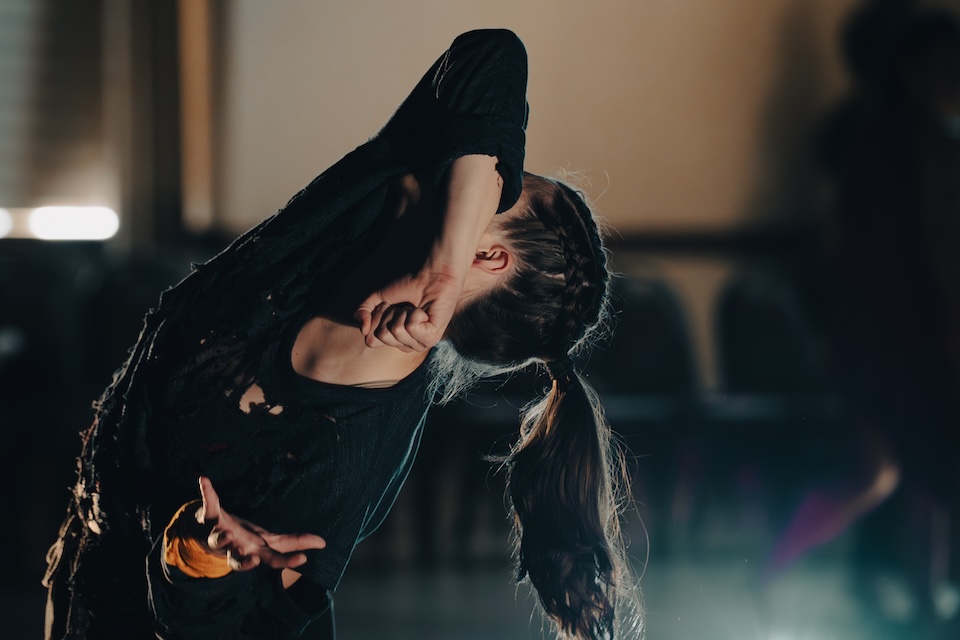
Personally, my muse offered me three moments of empathy through which I was able to connect with the novel. The first was the conquest of Mexico, which forced Indigenous peoples into mandatory conversion to Catholicism. The second was the constant biases and judgments that still exist today surrounding dance and free bodily expression. And lastly, and more personally, the exile experienced by my paternal grandparents due to the Spanish Civil War. For this reason, in my process of abstraction for the choreographic composition, I decided to draw inspiration from persecution, the need to flee, cultural dispossession (understood as the theft of the distinctive, spiritual, material, intellectual, and emotional traits of an individual and/or society), both in a literal and poetic sense; the geographical context, the temporality presented in the novel, the connection to animal instinct that human beings experience when they must fight for survival (for which I abstracted movement from ritual dances and the corporeality of primates in prehistoric times), and the traditional “jig” dance of the Métis community.
The rehearsal and staging process was a significant challenge for both the dancers and myself, as for many of them it was a new experience to confront ideas of movement based on contemporary floor techniques, which tend to be much more horizontal in comparison to modern techniques.[i] Initially, I thought about training the dancers alongside the rehearsals of the piece so that they could feel more comfortable with the movement and develop the corporeality and physicality that the work demands. However, due to the limited time we had, the movement scheme ended up transforming, opting for a fusion of modern and contemporary techniques, thus streamlining and facilitating the choreographic process and allowing us to focus more on the interpretive aspect. In this sense, the use of breath is very important to me, as it provides a sense of life and reality to movement; it is the creator of new qualities of movement and interpretive intentions that enable the creation of an artistic entity in dance.
The use of breath is very important to me, as it provides a sense of life and reality to movement.
It seems that for Cherie Dimaline, breath and rhythm in literature are also of vital importance—a coincidence she shared with me at the end of the premiere of the piece. She told me that when she writes, depending on the scene she is narrating, she changes the “manner” or flow of her writing in order to alter the reader’s breathing speed and thereby create a deeper connection with the novel. It was serendipitous and at the same time beautiful how we both use breath as the means to evoke emotion and connect with the audience.
On the other hand, I want to emphasize how special it was for me to have the participation of different cultures: a Greek musician, a Mexican costume designer and dear friend, the Métis culture as the foundation of the literal narrative, and presentation of the work in the United States, specifically in Oklahoma. In a world that fosters discrimination, racism, and segregation, we must remember that as a community we are stronger, that the power and greatness of the human race reside in diversity, and that art reminds us of the meaning of life.
Both the music and the costumes were original creations. In both cases, Cesia Farfán and I worked together to convey the essence of the novel poetically and artistically. For the costumes, we drew inspiration from Métis culture, the jungle ecosystem, and the characters of the work as well as both apocalyptic and contemporary temporal aspects. Meanwhile, in the music, Ioannis Andriotis used tribal, ritual, and electronic elements to maintain coherence with the fusion of tradition and contemporaneity.
Without a doubt, working with extraordinary artists and having the honor of representing the work of Cherie Dimaline was a challenging experience that provided me with immense artistic and professional growth. All that remains is for me to express my gratitude for this opportunity to World Literature Today, the University of Oklahoma School of Dance, Daniel Simon, Ioannis Andriotis, Cesia Farfán, and each of the dancers for believing in me, in my work, and for helping me give form—within the ephemerality of time—to all the ideas that arose in my mind.
University of Oklahoma
[i] The ensemble, featuring OU students in Contemporary Dance Oklahoma, included Liv Campbell, Zooey Cooley, Vivian Cunningham, Morgan Lingerfelt, Madi McVey, Trisha Pareizs, and Momoe Tanaka. Ioannis Andriotis composed original music for the performance. WLT is grateful for the support of Mary Margaret Holt, dean of OU’s Weitzenhoffer College of Fine Arts; Michael Bearden, director of the OU School of Dance; and Roxanne Lyst, artistic director of CDO.
Editorial note: To view the premiere of The Marrow Thieves and other 2025 Neustadt Lit Fest highlights, visit WLT’s YouTube channel. The performance was made possible, in part, by a grant from the Norman Arts Council’s Hotel Tax Grant Program. A full festival recap appears in the January 2026 issue of WLT, along with Cherie Dimaline’s acceptance speech for the NSK Prize as well as tributes by Danny Ramadan, Laura Harjo, and Kimberly Wieser-Weryackwe.