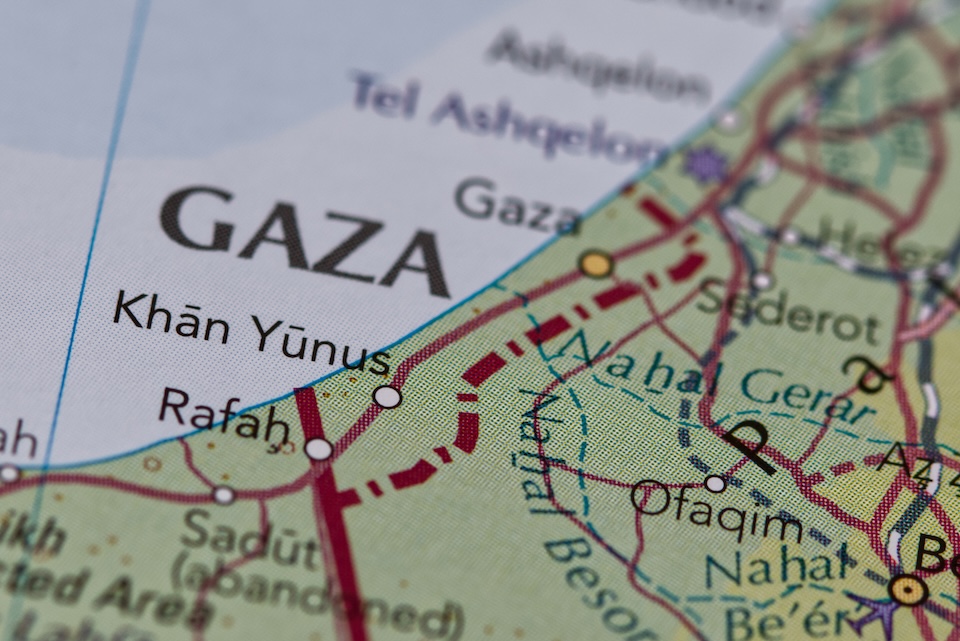
In telling stories, writers draw maps of the world. What if we imagined a different map?
I always have hewn to borders, physical and metaphysical, where hope and fear, virtue and disgrace, reach their utmost density. Exploring borders and boundaries allows for an introspection, a questioning: Where do I draw my own?
Every border is a human creation, a political choice someone drew on a map. Today, as you read this, one in eight people on the planet is on the move, having crossed or trying to cross—or being forced to cross—borders of continents, of countries, of towns because of genocide, war, epidemics, state violence, hunger. A million of these souls are in Gaza, in Palestine, where another million people, by most estimates, are lying dead under the rubble of their homes, their universities, their shops, their hospitals, their daycare centers, their libraries, their petrol stations, their mosques, their schools. And on the other side of the border from that abattoir—an illegal border, artificially created and fiercely guarded by the world’s most powerful governments—people in Israel go to school, go to the dentist, go to bars, go to temple, go to concerts, go shopping.
Every border is a human creation, and every border we create or cross requires us to adjust or fine-tune the communal boundary we have around our hearts: the boundary of the permissible. With the genocide that is ongoing in Palestine, we, as a human race, have crossed into unforgivable territory. Finding dignity from here will be a difficult task.
Every border is a human creation, and every border we create or cross requires us to adjust or fine-tune the communal boundary we have around our hearts: the boundary of the permissible.
My writing examines our connectedness and explores two interweaving meta-stories that make up our human fabric: our penchant for violence, on one hand, and our inherent defiance against depravity on the other. This, too, is a border. The intricacies of life are shaped within such precarious balancing: we are ecotone creatures, always straddling borders, the gritty membranes that resonate and magnify our most intimate aspirations and frustrations. As an immigrant who was born in the Soviet Union and grew up behind the Iron Curtain, I study borders as places where our most rigid Manichaean impulse—to bisect the world into Self and Other—finds a perfect outlet.
As part of my responsibility to perform this examination, I tell stories. I hope that through these stories I can understand and show why we draw boundaries and why we cross them. Why there are people at the border, or inside the border, or outside the border, hoping for a better life. Why there are other people, on the other side of the border, trying to keep these first people out, or make these people dead.
One of my favorite ideas about the role of a storyteller in the world today comes from my friend, the anthropologist Paul Stoller. Paul said an ethical ethnographer is one who invests love and loss in the community in which they work. I am a former war correspondent, and my work spans the entire world; I work in the community of planet Earth. You see now why it is ethically impossible not to make this conversation about Palestine. Because Palestine, today, is the utmost litmus test, the unparallelled clarifier of the boundaries that we contain: boundaries of our ethics, boundaries of our compassion, boundaries of our violence, boundaries of our love. Palestine today is creating for us a new map, a map of how we choose to be human from now on.
*
A map shows a relationship between elements in space and implies an observer, you. A map represents our effort to make sense of ourselves in a particular place—and thus, it charts our reach for meaning. It is no accident, I think, that the word “map” entered the English language in the sixteenth century via the French from the medieval Latin mappa mundi, map of the world, with mappa meaning napkin, cloth, tablecloth, signal cloth, flag: in short, an object that flaps in the wind, that shrinks and fades and stretches on a bias, that connotes a kind of unsteadiness. Maps are objects that, historically, we are taught to rely on, but they are historically unreliable.
Is it any surprise that we fumble as we look for the road ahead? A mapped landscape is always tailored to reflect the cartographer’s desire, the way when we say “acts of humanity” we mean “kindness,” though humanity is just as likely to commit atrocities. We map out the world seeing our own projections, filling in the blanks with imaginary stories or leaving them blank. Some things we don’t want to imagine, so we dismiss them. For what is a cartographer? A dreamer of worlds.
Storytelling, of course, is also a kind of map-making, a kind of boundary-setting, or boundary-adjusting. In the act of telling stories, in the act of demanding that our audience reconsider the way it sees the peopled world, storytellers cross the boundary between the polite and the urgent. It is a perilous crossing, because it insists on pushing the boundaries of the audience—the boundaries of empathy, of sorrow, of shame. Like many border crossings, it can be deadly. The Russian poet Osip Mandelstam, who died of typhoid fever en route to a Soviet concentration camp—died while crossing the border between relative freedom and enslavement-like imprisonment—once joked that “only in Russia is poetry respected—it gets people killed.” Israel must respect the hell out of poetry, because it has killed more than three hundred poets, writers, and journalists in two years. Even after the so-called ceasefire in Gaza does Israel continue to murder storytellers: on December 2, 2025, an Israeli drone murdered Mahmoud Essam Wadi, a Palestinian journalist who was documenting what passes for life now in Khan Younis, in an area Israel had designated as a “safe” zone. .
*
For the first months of the latest genocide in Gaza, when my social media feed began to be populated by images of the dead, I tried to not look: not because the images upset me, which they only did in proportion to the actual violence they chronicled, but because looking felt voyeuristic. And while I wrote, spoke, and—whenever the censorship allowed—published about the genocide, I did not share the images because it felt wrong to amplify Palestinian suffering. Maybe even during genocide I wanted my storytelling to somehow rise above and beyond what I saw, at the time, as the essentializing of the Palestinian. Maybe I had expected better of our world, expected that words would be enough to end this holocaust. It took me months to realize that they would not; and that, as a storyteller, I had, in fact, an obligation to broadcast the photographs, especially at a time when so many of my colleagues, whether out of careerism or Zionism, were silent. And then, on November 20, 2025—two months after the ceasefire—came the video from Khan Younis: a girl, maybe seven or eight years old, hair braded into four neat plaits, slapping her weeping face and knees—and in the background, a succession of men with cell phones, handheld microphones, and professional cameras aiming their devices to record her mythic, ritual grief. I was looking at men looking at suffering, and the choice before me was to make the world look or to protect the girl from all of our eyes.
Now I invite you to consider, or imagine, that a border is not a place, but a time. Actually, let us take a step further and think of space-time, and consider, or imagine, that time is also a country. More than two years ago, we crossed the border into a country where—or when—we have since been watching Israel kill an average of one Palestinian child every hour. A country where, or when, we expect, in the morning when we check the news—even despite the ceasefire in Gaza—to see more dead, mangled Palestinian children; more doctors led away at gunpoint; more girls in agony over the murder of their loved ones. We have crossed the boundary from the age—the country—of people who don’t allow a televised genocide, every hour of every day, for two years and counting, to the age—the country—of people who do. On this side of the border of Our Time, the Country of Now, which we all inhabit as a human race, such things are a part of our daily life. We can never be the same after we have lived through this time, through this country of habitual, quotidian murder and brutalization.
Here is where I, as a storyteller, must draw a new map.
The origins of genocide in Palestine, and of the abysmal mistreatment of migrants, and of the climate catastrophe that is devastating cultures and home-grounds all over the planet, and of the A-bombs that continue to haunt us eighty years after Hiroshima, lie within what J. M. Coetzee once called a “failure of love;” this failure—on display now anywhere families are bombed, mothers deported, men stuffed into unmarked vans—is inherent to the colonialist world order we inhabit. But this world order is not something we are destined to have, to abide by. It is not inevitable. It is, too, a kind of bordered country, something we had imagined, at some point. And I believe that we are capable of reimagining the world in radical ways.
I believe that we are capable of reimagining the world in radical ways.
I spoke about the boundary of the permissible earlier, and now I want to speak about the boundary of the possible. I am submitting this essay—and you are reading it—via technology that did not exist in the country or the time where I was born, fifty years ago; and maybe you, readers, as well. For us to have crossed, collectively, the border into the land of internet communications, somebody, or some bodies, had imagined what can lie beyond the border—and then made the crossing. Somebody—a human being—had imagined and made possible a heart transplant. Other human beings imagined and made space travel possible. Our young people are even better at imagining: look, in a mere decade, and pretty much worldwide, they have reimagined gender! Facing a great deal of resistance that causes enormous suffering, they are—and we are alongside them, if we choose to—remapping a more loving way to be, storytelling a future world, or a future time, that is not patriarchal, colonialist, and capitalist; a world, or a time, that does not require the sacrifice of a child every hour to the beast of fascism for two years and counting; in which the choice before us is not whether to look or look away as grown men point cameras at a weeping girl to broadcast her anguish.
Philadelphia