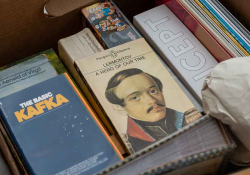

To acquire the habit of reading is to construct for yourself a refuge from almost all the miseries of life.” What was this quote, from Somerset Maugham, doing written on a scrap of paper shoved into a book in my hotel room in Hangzhou, China? Because it was a sentiment I agreed with, and because little had made sense to me since arriving in the country—I was a lǎowài, a foreigner, with no skill in Mandarin—I gave it only a passing thought. And it wasn’t as inexplicable as it may seem. In 1919 Maugham traveled to various parts of China, publishing his encounters as On a Chinese Screen. “Nothing hinders friendly relations between different countries so much as the fantastic notions which they cherish about one another’s characteristics,” he wrote in that work. This sentiment soon felt timely when, in a café in the Xiaohe District of the city, I found, tucked between a copy of Yu Qiuyu’s Quest for Chinese Culture and a handbook of English Verbal Idioms, a copy of Westerners Through Chinese Eyes, a collection of cultural observations by Chinese writers.
The quick read revealed some fantastic notions, indeed: Mei Yuan, in “The Beauty, the Water,” imagines that “most French men lack the mettle of a mountain, and the majority of Swiss women are not feminine.” Of my countrymen, Chen Zhongming, Wang Xiao’ou, and Chang Yuemin wrote in “The Melting Pot and the Mosaic: A Comparison of Americans and Canadians” that “many Canadian men do not take women as seriously as they do their fellow men.” And so on. Broad opinions from an older time, perhaps—the book was thirty-five years old—or simply the kind of blithe, biting conclusions that are all too easy to make in passing. I sought a second opinion, and I didn’t need to look far; a man had been looking over my shoulder as I read. He was gnawing on a boiled chicken foot, biting the toes off and, after sucking them clean, spitting them into his other hand. Through the translator on my phone, I explained to him what I’d read and asked him his thoughts. “Canada, Canada,” he muttered, dropping the bones on the ground and wiping his hands on his trousers.
Traveling takes such a firm grip of the sensibilities that it’s easy to forget that we are also being looked at, that we are not just visitors, but emissaries.
Traveling takes such a firm grip of the sensibilities, the outward gaze is so focused on the new and unusual, that it’s easy to forget we are also being looked at, that we are not just visitors, but emissaries. I was in Hangzhou for ten days on a lark, taking advantage of China’s new ten-day visa-free scheme. Working hard not to let any fantastic notions fill my head, I went searching for some local books to help calibrate my sense of the place. I’d learned before my journey that Yu Dafu, the early twentieth-century novelist who spent some of his early life in Hangzhou, had noted the southern part of the city—near the City God Pavillion—was where one would buy books. Accordingly, I went first to the Nanshan Bookstore, a beautifully murky shop adjacent to the Academy of Fine Arts. But the books were all in Mandarin, and I came away instead with a handful of fan leaf paintings. Next, I tried the Wind and Rain Bookstore, but it confusingly only sold vinyl records and cassette tapes. I stopped at Ulysses, but it was a kind of gimmick-shop, selling only variations of the Joyce novel whose name it shares. I went further afield, traveling to Xixi National Wetland Park, where I visited the Baobei Bookstore, a massive, flair-hipped building of stone and wood, made without nails. One must pay to enter—158 yuan, around twenty-two dollars—and the focus is far more on architecture than literature.
“Hangzhou is for poetry,” the hostess at my hotel told me, when she shimmy-stepped in with breakfast one morning. “Do you know Lin Bu?” She chose another book from the mantlepiece in the room and translated as she read: “Lake water washes up to the fence; mountains surround my dwelling. / A hermit’s hut should be isolated from the world.”
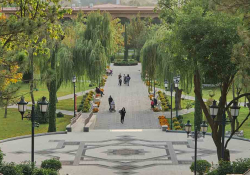
“His hut was there,” she said, pointing out the window, toward the leaden waters of West Lake and the tree-thick Gushan Island. Later, I made the journey there, crossing the long Baidi causeway that connects Gushan to the mainland. It would be difficult going for a hermit today, among the tourists and sightseers who gum up the sidewalks taking pictures, boarding ferry boats, and queuing to enter Starbucks. Still, West Lake was beautiful, bounded by manicured gardens that occasionally whiffed of herbicide.
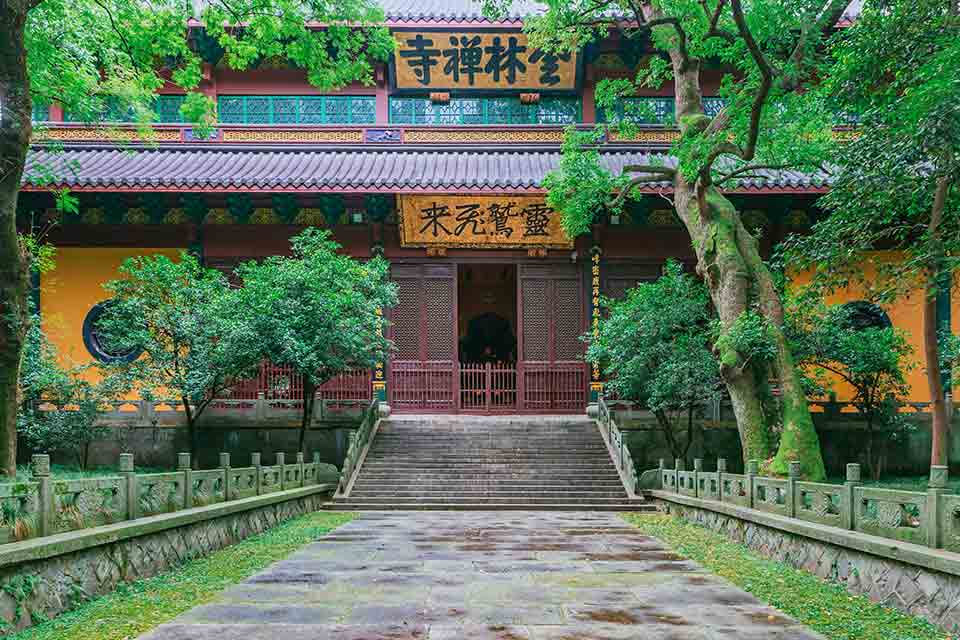
A cohesive feeling escaped me in Hangzhou, which instead presented itself to me in scenes, hung here and there like postcards on a busy wall. Outside the Lingyin Temple, I watched an old man poke at a hedgehog with his walking stick. Along the Jing–Hang Grand Canal, a cluster of men squatted on the ground peeling water chestnuts. In the night markets, I looked into aquariums of translucent jellyfish, buckets of live turtles with psychedelically painted shells (5 yuan for one, kept in the pocket for luck), and bubbling woks filled with fetid squares of black tofu. (Seeing me reel from the odor, someone used their phone-translator to say, “Once you get over the smell, it’s quite tasty.”)
A cohesive feeling escaped me in Hangzhou, which instead presented itself to me in scenes, hung here and there like postcards on a busy wall.
The people I encountered seemed to me obsessed with cuteness, free samples, and my big feet, taking pains to point out to me every potential trip hazard. There was an ingrained politesse that kept them distant, and no one seemed ready to discuss politics. But they were also affable and never rude, quick to offer a cigarette, a handful of sunflower seeds, or a deal-sweeter: a free hair fascinator, porcelain cup, or extra piece of meat. I sensed an aversion to doom; at one point, I realized that of all the stories, myths, and tales I’d been told, not one contained mention of a disaster, a failed mission, death, or even setback. They were all episodes of kindness, generosity, and great success.
I never felt close to understanding Hangzhou, and I began to feel like its essence was being kept a secret. The secret, of course, is the foreigner’s obsession in China, and it becomes characterized by a search for the one illuminating phrase, the clairvoyant moment, that will bathe everything in light. It never comes. One cannot claim to understand the Celestial Empire after such a short time as I had, if ever. It is simply too vast, too old. There remained so many unanswered questions: Why didn’t the ice cream melt? How can they eat so much and stay so trim? Why are the washroom doors always made of transparent glass? Returning to my hotel one evening, I came across a square in which a crowd of people walked in a never-ending circle, waving their arms in unison with jaunty music while exercise instructions were read over a loudspeaker. I couldn’t comment on any of it; all I could do was let go and merge with the crowd.
Gladstone, Manitoba