
Japanese fiction offers no shortage of cats. From Natsume Sōseki’s I Am a Cat at the turn of the twentieth century—in which a sardonic feline reflects on the pretensions of Meiji intellectual life—to Haruki Murakami’s metaphysical strays in Kafka on the Shore, and more recently to the gentle, time-bending café of Before the Coffee Gets Cold, cats have long padded through Japanese literature as intermediaries, guides, and witnesses to human longing, symbols of a distinctly Japanese intimacy with the ordinary. It is perhaps inevitable, then, that one of Tokyo’s most charming bookstores should be devoted entirely to them.
Nyankodō sits at the center of Jinbōchō, Tokyo’s historic book district. Emerging from the Tokyo Metro, I was carried upward in a steady current of commuters only to find the pace slacken almost immediately at street level. The rush dissolved into passersby lingering over sidewalk carts and narrow storefronts spilling over with used books. Browsers paused midstep to leaf through books, from manga to medical textbooks. Today, some 160 bookstores still cluster here, many centering on a particular subject. Nyankodō’s happens to be cats.
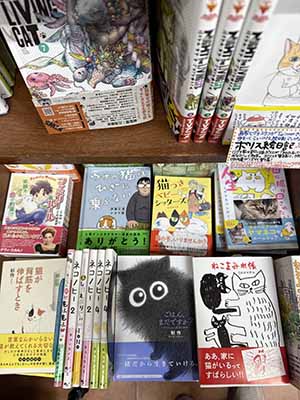
The shop occupies a modest corner next to an udon shop, but its scale is deceptive. Over six hundred different cat titles—nearly two thousand books in total—fill the shelves, their covers displayed outward like a gallery wall. Picture books, novels, essays, photography collections, children’s stories, manga: all feline, all available to browse at leisure. I felt no pressure to buy quickly or to funnel toward a bestseller table. Under the gaze of illustrated cats staring back at me from every angle, I was compelled to linger.
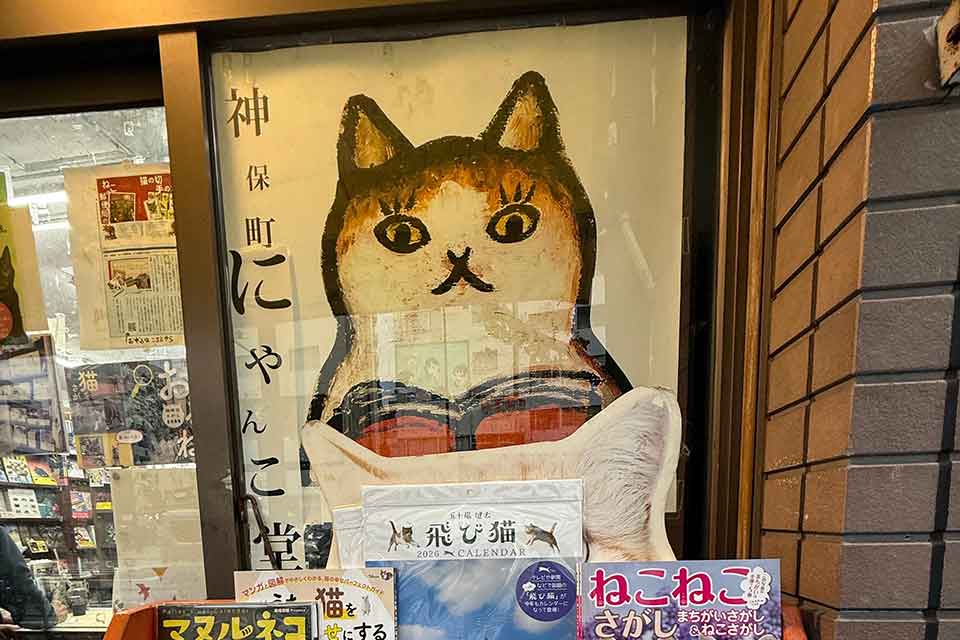
Nyankodō’s origin story, scrawled in Japanese beneath a wall of photos of the owners’ previous cats, is one of resilience. In the early 2010s, like countless small bookstores, it was facing decline. Online retailers and a shrinking print market made it difficult to stock new titles, let alone compete with larger chains. Closing seemed inevitable. Instead, the owner turned to his daughter with a simple question: could she create a bookshelf that was interesting, regardless of profit? Her answer was cats.
At the time, large bookstores relegated “cat books” to a few titles in the pet section. But, as the kind and elderly clerk told me, the owner’s research on the genre revealed a trove of essays, novels, picture books, and magazines. When Nyankodō opened its four-shelf cat corner in 2013, customers began to appear, seemingly beckoned by the curious eyes of the many covers’ creatures.
Inside Nyankodō, warm light pooled over the shelves, softening the edges of the small space, while a low hum of jazz played somewhere behind the counter. As I moved through the store, cat-themed stationery, art, and merchandise appeared between the books, tucked into every spare corner. The narrow rows meant that browsing required negotiation: I shuffled sideways past other customers, pausing while someone crouched to examine a lower shelf. Yet no one seemed in a hurry. When I finally chose a title for my friend, it was wrapped in Nyankodō’s original cat-designed cover, a small, deliberate ritual that made my visit feel like a keepsake.
Like the cats in Japanese literature, Nyankodō watches the city quietly, confident in its presence. In a district already dense with books, it survives by narrowing its focus—by trusting that readers will find meaning in the small, the specific, the lovingly curated. When I finally left, the moon having risen in the ebony sky, I was struck by how perfectly the shop marries two enduring motifs of Japanese fiction: the bookstore as refuge and the cat as companion. I left feeling satisfied and warm, knowing that I had not merely passed through, but briefly inhabited, the little world of the store.