
Zsuzsa Selyem’s second novel to appear in English, Cosmall (forthcoming from Contra Mundum Press, 2026), follows the zigzagging trajectories of a handful of people, parents and children, friends and lovers, each other’s betrayers and informers, across a small cosmos of pre- and post-1989 East Europe. Its local fauna consists mostly of members of the Hungarian-speaking Transylvanian populace in Romania, whose enmeshed personal and family histories enact cross-generational patterns of dependence and abuse bred by successive dictatorial regimes and their murky aftermaths. At its center is Icu Windisch (the mother of Mira and Soma in the excerpt) and her circle of acquaintances, whose stories only touch one another erratically.
But to say that Cosmall is a study of transgenerational trauma in East Europe caught in a secondhand time would not do it justice. Rather, the question the book insistently asks with its abrupt changes of perspective is: What resources can we use for resistance, in the post-truth age, to prise open the deterministic worlds foisted on us? What are the possibilities of making visible our co-belonging with, and responsibility for, creatures who are too remote for us to notice and also our inalienable freedom? Suspending the preestablished accounts, the book creates moments of defiant, worldly joy that are available to all involved, irrespective of their inheritance and fragility. These moments can, albeit fleetingly, connect them to a sense of noncompartmentalized existence, into realms of the empathetic imagination that we can share with an orphaned child or, as in this excerpt, a dolphin.
Selyem’s previous novel, It’s Raining in Moscow, recast the genre of Eastern Bloc gulag memoir and family history—replete with 1950s forced labor, deportation, occultation of the Holocaust, and repression during the Ceaușescu regime—into a polyphonic book where each episode in a family history is narrated from a markedly outsider perspective, most often an animal. This change of vision allowed for a derailing of the expected pathos and for an understanding of the broader implications of traumatic events involving not only human lives. Even more than in the previous novel, Cosmall enacts what it means to undergo and suffer history in the body—and, more precisely, in the multiply subjected female body—and how this very body may and does become a small cosmos resistant to being framed and appropriated in narratives of control. For even if it happens in an aquarium, as the book tells us, swimming is still the closest we can get to flying.
While V. V. Putin’s army continued bombing and shelling Ukraine, dead bodies of dolphins continued to be washed up on the shores of the Black Sea. The birds fled from the war, looking for other places to build their nests. Even if they grew weak and managed to raise fewer chicks, they still had something of a chance. But the dolphins, whose ancestors, like so many Eurydices after Orpheus turned back to look, to be on the safe side, withdrew into the water some fifty million years ago, as I say, the dolphins had nowhere to flee from the underwater bedlam, only once more out onto dry land, to die.
When they were bombing my city, I was still swimming about to my heart’s content in my mother’s belly. I could hear. I felt my mother’s fear, as if the Earth itself had been afraid, I was afraid, I tried to flee, but where to? I felt a jolt, I started on my way out. I had to pass through strait after strait, I thought I was going to get stuck forever, but a pulsating force kept pushing me, and then something sharp pierced my throat, my nose, I was out on dry land. All I know is that I was born at seven months, mom and dad don’t speak much about this, in point of fact they don’t speak about it at all, but now after seventeen years I’ve managed to piece together what happened. It’s even in Wikipedia that the Serbs bombed the city from Mount Ozren, some two hundred people were killed. May 25, 1995, the Tuzla massacre. Father wasn’t even there because he’d been drafted. Or he went by himself, no idea. Mom at home with me in her belly, she must have worried herself sick. That time too. Then to cap it all, I came along, the seven-month-old girl washed ashore. Fuck knows how I survived.
When they were bombing my city, I was still swimming about to my heart’s content in my mother’s belly.
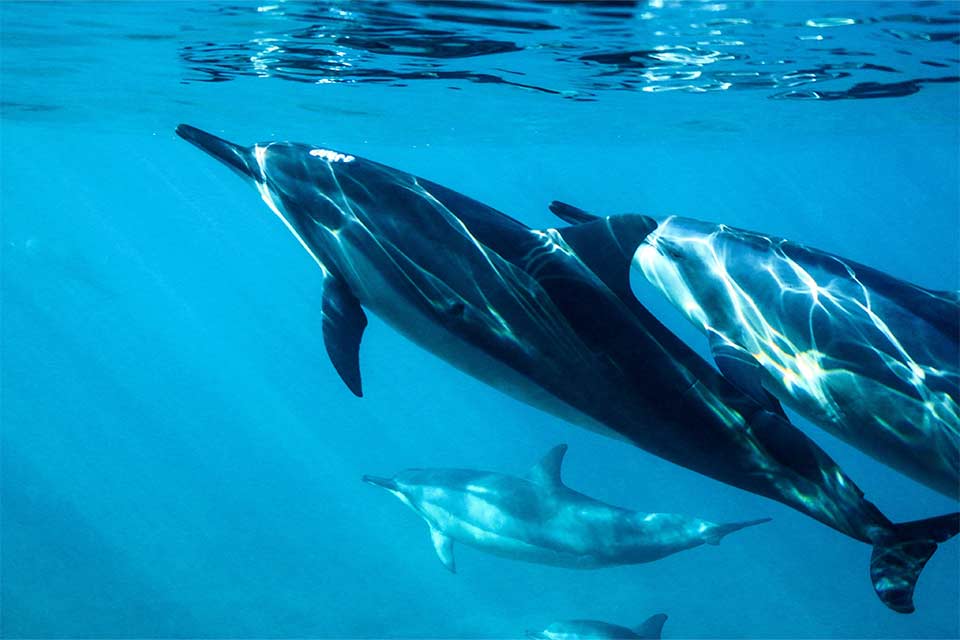
My secret name is Eurydice, I want to swim back, but where? The Adriatic? The Black Sea? The White Sea? The Yellow Sea? The Pacific? The Peaceful Sea? In our parts there are three kinds of eurydices in the sea: the bottlenose eurydice, the brown eurydice, and the plain eurydice. We swim in pods, but we have been known to stray and join others, no one makes a big deal about it. Our hearing is top-notch, we keep clicking away, our sounds collide with a shoal of sardines, the echo bounces back and we instantly know where to go if we are hungry. Everyone has their own distinct whistle. One of the unmistakable sounds of infinity. If one of us gets caught up in some invisible whatsit, they call and call, we go and if we can’t free them they will continue to thrash about, the poor wretch, until a human comes and cuts off the fin of our mother, our brother, our sister, our friend who is bleeding, for a while we try to keep them going but they grow weaker and weaker and we know and they do too what it means to die and be eaten by the others. Out there we are rich, we have a big two-story house with a swimming pool, dad and mom have their own cars, but I got tangled up in the net and keep waiting and waiting for the poacher to come and cut off my fins. I’m trapped inside our swimming pool, dad comes and teaches me to play with a ball, mother comes and holds up a hoop for me to jump through, and I play with the ball and jump through the hoop just so they don’t leave me on my own. The pool is a tad narrow, but if you are nice to me, if you don’t tell me off, if you throw yummy anchovies into my mouth, if you teach me your manner of speech, if you pet me, we play a lot, then one day whizz-bang you’re gone, Mamama, then I’d rather stop coming up for air.
Mom and dad say you can’t make a living from acting, but dentists make good money. Especially when bombs are raining down. Anyway, they won’t let me out after eight in the evening. That’s my safety taken care of as far as they are concerned. I’m not even sure what I was hoping to get from them. My friend Šelja has tried out a thing or two, admittedly she isn’t kept on a tight leash like me. Her father died in the war, her mother is an alkie, Šelja takes drugs and is hooked on the slots. She doesn’t give a shit about her body, anybody can have her. Well, I wouldn’t go that far. We’ve fucking well had it with everything. Before eight I too hang out with the others around the garages, after eight I’m on the computer. Oh, I almost forgot, in the mornings there’s the ennui called school. Not worth mentioning. Only the English classes are worth the bother, the teacher is young and a real hottie, she can be tough but she can also be funny. I love it when she mimics the accent of the bogmen. Šelja and I are allowed to call her Zara outside school. We sometimes have an ice cream together and a smoke by the lake. Apart from us she doesn’t have anyone, I guess. The story goes that her lover was blown up right next to her. And that she was raped. Who wasn’t, twenty thousand women were raped in the war. I read that in The Vagina Monologues, in English. At home there’s a great big fucking silence about it all. When I cautiously mentioned Eve Ensler to Zara, although I suspected she didn’t care so much about the topic but still, I hoped she would appreciate I was already reading in English, she gave me a look that made my blood curdle. She wouldn’t even mention the Trojan War let alone ours. But I have no trouble at all imagining her in fatigues with a Kalashnikov. She’s insanely good at World of Warcraft.
Mom and dad say you can’t make a living from acting, but dentists make good money. Especially when bombs are raining down.
Eurydices are also deployed for military purposes: the US Navy has them detect underwater mines, the Soviet Navy, for guarding strategic harbors and identifying enemy warships. Using their echo-locating skills, they can establish with far greater precision than ultrasound the nature and size of what is approaching. Roughly one year passes from conception until the birth of the little eurydice. It comes out tail first. Because the mother loses quite a lot of blood during birth and the blood attracts predators, a pod of eurydices swim around to protect her. In the first months the mother keeps whistling, so the little one soon learns her signal. At only one month old it already has its own whistle. Otherwise we live in polyamory and make love a lot. Our skin is highly sensitive, the water too has a gentle caress, but when another eurydice touches me it sends a shiver through me and through the other too, and we laugh throughout, it feels so good. If a pufferfish swims our way, we play with it, toss it to each other with our noses, which makes the poor dear go into a funk, although we mean no harm, but that special stuff it ejects by way of self-protection is something quite heavenly, there are no longer vanished mothers and cut-off fins, only happiness. Mélange. We poke the pufferfish gently with our noses, plug in to the world’s heart chakra, and chill, and the pufferfish floats off unscathed.
Eurydices are also deployed for military purposes: the US navy has them detect underwater mines, the Soviet navy, for guarding strategic harbors and identifying enemy warships.
During one class Zara brought up some EU competition that our school was entered for, with the theme: Beware, Stereotype! Schools from Amsterdam, Berlin, and Paris are also entered for it, all you have to do is write an essay in English on prejudice. And she gave me and Šelja a knowing look and quietly added something about the nasty, mean prejudices of the affected rich bitches who come up with such stuff. And then in the spring we can go to one of these EU cities, to a local school. We googled the topic, spliced together the required essay and sent it in to Zara. She drew a heart on my paper. I kept thinking of the trip, that there would be a few days when I won’t have to be home at eight. I was squeezing mom and dad for pocket money nonstop. I managed to milk father several times because he kept forgetting he’d already coughed up. I always bummed him when his football team scored and he was overwhelmed by a feeling of omnipotence. Not even Allah himself remembers everything.
The army wasn’t slaughtering us deliberately. The men who were drafted and for some reason got caught up in the war were completely oblivious of our existence. The commanders and common criminals above them saw to it that they wouldn’t know a thing. That they slaughter on command, under the influence, the women, the old, the sick, children, everything. Slaughter and rape. If one of their soldiers fell, they left him by the roadside to decompose slowly and surely. Nobody would ever know who he was and what he was doing on this planet. It was known full well though that the unhinged authorities needed unimaginable energy to keep the lunacy going, indulge its arselickers, and bribe their court artists and scientists. So no one would confront anybody with their previous actions, so that the consequences could be conveniently glossed over. So that no justice was ever served. Let lightning strike rather, let’s have the brutal bombs and the collateral damage. Desertification and deluge. Even if sooner or later it will obviously get us all pegged out, all the merrier, they think, life’s a piece of shit anyway, they think. Stuff happens, you know. Stuff happened to me too, but I can’t wait for the end of this effed-up world, where dad beats me and mom, mom doesn’t love me.
Then it turned out that our team had been assigned to some city in Romania, Cluj if you please. Zara even told us on the bus to keep an eye on our things because there are Gypsies galore here, oh excuse me, “Roma.” I’d forgotten from the outset, although Zara had indeed told us, it’s been looming large on the program, that we’ll be put up with local pupils’ families. Had I known, I’d have brought a safe. I always kept my 800 euros on me and never took them out. The local currency turned out to be Romanian lei. Pffff.
The chick I was assigned to lived with her mom, brother, and sausage dog in a small flat. There was a bunk bed in her room, I was graciously given the lower bed. The dog was all over the place, and whenever it saw me it barked. To cap it all, it covered all my stuff with its fur. After dinner we sat around in their minuscule kitchen. I was dying to retire to my (shared) room. Mira (this was the chick’s name) sat smoking, all chill in front of her mother. Her brother, Soma, was already at uni.
Soma asked me what kind of music I liked, Mira, where I go partying in Tuzla. Their mom, what I like doing best. The usual getting-to-know-you small talk. They told me how once at the Sziget Festival their mom’s wallet was stolen with all her documents, and it was no use going to the Romanian embassy, the ladyship snacking on the national sweet behind the counter told them it took two weeks to issue a piece of paper she could cross the border with. And that would have been a total disaster, because they already had their plane tickets and rented car for Corfu. Oh tragic. And how they had to fix three bikes onto the car because that’s how they moved about in Budapest. Mira stayed on for a few more days with some auntie, Soma and their mom decided to try crossing the border with his mom completely paperless. But Soma had both his ID and passport. And they whipped up the drama: imagine how it would have sucked to be turned back after spending two effin hours to tie the bikes onto the car. It would have been bye-bye to the holiday. My heart bleeds for you. So the woman stuck her son’s passport and ID under the border guard’s nose. The guy, Soma said, didn’t even look, he just patted his palm with the papers, gave them back and waved us on. You can imagine, Naida, how mom and I yelled with glee the moment we got across. He smiled at me as if I too had yelled with them.
Soma and his mom were drinking beer, me and Mira orange juice. I’m not religious, but somehow alcohol is really not okay. According to Mira weed is so much healthier, but the liquor lobby is preventing it from being made legal. She even has a small marijuana plant in a pot, she’ll show me when we go to bed. Mom and dad forbid me from smoking. It’s not even that they prohibit it: they simply couldn’t imagine me doing it. Anyway, that evening we smoked together with Mira, Soma, and their mom, who at one point tried to persuade me to not give up, if I wanted to become an actress I should become an actress. There it was, on their fridge, just like that, written with a marker: A WOMAN’S PLACE IS IN THE STRUGGLE.
In general we have one life, Naida, but actors have a myriad, the woman said, to me, the dolphin. I told her, so she’d know who she was talking to, that in the Midsummer Night’s Dream we did in our drama group I was Puck. I turned the forest into a sea, where I was a dolphin and then I morphed, let’s say, into a pufferfish, and made everybody dream crazy dreams.
That’s cool, isn’t it, she grinned and added, in life too it’s almost like that.
But what if I’m not talented enough, I thought, but out loud I only said, it’s by no means certain I’d be admitted to drama school.
No point thinking about that, Naida, you shouldn’t care, the woman said and lit another cigarette. If you put yourself into it for real, you’ll be good. If you work with everything you’re living through.
Sure thing, I thought, especially when grenades are going off all around you. Well, in Tuzla that’s not so simple, I said.
I can imagine, she said and nodded, then asked if it was not somewhere around there that Susan Sontag staged Godot.
At the wrong place at the wrong time, Soma joked.
To get dancing lessons from a shriveled tree, Mira added. I will gladly learn to dance from a living tree, but a shriveled one?!
I don’t understand this family, but they seem to understand each other.
We miss the thing by waiting for it, their mom said, she waited a bit and added, and we also miss the thing by not waiting for it. Our lives are spent on something that wasn’t even our business, although the war will be over, in your place too it is over.
It’s not over, ma’am, it’s just that a few years have passed since.
Soma looked at me and sided with me: Didi and Gogo too are still waiting for salvation, but only Pozzo comes along with his philosophizing dog.
The woman thought about this a bit but not too long, for she launched into an explanation along the lines that it’s better if you do nothing than to collude in your own oppression. That all you have to do is bear that, just as Didi and Gogo too bear it all along, although their situation is kinda shitty. Then she launched into some weird old story, that a guy, I presume a Jew, though she didn’t say he was, made drawings for a Nazi officer, in exchange for his survival, and that he filled the room of the Nazi’s sprogs with his drawings etcetera, he did everything they asked him to, while the charming couple were shooting Jews from their window. And that they took out another Nazi officer’s own houseboy, at which in revenge, he took out this guy making the drawings.
Mom, sometimes it would really be better if you kept quiet, Soma said finally. No harm meant, but you could learn from Buksi. I imagined the scene, the sausage dog teaching the woman to keep quiet, clam up after me, but she keeps blathering on, at which the dog . . . oh well, anyway, I told them that in Sarajevo the square with the theater is named after Susan Sontag. I probably shouldn’t have, because the woman now launched into, theater is a refuge, provided it’s good. I don’t know why she needed to add that, who is to say whether theater is good. And she went on, that the games you play when you think no one cares about you and there’s nothing you can do, those games suck you in, squeeze you dry and prepare you for the idea that killing is okay. Bang! I felt someone had taken me out from a window. Soma must have noticed something, because he snapped at his mom quite rudely, what’s this to do with the other thing? You know nothing, mother, about games people play merely in order to get a breath of air that they need, by this logic action movies too prepare you for war, it was as if I myself had said it, it felt so true, and she quietly said something, you couldn’t make it out exactly, she mentioned some kind of kindergarten, a kid whose parents play WoW all night, at which Mira with a grin, that’s romancing the machine, at which point I told them that was much better than waiting to the point of idiocy to be loved in such a dry world as this.
I told them that in Sarajevo the square with the theater is named after Susan Sontag. I probably shouldn’t have, because the woman now launched into, theater is a refuge, provided it’s good.
I didn’t sleep all night. The images kept flashing: me small, running with a smile to mom and dad, but they don’t even notice me. Or mom snapping at me all upset, fix your skirt, look what a sight you are! Whatever I asked them they didn’t reply. All they ever asked me was what grades I got in school. Their life would be so much easier without me. I bring them only trouble. I blast their nerves to hell with all the worry. That I should study hard, keep mum, get admitted to do dentistry, earn a pile of money, so I’m no longer a burden. This woman has no inkling what WoW is, she’s just full of smart-assery.
Then the first thing I saw in the morning was Mira’s little marijuana plant in the pot on the windowsill. I took a picture of it. Off to school I went with my trolley, I couldn’t have taken another night here. When I showed Zara the picture on my phone she took it and went straight to their headmaster. Let them kick that Mira out of school, people like that make me puke, who do they imagine they are, sitting here in their run-down country spouting into empty space, riding their bikes, flying to Corfu, and of course no man around to put that house in order. If, that is, you call that den filled with doghair a house at all. Let me become an actress, sure thing, easy to say, but while I starve to death she will be happy to guzzle liquor with her drug-addict brats.
The Bosnian colleague stormed into my office asking, what kind of school is it where the pupils engage in illegal activities. Good morning, dear colleague, I said slowly, but she gabbled on barely taking a breath. She had a phone in her hand and was showing me a picture, but her hand was trembling so badly I could hardly work out of what.
What shall I say to the parents of my pupils, how could they let their children come over here if you can’t even guarantee them a modicum of safety?
Please just tell me what happened and I will take appropriate steps at once.
What happened, what happened, too late to take action now, you should make sure to bring them up so things like this simply don’t happen! Look, this is a marijuana plant, one of my top students took the picture in the home of one of your pupils.
The colleague finally handed me the phone and I took a good look at the incriminating picture. In a small, red-and-white polka-dot pot a miserable little green stalk with a few small leaves. Would this be the marijuana, then?
You as the school’s headmaster bear direct responsibility for what happens to exchange students on such EU programs.
I can assure you I am fully aware of my responsibilities. Will you please tell me what happened? Is anybody hurt? Has anybody insulted your pupil? I was asking her slowly, hoping she might calm down. I listened attentively to what it was she was trying to make of that small pot.
What will I tell the parents? Did I bring the children here to take drugs?
What drugs are you talking about? Did anyone fall sick? Have you noticed any improper behaviour?
No, but there could have been.
Look, please, all I can see here is a flowerpot with some green plant. I don’t understand why we should make a big deal out of that, why the parents should be alerted for such a trifle.
You don’t expect me to become an accomplice of your drug-taking student, do you?
Please calm down, nothing of the kind happened. Tell me the name of our pupil and I’ll take appropriate action.
Mira Portik-Windisch.
I stifled a sigh and while the woman stormed out I asked the secretary to call Mira’s mother and put me through. Before I could finish the Wikipedia article on marijuana she had arrived. Of course, because she too goes about by bike. I called in the Bosnian colleague and Mira’s class teacher to clarify the situation.
What could I have done to offend Naida so badly that she denounced me, I wondered, but there and then, on the directorial carpet, the vixen awoke in me who is not prepared to freak out at the sight of the chasm between lofty principles and unvarnished reality, and I said, I refuse to even look at the incriminating photograph, no one has the right to take pictures without permission in someone else’s home, and in any case why should anybody imagine they can summon me on trumped-up charges, and all this in a European Union program devoted to the elimination of stereotypes where, if anything, we should be working toward getting to know and befriend each other.
These folks have not the faintest what we had to live through, they think you can fix anything by being nice, well no, my dears, it can’t be fixed, what on earth are we doing in this filthy hole anyway, I thought, but all I said aloud was that to the best of my knowledge growing marijuana is forbidden throughout your beloved European Union.
To tell the truth that photo didn’t exactly show a plantation, I thought, but what I said to the Bosnian colleague was that we will without fail look into the matter and draw the necessary conclusions.
Well, yeah, this is how we run the world, trumpeting togetherness under some nice tagline, then by some curious accident never twinning Cluj with Berlin, Tuzla with Paris. Let those troublesome East Europeans with their messy histories eat each other alive, I thought, and said nothing.
Let those troublesome East Europeans with their messy histories eat each other alive, I thought, and said nothing.
So what now, I asked mom when she came out of the headmaster’s office.
All’s well, Mira, empty vessels make the most noise. At the end I couldn’t resist asking the teacher from Tuzla why she thought it was fine to take photos on the sly and denounce our hosts, at which she straightened up a bit and said, tradition. That she must safeguard their traditions.
And nothing was said about my other plant? The little carnivorous one, wasn’t she also accused of something?
Why? Don’t tell me it eats pork?
Mom, you know very well that me and my plant, perhaps Naida too, like our pork when it’s in the pig state, alive and oinking.
Oink-oink. There in the headmaster’s office I was struck by the confined reality into which school was trying to squeeze children, that the history of mankind is but the history of destruction crowned by a sticky, fake heroic halo. . . .
Have you seen that video with pigs slithering down a slide? They trot up the steps again and again, to splash into the small pond. Even seeming to be grinning all the way.
Every moment that is wholly permeated by life is pure and eternal. The bitter, shifty, rictus-smiling leaders and warlords and other betitled autocrats are in fact spineless bladderbags. We can see and feel how much pain it must have taken to scare their lordships so badly they’re even too scared to live. But we don’t pity them. That would be beneath our dignity and theirs. If we weep, it is not for them that we do so. They are grown-ups, it is their sovereign decision to wage war without, while their wound is within. They surround themselves with security guards, weapons, walls, and busy schedules. So they have not a free minute to themselves. So they have no need to see all the beauty in this world, all the goodness that they destroy so relentlessly, because they’ve been destroying it for far too long, and if they were capable of thinking anything about the matter they would think that it’s too late to start making good all that destruction, it’s impossible, all that is left for them is to continue to arm themselves and bossing people around and erecting walls, because they are afraid of everything, most of all of themselves. The neighbor within: it scares them out of their lives.
The Russian submarines had invaded the section of the Black Sea between the Danube and the Dnieper long before the tanks and the soldiers invaded on the dry land. When in accordance with our custom we swam up from the south to the Black Sea’s northern shores, where the Tuzly Lagoons National Nature Park lies, the submarines were already scanning the area with their underwater sonars, to thwart the movement of Ukrainian vessels. Those powerful noises are more frightening than anything else. We kept circling around in one place, there was nothing to eat, so we started digesting our own fat, but that was teeming with viruses which wouldn’t have infected us had we been strong and healthy, but we were not strong and healthy but long weakened and wasted amid that noise and starvation and lostness.
Or we were burned by the phosphorus mines, the ones that even water can’t extinguish.
Or when they bombed the Boyko gas towers we bobbed up to the surface too quickly and, just like your divers who come up from the depths too fast, we died of the bends, not getting enough oxygen, because our veins filled up with nitrogen gas bubbles.
Now what, I asked Zara when she came out of the headmaster’s office.
Everything is OK, my dear, I demanded that they expel the druggy chick from school.
I’m not sure if . . .
Don’t worry, today we’re still here, tomorrow we’ll be far away.
In the swimming pool Soma reflected that once upon a time we were all fish. And that even if you don’t know the techniques, swimming is still the closest you can get to flying. Apart from him there was only one little boy in his lane. He must have been around nine or ten and swam backstroke with knees slightly bent, but without pausing. And humming all the while. Whatever happens, no one can take this away, this gliding along the smooth surface of the water in the white-varnished pool, the yellow flicker of the tiny globes of sunshine underwater, the voice of the child.
Translation from the Hungarian