
How did hi-tech musicians forge a new subculture out of being stubbornly analog?
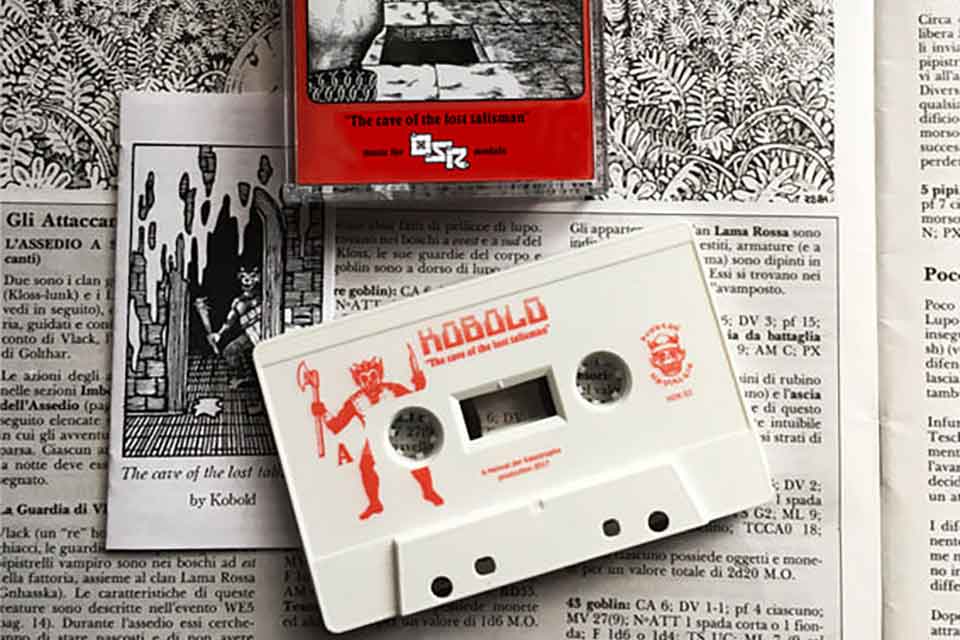
A garish pen-and-ink drawing dominates the modest real estate of a cassette cover, re-creating bygone eras associated with two different, if related, gaming cultures. The drawing is composed around a dog-headed humanoid figure brandishing a sword as it emerges from the gloom of a dungeon hallway ahead. The figure, which shares a name with the album’s creator, Kobold, is knowingly rendered with an awkward sense of anatomical form reminiscent of early editions of the tabletop role-playing game Dungeons and Dragons. The whole composition is forced into the awkward first-person perspective associated with early computer role-playing games, replete with hands holding a torch and a dagger, respectively, framing the shot on either side.
The album’s title, The Cave of the Lost Talisman, is listed below the main image in an unassuming nontitle case captured in quotes with the mock branding of OSR (echoing the original publisher of D&D, TSR Games) spelled out in hex squares like the map of a tabletop dungeon. Unpacking the cassette box, this gaze toward a mythical past of uncomplicated fun is made manifest by the goofy red-ink design printed on the queen mother of all generic white cassettes. The back of the cassette’s J-card cover features a map keyed to a simplified role-playing adventure, known to gaming enthusiasts as a module, printed on a small booklet within the cassette. Later editions have seen Cave released on twelve-inch vinyl with the booklet adventure expanded into a full-sized and fully illustrated module that ships tucked inside the cover with the record.
This attention to packaging-as-artifact is the hallmark of Kobold’s record label / distributor, Heimat der Katastrophe (HDK). Based in Milan, HDK was founded in 2017 to publish music associated with an anarcho-punk collective known as the Kalashnikov Collective that didn’t fit into their raucous live persona. To this day, it’s rarely clear how much of HDK’s output is the metafictional creation of one of its publicly known members and how much is the independent work of creators aligned with their aesthetic. In the words of an unnamed member of the collective, “Some HDK artists . . . come from the punk or indie scene and are people we see every day in our city. Some of these even . . . we are ourselves!”
It’s rarely clear how much of HDK’s output is the metafictional creation of one of its publicly known members and how much is the independent work of creators aligned with their aesthetic.
Kobold’s music can be heard through several critical lenses. Broadly, it is electronic music with references that trail all the way back to Wendy Carlos and Kraftwerk. The Cave of the Lost Talisman is now recognized as sparking a renaissance in a subgenre of electronic music known as dungeon synth. Originating in the early 1990s as part of the black metal scene, dungeon synth was characterized by lo-fi recordings of cheap synthesizers playing long-form ambient music full of dread.
Kobold takes that lo-fi aesthetic to the next level by narrowing the palette on their compositions to synthesized sounds associated with the computers of 1980s, a nod to a subgenre of electronic music known to enthusiasts as chiptune. While chiptune, old or new, isn’t necessarily limited by using or emulating the synthesizer chips popularized by robust machines like the Amiga or the Sega Genesis, dungeon synth’s predilection for tones that sound creaky and on the verge of collapse elevate older and more limited chips. Of particular fascination are chips like the MOS 6580 (also known as SID) that managed sound in the Commodore 64 computers that were widely sold in the US, the UK, and across Europe. In the hands of an able composer like Kobold, emulating the three voices definable only by the shape of the waves to produce them and a narrow band of effects constitutes a kind of primitivists’ palette of electronic music composition.
The Cave of the Lost Talisman has been reprinted five times in small batches of just a few dozen cassettes at a time and sell out as quickly as the lots are offered up. Even considering the run of 300 copies of the vinyl edition that was printed and immediately sold through in 2021, the album has probably shifted less than five hundred copies in a physical form. But where demand is high and supply is low, the cost of any version in its pristine physical form skyrockets. Copies of Cave on vinyl, which sells for €25 upon release, regularly sell for more than $100 on the aftermarket, creating a kind of instant collectible market for HDK product that draws more inspiration from Pokémon than Polydor.
The elevation of the cassette to the fundamental unit of currency in the scene feels anything but accidental. It was, after all, the cassette that broke through the wall of irreproducibility that gave recorded media much of its perceived value as a commodity. The compact disc inherited this expectation that the consumer should be given the choice of whether or not to pay for licensed materials as the cost and difficulties of media reproduction arced toward almost zero. As discrete album sales continued to plummet across the decades, the profit to be made from people listening to music could only be found in aggregate through streaming services.
Judged by its utility in the marketplace, the cassette ranks only above the most forgotten media like the 8-track and the wax cylinder. By centering its own worthlessness as a medium intended for serious circulation, HDK’s cassette releases take on a totemic quality, more valuable in a philosophical sense as an object of meditation on the absurdity of “owning” music than as a serious vehicle for consumption or distribution. The barriers to actually listening to an HDK release on cassette (finding one at a cost inflated by scarcity, finding a working cassette player, etc.) all work to incentivize consuming it digitally and at a cost assigned by the consumer. It takes on the value of the listener’s longing to be included.
HDK’s cassette releases take on a totemic quality, more valuable in a philosophical sense of an object of meditation on the absurdity of “owning” music than as a serious vehicle for consumption or distribution.
It’s a model that HDK has applied with varying degrees of success now to more than two hundred albums, pseudonymical concepts, and repackaged projects from musicians all over the world inspired by their collectivist model. Nearly every region with its own DIY punk or metal scene has an “HDK” of its own with a healthy degree of cross-collaboration and egalitarian platforming the likes of which more mainstream genres of music haven’t enjoyed since the mixtape underground hip-hop heyday of the late 1980s and early ’90s.
The rise of HDK and the artists and music associated with their label seem to suggest a progression beyond McLuhan’s postmodern formulation of the medium being the message; a formulation where the packaging becomes a meditation on branding and what is real and what is imagined in the buying and selling of art as a commodity. It resonates ably alongside pseudonymical play in postexotic fiction and embraces the liminal nature of digital media, in both consumption and production.
University of Oklahoma