
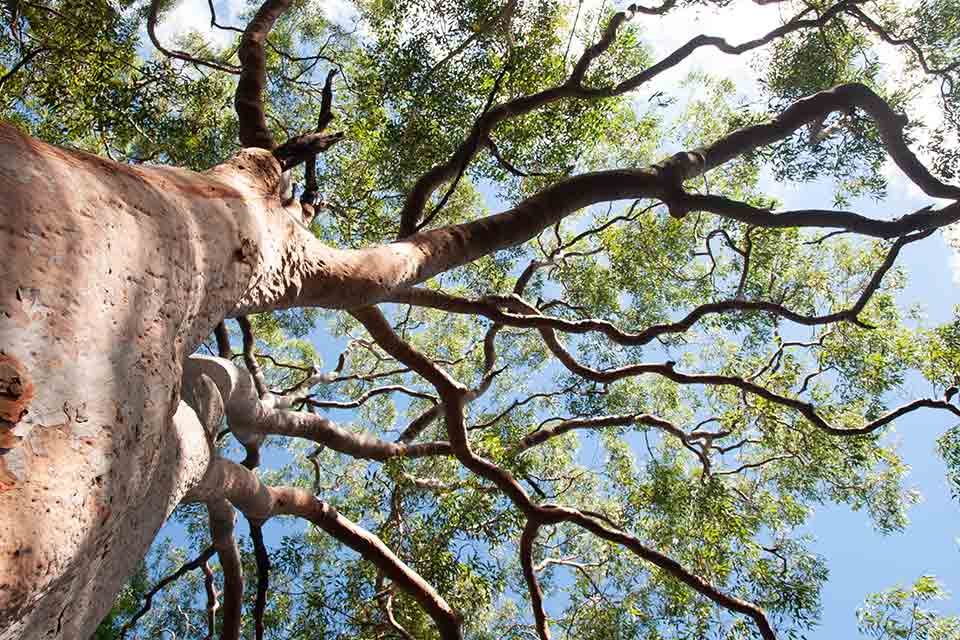
In this story from Australia, neighbors gather to await, and possibly impact, the fate of a giant mountain grey gum.
I first notice the cherry picker from the top of our garden, while surveying the mountains to the south and the valley below. It strains to penetrate the upper reaches of the tallest, oldest tree in town.
I have heard enough about this tree to know it’s a cause of some consternation within the community, have seen protesters and even a goat camped out around its base for months, but haven’t asked or listened enough to take any position on it.
It is the final day of autumn, and the garden’s unruliness is already feeling tamed by forces greater than itself. Its abundance is waning.
The pathways are buried under fresh carpets of curled leaves that have given up.
The roses are now home to only a few forlorn, half-wind-stripped flowers that refuse to leave, won’t accept that the year’s party is over, and whose dilapidated beauty is laid bare and held up for all to admonish by the sickly stems that grew them.
The buffalo grass is yellowing and chewed up from dozens of rosellas diving for the insects wandering blind inside its deadly labyrinth as winter closes in.
But today is unseasonably warm and gusty, and observing these changes in season remains a novelty, having never felt them so keenly before. Having relocated from the city just six months prior.
I wander along the riverside track with our sweet, spotty dog in the direction of the tree and the cherry picker and the indistinct syllables of yelling, which hasten my step.
All along the riverside, the tree ferns’ fronds have matured into a deep green while the introduced species present as stripped and wretched skeletons of their summertime forms, their skin melting off in real time. The river’s brown water runs high and angry, sloshing against fallen trees and worn-away banks. The sky ripples with a sea of thinned-out clouds, blown through the valley on changeable gusts and trapped by the mountains.
The canopy of the tree—a mountain grey gum—comes back into view as we cross the swing bridge. Its hulking limbs move to the will of the winds in an awkward synchronicity with the cherry picker’s carriage. They dance together.
The sun is blurred and hazy—a diffused key light for its solitary subject. Its towering spectacle. Tiered mountain grandstands packed with trees, a hundred thousand or more, watch on silently from either side.
Temporary fencing clangs at its imperfect joins all the way around the tree—a circular arena not much smaller than an Aussie Rules field. There are signs cable-tied all around the fencing, laminated and repeated:
restricted area – authorized personnel only
council notice to vacate trespass – you are hereby warned and directed to immediately leave the affected area
There are A4 sheets of fine print, too, summarizing a council-hired arborist’s report that the tree is sick, is dangerous, is to be cut down immediately.
In navigating around the perimeter, I start to get looks.
A policewoman. Subtext: You here to cause trouble?
I nod and smile subserviently and then chastise myself for being pitiful.
There are banners, too, homemade in hessian and mesh:
community consultation not coin
pave paradise and put up a parking lot
The most conspicuous message is in white spray paint on corrugated tin, nailed into the trunk at a height of three meters:
leave our tree alone
The most conspicuous message is in white spray paint on corrugated tin, nailed into the trunk at a height of three meters: leave our tree alone.
So girthy is the tree that seven or eight people could link arms and still not reach all the way around its trunk: a trunk of creamy, smooth, and unblemished wood, halfway concealed by streaked, blotchy grey bark. A trunk around which five central, upright boughs each support a vast network of branches, knots, and bunches of lance-shaped eucalyptus leaves and buds. A trunk now inaccessible to all but those inside the perimeter.
Every variety of cop is to be found in there: suited cops, sports-jacket cops, casual cops, clipboard cops, wraparound-sunglass cops, bulletproof cops, chino cops, riot cops with helmets, guns, radios, and torches, all with different styles of cop car and all parked in perfect rows like in an American action film—such is the extraordinary volume and variety of cops.
Back outside the fence, a stocky onlooker in a denim biker’s vest with a grey, gnomelike beard and close-cut mohawk stares at me with unflinching judgment. Subtext: One of them hippies, aren’t ya? Reckon the tree should stay, don’t ya?
His arms are crossed over his belly, and in one hand he grips a red-and-black can of premixed whiskey—public drinking in full view of every cop within a fifty-kilometer radius—with a vintage motorcycle beside him. No, actually—I have no idea what’s going on, as per usual, I imagine responding.
But I just nod, a self-assured nod generally reserved for the hardware store. A borderline toxic nod. Subtext: I am not a yuppie who learned how to light a fire two weeks ago.
Around town I wear a thick cotton work shirt, shapeless jeans, and black runners, which—coupled with my longish hair and beard—camouflages me in the cloak of utilitarian nondescriptness and placelessness I require to not feel inadequate, to not run the risk of being outed as a clueless, useless outsider.
My dog and I move through the crowd, slowly and tentatively, with an agenda to overhear as many soundbites as possible, most of which are projected at such a volume as to be heard by everyone.
Make good firewood, I reckon . . . bring ya chainsaws, boys?
Can’t they wait for that independent assessment? Not like it’s going anywhere. Only been here two hundred years.
Plenty of other trees, love—look ’round ya.
When people aren’t exchanging glances, aren’t evaluating their neighbors, they look up. A tense dissonance of jeering and cheering starts up as the cherry picker descends, and a protester is revealed to be lodged in a join between the two highest branches of the crown’s upper reaches, maybe seventy meters up. A jolt of terror courses through me.
One grizzly spectator, pacing about and gesturing at the tree, is so incensed by the presence of the protester that he mutters fuck and fucken under his breath and through his teeth, alternately and without pause. Others give voice to his misgivings.
Cut it down with that idiot still in it. Go on! We’re paying for this shit.
They can’t threaten him, nothing scares him. Fines, jail. Means nothing.
The protester up the tree faces away from me, northwest where the sun sits a little lower and gloomier than before. It penetrates the foliage, sculpting a koala-like silhouette of the man and a sundial of the tree, which casts its shadow all the way across the grassy embankment upon which I now stand and down the main road to the petrol station.
I consider the view from up there, twenty stories high, a view no other person has ever seen and probably never will. A vantage point that has likely been home to hundreds of generations of galahs, kookaburras, koalas, majestic birds of prey, all nesting in its hollows or feeding off its branches.
I consider the care, the connection, the shielding responsibility this protester must feel for the tree, knowing that he is the only person preventing its annihilation.
I consider how tall and dense and old the tree is—its rings bearing the dates of federation, the births and deaths of William Barak, of Queen Elizabeth, of colonization itself.
An Aboriginal flag billows beneath a lower branch, parachute cord tied through its grommets. Seen from straight on through the fencing, the flag is centrally framed by two small, handwritten cardboard signs:
hands off wurundjeri country
sacred pre-settlement tree
The tree’s roots reach down into a country of the deep past, to a time beyond impulsivity and impatience and bulldozer progress.
The tree’s roots reach down into a country of the deep past, to a time beyond impulsivity and impatience and bulldozer progress.
But in this moment it appears helpless, static, and passive.
I consider this perpetual urge to personify. And wonder whether it’s possible to just care about the tree for the tree’s sake, without having to attribute to it some dim-witted personality. Maybe all the sympathizers are doing this to some degree or maybe it’s just me—the drama vampire, sniffing out this bloodthirsty scene from my perch and showing up at just the right time.
With the cherry picker lowered, a dozen arborists in high-vis orange-and-white helmets stand about smoking, cracking jokes, on the clock and content to do nothing. Some have familiar chats with locals through the fence, and I consider that before this town’s present iteration as a tourist town, and even before its previous few decades as a hippie town, for a hundred years or more before that it was a logging town—and that some of these arborists and their families must go back generations here. For them, this tree must be just one of hundreds of thousands of trees amidst these mountains, which—logged into starkness by their fathers or grandfathers—are now blanketed once again by whole new generations of loggable trees.
Around the tree’s base gather a ragtag crew of security guards in mismatching yellow vests, ushered into place by two cops whose arms swing at an exaggerated distance from their torsos, each taking up as much space as a small car, and with voices lowered to sound like newsreaders.
Including the various police, the security guards, and the arborists, there are maybe fifty people inside the fenced circle.
The bikie with the long beard and the premixed whiskeys approaches me directly, and my mind churns through all the catastrophic outcomes of an altercation with him. I resolve to offer no indication as to my still-forming opinions and then plot the most direct route toward the largest cop.
They’re trying to smoke him out, poor bastard.
Subtext: Your toxic nod was misplaced.
Been up there for weeks now, on and off. Tonight’s the night, though.
Over the next hour, myself and the bikie—who’s maybe just someone who owns a bike and has a beard and breaks public drinking laws—speak in long pauses, gaze up at the tree as if it were a campfire ,and ruminate on how this could end.
He asks a protester on the ground who has a two-way radio, in contact with the man up in the tree, if there’s anything we can do to help, and she says we already are by showing up and sitting here.
I consider why there aren’t any journalists here, too. They’re vampires for drama, I tell the bikie and the protester, hoping to offset some shame.
She says he’s getting tired up there, thirsty, too, since they can’t get supplies to him any longer, but he appreciates everyone’s support. That he’s doing it because he knows it’s the right thing to do, a local who grew up climbing and playing in this tree, now has young kids who did the same and wants them to see, to understand, that this—she gestures to the tree, the mountains, the valley—we’re only here to look after all this. Right?
The bikie buys us a six-pack of premixed whiskeys, and I pick up a margherita pizza as the crowd thins.
The sun drops behind the mountains, which briefly bounce the sun’s soft glow like a reflector board into a warm, orange gradient on the clouds above.
He speaks about permaculture and his own greenhouses and graciously answers all my questions as I try to understand.
I intermittently pause our conversation to make voice memos about wildlife-attracting, food-producing native plants and to take some pictures of the moon, which—diffused by clouds as the sun was during the daytime—hangs like a huge Christmas bauble in the tree’s crown.
The now barely visible man up the tree, still silent and unyielding, feels more distant than before, as if having ascended to someplace else. As if having merged with the tree. I don’t understand him, I now realize. Maybe nobody does. And when the gusts roll through, we all look up. But he never stirs.
The now barely visible man up the tree, still silent and unyielding, feels more distant than before, as if having ascended to someplace else.
Four security staff approach the base of the tree. The reflective strips on their ill-fitting yellow vests catch the light of the intermittent car headlights down the main road. They lean an extendable ladder up against the trunk—two holding the ladder while one supervises and the fourth climbs up to the leave our tree sign.
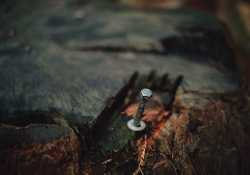
With a sense of ceremony and the peen of a hammer, both nails are removed and pocketed with care. The sign is flung to the ground. Its corrugated tin clatters thin on the bitumen below. Subtext: We have council orders to grind you down until you have no morale.
Two stoned ladies pause their Bluetooth speaker and scream expletives littered with bogus legalese about property damage and theft and suing the security guards, suing the council, suing the state government, while holding their videoing phones up to the temporary fencing. The whole world will see this! You’re a disgrace!
The arborists clock off for the day though their crane remains. With the tree having survived another day, the mood lightens and conversation turns to getting the man out of there under the cover of darkness, avoiding arrest.
A curious cast of locals share a drink or just sit with the bikie and me as the hours pass—one with a donkey in tow, another pulling up in a European sportscar—some having periodically checked on the tree like this for the days and weeks prior. What’s the plan? Can’t sleep up there, can he?
The security guard who disposed of the sign approaches each of his subordinate security guards, all scrolling social media or texting on their phones. He hands them each a small bag of Pizza Shapes, requiring a dainty manner of eating that’s at odds with their—mostly large—security guard hands.
I discreetly ask the closest security guard for a Pizza Shape, which he grants—feeding it through the temporary fencing to our mutual amusement, then consider what my own presence here—surrounded by empty cans—might hold in the eyes of powerful people who wish to discredit and dismiss all of those in opposition to their carparking plans.
Just before eleven o’clock, consensus is reached that for the man up the tree to safely descend to terra firma, to sleep somewhere and maybe get back up there again tomorrow, either a major distraction is required or else the atmosphere should become even less charged, such that the guards and police—now fewer, too—aren’t on high alert when he makes a run for it.
The bikie, whose troublemaker energy after a dozen cans has me suspecting that he might really be a bikie, leaps up with a plan to burrow under the far side of the fence and then jam nails into the tires on the cherry picker, before being convinced otherwise by the core group of protesters.
Those of us who have only been present today agree to leave, to help wind things down.
My new friend and I shake hands and admit to having enjoyed each other’s company despite the circumstances and agree to meet back here tomorrow morning. I make him promise not to dig under the fence, not to puncture the tires because we’re maybe both clumsier and more conspicuous than we realize. You’d be buried alive under a pyre of cops before you’d even nailed the first tire, I joke. He agrees and I leash the dog and—nine hours after having arrived at the tree—finally leave.
The dog and I cross back over the river and encounter her first late-night wombat, then her first suspected deer. Suspected on account of the absence of any streetlights or torch. My phone has run out of battery, too.
She is pulling and yowling, and where I would usually feel sped up and scared—of the possibility of wombat mange, of being kicked in the head by some unknowable deer, of the depths of the darkness down by the riverside and what else might lurk around the next corner—I am not any of that and feel its peaceful absence.
I consider the possibility that I am just brimming with some artifice of belonging, of friendship, of simulating what it’s like to be a part of something rather than just peering in for half a day, an environmentalist voyeur scavenging for meaning and pretending to find it at the base of a tree like a golden ticket—dinner and drinks and a show—rejoicing in the arc of it.
But as we move toward home, I shake my head at the day and the night that’s been, at the wombat and the deer just now, at the gentle and empathetic bikie and the man who could only say fuck, at that security guard with the Pizza Shapes, and the man up the tree—that colossal, beautiful tree—as we open the gate to the garden.
I fall asleep to these thoughts, dissecting the day’s meaning. But wake after just two hours.
The scream of chainsaws tears through the valley at two a.m.
We stagger toward the top of the garden. The dog is uneasy.
The aggressive locals. The ones who wanted to burn it as firewood. The generational loggers. The ones who wanted to kill the protester. This must be them, has got to be them.
The tree is floodlit from below and woodchips churn like a brown snowstorm across the town on the roaring wind. A probing seventy-meter telescopic arm dances about, two small figures pruning and probing from within like angry ticks. Nipping and tormenting.
The tree’s leaves and its uppermost boughs and branches—all amputated.
This statuesque mountain grey gum—tall and straight and lit up like a lighthouse—suspended in blackness—maimed into embarrassment.
With dog leash and torch and shoes and phone and keys we are back out the gate, down the street and over the swing bridge.
The full height of the tree comes into view and we pause.
Even with just its head and torso and legs and feet remaining, the resoluteness, the power of its mutilated presence arrests. This Venus de Milo—bleeding out into the darkness.
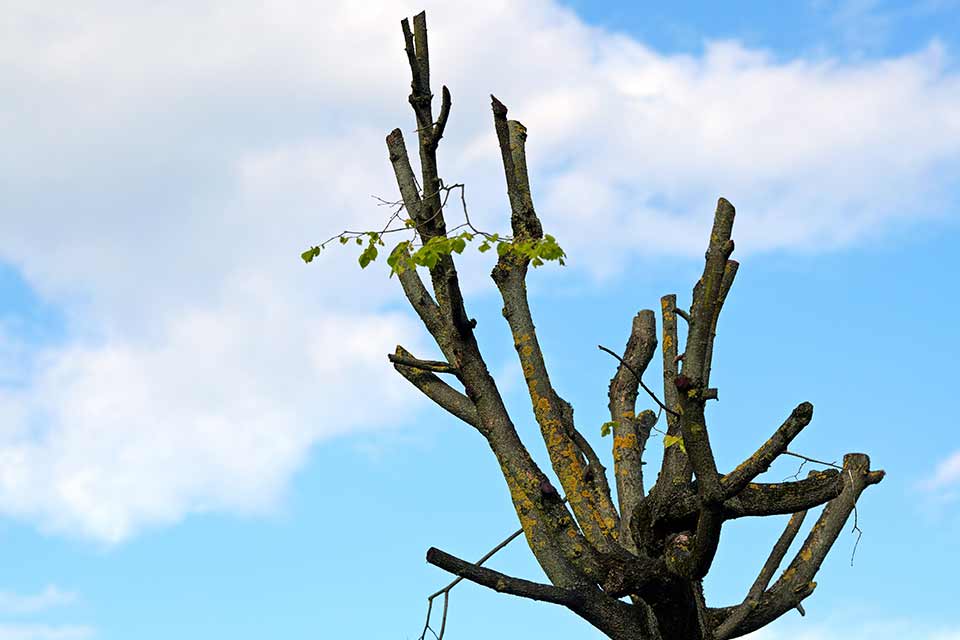
Even with just its head and torso and legs and feet remaining, the resoluteness, the power of its mutilated presence arrests. This Venus de Milo—bleeding out into the darkness.
Alone in the carpark but surrounded by beeping machinery and chugging diesel engines, by arborists trudging about with unremarkable purpose, by clanging fencing—all here to herald its demise—the old world’s final foothold in this town before nature can be reduced to a series of curated vignettes and purchases—take your photo, order a coffee, and onto the next place. Nothing wild that you can be inside of, feel a part of.
The basket is ten meters from the top of the trunk.
An excavator with a claw at its end shuffles about below, stacking piles so large that they peek over the tops of the fencing. The menthol oil of the eucalyptus leaves and the dense musk of the freshly exposed orange gum blend into an aroma so grounding and cleansing as to feel betrayed by all smell—to shut that sense off for its insensitivity.
The chainsaw’s pitch goes up. Up. To a crescendo that it sustains. And it holds that crescendo inside the neck of the tree, its sharp teeth tearing at the decades and centuries—exposing the tree’s innermost rings to their first taste of gasoline, to their first contact with an engine—roaring hard and hot.
Everyone is awake. Everyone can hear it.
Some are saying it’s about time. Or reaching for their earplugs, putting pillows over their heads. Or sighing and shaking their heads—so flattened and tired from always losing, this town as all towns, these mountains as all mountains, tree by defiled tree.
Even the arborists with the big earmuffs up in the basket and the ones pulling on ropes from the ground, thinking about something else while they’re laboring, relying on muscle memory alone and aching to go back to sleep like the rest of us—to be anywhere but here, anytime but now—they must hear it, too.
Everyone has their own version of it. But everyone hears it.
And I feel it in my chest. That gunshot thud as the trunk meets the bitumen.
Naarm / Melbourne