
Enough with this.
I put the book of poems aside
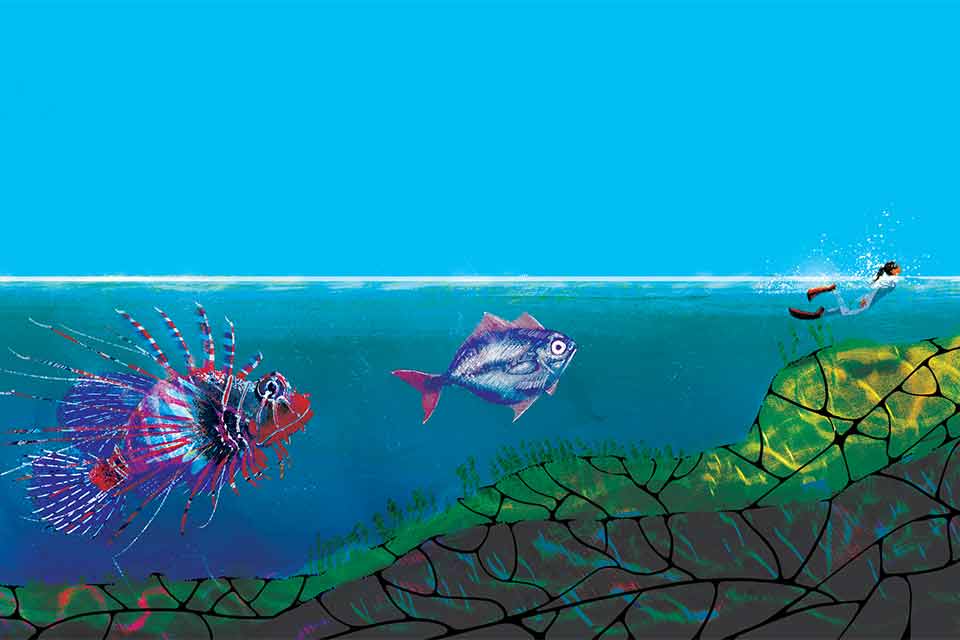
like a diver floating to the surface
to catch her breath.
There is a finite supply of oxygen
you can press into your lungs
when you dive under water;
a finite supply
when you sink into a poem.
The water is cold,
chilling to the bone.
You weigh nothing.
And the light is faint.
Strange sea creatures
swim around you,
and metallic fish.
There is nothing on land
that can come near the world
you find here.
Still, you can never stay too long.
You must always rise
to the surface; to return to the sun,
and have it dry you.
To pluck fruit
from a tree.
To draw one breath,
and let one out.
You must fall in love,
kiss a mouth, bite down
on the lips.
To be jolted by a softness
you can pull apart
with your teeth.
Before they tear down prison walls and royal palaces,
before they assemble outside police stations and parliament fences,
before they cleave the streets with banners of rage,
men and women whisper,
invisible to the eyes of the executioner,
and the informant.
They whisper in coffee shops,
behind closed doors, beneath quilts, in flats with all their lights on
in the middle of the night,
on lunch breaks, between shifts, on the Damascus Gate’s steps,
clustered in small rings in Haifa—
and opposite vegetable crates in Nablus,
where two friends meet by chance and whisper:
who had been tortured, who kidnapped
from outside his house;
how in the night the soldiers arrived;
what the prosecutor said;
how they broke into the cultural center;
and who they thrust into the prison van.
Look how (A) rolls a cigarette, then slants toward his friend,
how (B) puts down the groceries, raises her eyebrows
as she recounts to (C) the events of the previous night,
how (M), (K), and (G) gather around (O) to find out
what happened with the neighbors;
look at (F) and (R) whispering on the stairs.
Look at everything that comes to light
when two people scheme from behind a window
like a pair of shadows.
O whispers:
you are what trees trade on blameless summer nights,
before the storm arrives.
The scales of Palestinian poetry
have been balanced: now
Mahmoud Darwish
and Zakaria Mohammed
live in opposite flats,
like a divorced couple.
And I am their daughter:
the daughter of two doors,
each closed to the other.
The daughter of two solitudes.
Of the man who said:
“The stars are words
on their way to me.”
And the man who said back:
“There is no limit
to the soul’s abstinence.
A drop of rain on the nose
revives it.”
I have a room in both houses;
a lantern in each room.
Here, we pick daffodils as we sing.
And here, we float silently in the Dead Sea.
I cannot pack my things, move
from one house into another.
How can I choose between them
when their gifts and sins
press into my hands?
Their blood
runs through my words.
As the daughter of a broken home,
sometimes I forget which bed I slept in,
and in which drawer
I left my paper and pens.
And sometimes, I catch them
secretly kissing
with the hunger of stars over Jericho
for the Jordan valley, and I swell
with envy and hope.
Translations from the Arabic
Editorial note: From Enter World, forthcoming from Graywolf Press in November 2026.