
WLT is pleased to announce the winners of the second annual University of Oklahoma Student Translation Prizes: Zain-alabideen Mirza in prose and Aiden Wilson in poetry, with Emily Holson as the poetry runner-up. WLT editor in chief Daniel Simon made the announcement on Thursday, April 2 at the opening reception for the 2026 Puterbaugh Lit Fest at Norman’s historic Depot.
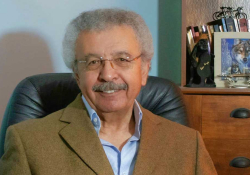
Three OU faculty members—Dr. Emily Johnson (Modern Languages, Literature, and Linguistics), Dr. Mina Raminsabet (International & Area Studies), and Dr. Julie-Françoise Tolliver (English)—judged the longlist of entries, with Dr. Simon as chair of the jury. Final selections were made by a guest judge, Arthur Malcolm Dixon, an OU graduate and award-winning translator from Spanish.
The translation prizes—$200 for the winning prose translation, $200 for the winning poetry translation, and $100 for the runner-up—are made possible by two generous gifts from Dr. Alice-Catherine Carls, a longtime World Literature Today contributor and current editorial board member, supplemented by matching contributions from OU’s Dodge Family College of Arts & Sciences and the David L. Boren College of International Studies.
Graduate and undergraduate students who have been working on literary translations during the 2025–2026 school year were eligible to enter their work. Dixon praised each of the finalists for their work:
With this translation of prose by Syed Ahmed Shah Bokhari, Zain-alabideen Mirza achieves one of the most difficult feats that any translator can face: communicating humor across the complex lines of culture, geography, and language. The amusing, colloquial levity of the English text is a testament to the talent behind its translation.
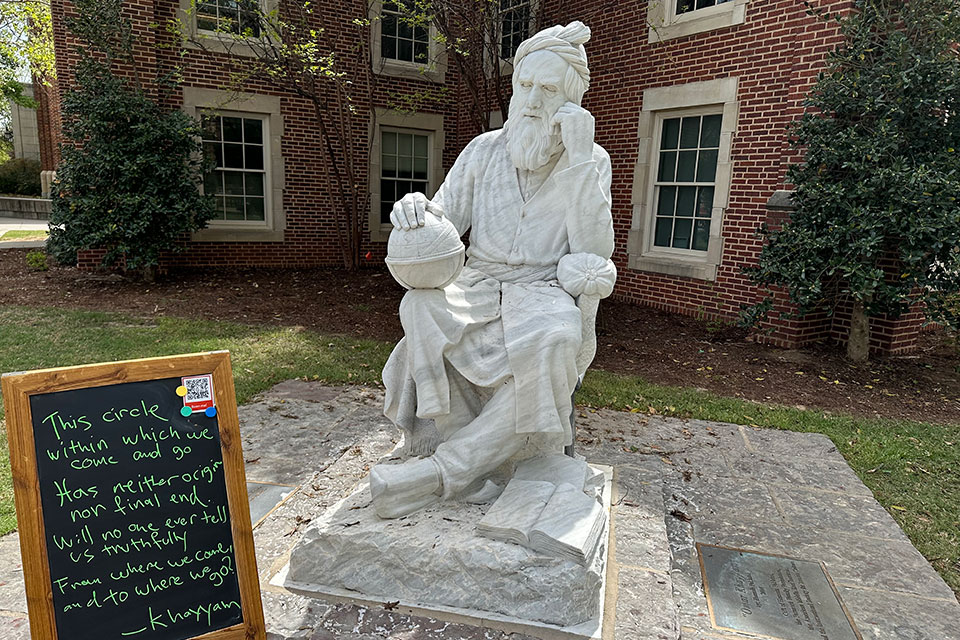
Aiden Wilson’s translations of Omar Khayyam demonstrate one of the beauties of translation: that human feelings can endure through words, affecting others many miles and centuries away from their author. Aiden captures resignation, gaiety, and rhyme with grace and concision, such that a twenty-first-century reader of English can truly relate to the classical poetry of eleventh-century Persia.
Emily Holson’s translations of poetry by David Mandessi Diop stand out for their striking balance between beauty and meaning. Not only does she skillfully evoke the sounds and images that mark these poems; she also maintains the bonds between these aesthetic elements and the poems’ profound and relevant political significance.
Mirza is a senior international studies major of Pakistani descent, OU Urdu Club president, and Model United Nations ambassador. He translated an excerpt by the Pakistani writer Syed Ahmed Shah Bokhari. After accepting the prize, he offered the following comment: “For most of my life I haven’t been exceptionally inclined toward poetry and prose. But at the beginning of this semester, I founded an Urdu Club here on campus (OU_UrduClub on Instagram). Urdu, spoken by hundreds of millions across India and Pakistan, has a rich history of literature, which hails from Persian, Arabic, and Hindi influences. Founding this club opened up amazing opportunities like this competition, and so I’d like to extend a special thanks to the College of International Studies’ Dean Stalling as well as WLT’s Dr. Simon, both of whom have been incredibly supportive in my goals to create a space for Urdu and South Asian culture to flourish here in Oklahoma.”
From Norman, Oklahoma, Wilson is a history and international studies dual major with a minor in Iranian studies, currently learning Farsi in Tajikistan. He translated four poems from Farsi by the legendary poet Omar Khayyam. “This semester I have been fortunate to have the opportunity to study the Persian language immersively in Tajikistan,” Wilson wrote. “This has not only been invaluable in strengthening my language skills but also in helping me connect with Persian poetry on a deeper level. Three times a week, I take rubab lessons, a traditional Persian instrument. I have learned how to sing the poems I submitted for this competition, and many more, in the way they were intended to be experienced. What is special about this experience is that singing these poems and playing the rubab allows me to step into a centuries-old musical and literary oral tradition that is the equivalent of physically experiencing history. I am excited to see how understanding the musical aspect of Persian poetry strengthens my future translations.”
Raised in Owasso, Oklahoma, Emily Holson is a senior at OU, double-majoring in French and English. A dedicated writer, translator, and artist, she previously studied animation at Gobelins l’école de l’image in Paris, France. Her illustrations have been featured in World Literature Today, and she was the third-place recipient of the 2025 Scissortail Undergraduate Writing contest.
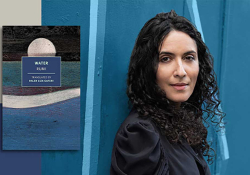
At the reception Thursday evening, Haleh Liza Gafori, the 2026 Puterbaugh Fellow, congratulated the prizewinners and also gave a brief recitation of some of her renowned Rumi translations.
OU’s award-winning magazine of international literature culture, World Literature Today is currently celebrating its 100th year of continuous publication. The July 2026 issue will include a cover feature devoted to the 2026 Puterbaugh Festival and contemporary Iranian literature.