
Contemporary literature by authors from Madagascar is as multifaceted as the many faces and voices writing it. There are some shared characteristics, of course. It is insular, because it comes from an island. It is postcolonial, because it’s being written after 1960. It’s all about identity, because what isn’t, really? It is part African and part Indian Ocean because of how physical space works. But a common geography does not a category make. Literature coming out of Madagascar can also be poetic or sparse or realistic or dystopian or historical or modern or anything else, and everything else.
Tiffany Tsao has rightly pointed out that “literature isn’t a tourist guidebook.” And so, these recommendations are not meant to be a reader’s primer on what an entire country is like. This is an area of the literary world with which most English readers are unfamiliar, due in part to the dearth of English translations. But as I’ve been working with Malagasy authors for many years now, I can share recommendations from my own experiences.
A common geography does not a category make.
Malagasy literature is still rather underrepresented in English translations. All of these translations were translated from French; the only book-length translations from Malagasy are a scholarly work on hainteny by Leonard Fox (currently out of print) and translations of early twentieth-century poetry by Jean-Joseph Rabearivelo, which include both Malagasy and French sources, including Translated from the Night, translated by Robert Ziller. For contemporary poetry, you can read a few poems from Esther Nirina (translated by Alison Anderson) and Raharimanana (translated by Alexis Pernsteiner and Antoine Bargel) at Words Without Borders, or check out the bilingual anthology Voices from Madagascar / Voix de Madagascar, edited by Jacques Bourgeacq and Liliane Ramarosoa (translated by Marjolijn de Jager and featuring selected translations from Jacques Bourgeacq, Jacques Dubois, and Gertrude Champe).
As an additional note, you may have seen Madagascar in the news recently, as a Gen-Z revolution was sparked in Madagascar in late 2025. Both Soamiely Andriamananjara and Raharimanana have written poetic and essential primers about it, giving incredibly important context to a series of events that continue to evolve. Both are available for free online at Medium and Literary Hub.
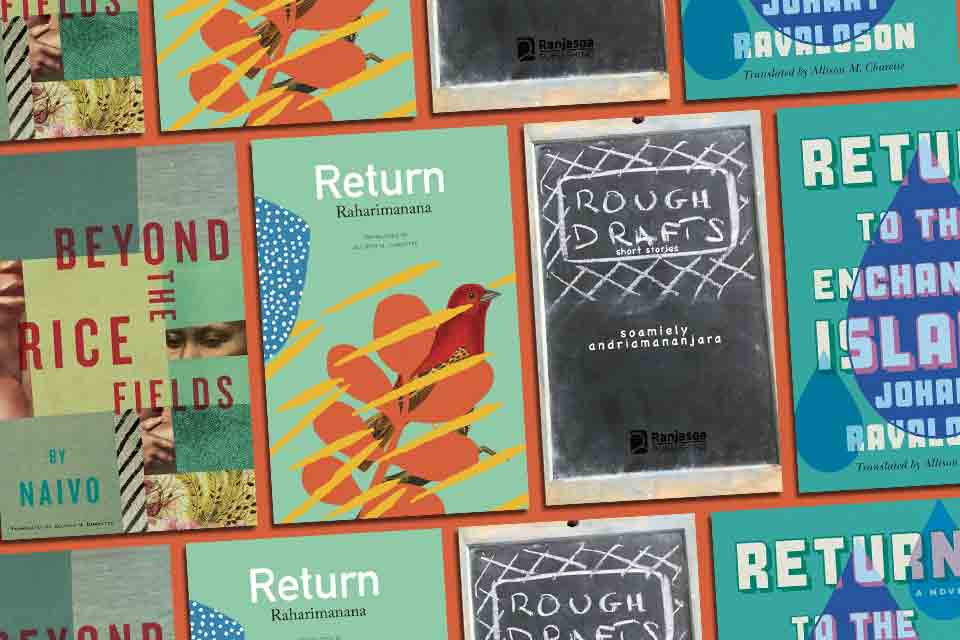
Naivo
Trans. Allison M. Charette
Restless Books, 2017
If you like historical fiction, fated love stories, richly drawn worlds, and the ambiguity of poeticism, then you’ll probably like Naivo’s Beyond the Rice Fields, a deep delve into the upheavals of early 1800s Madagascar as the country confronted Christianity and industrial modernity.
Although a novel on the surface, this narrative is structured like a hainteny, which is a traditionally Malagasy poetic way of speaking veiled in enigma and generally takes the form of a dialogue. Our dual narrators here are Fara, a country girl, and Tsito, her family’s slave, who tell the story from differing perspectives and timelines: Fara speaks in the present tense and grows up as the story progresses, while Tsito is an adult using the past tense to look back on his life. An extensive and detailed historical past is illuminated through the eyes of these two everyday people who, as Poornima Apte puts it, “have to find their way forward no matter how tortuous the path.”
Raharimanana
Trans. Allison M. Charette
Seagull Books, 2025
If you like fever dreams and wandering, deeply emotional and visceral resistance, childhood stories, and words used in gorgeous ways you’ve never dreamed of, then you’ll probably like Raharimanana’s Return, a testament to the act of beauty that is writing, speaking truth and condemning the violent legacies of both personal and national histories.
This is Raharimanana’s first novel to appear in English, and it is a reckoning. He wrote the book as a semi-autobiographical novel, drawing from his and his family’s lived experiences within the collective national trauma of (post)colonialism. But Raharimanana is also a multifaceted artist of many forms, and so any prose novel from his hand will never be just that. He draws from the rhythms of valiha music, the imagery of poetry, and the composition of photography to craft a masterwork of the written word. Shaiq Ali writes that “Return is a boiling encounter. It breathes in all ways. In fire and smoke. Drowning one in its histories. Raharimanana takes you to the sea and back, across all its waves, rocks, birds, stones, and sands. It is a chronicle of a land that mourns but of a people that live on.” (You can read an excerpt at Words Without Borders.)
Soamiely Andriamananjara
RanjaSoa, 2018
If you like underdog narratives, character studies, fresh rhythms in prose, and journeying through the many strata of a single society, then you’ll probably like Soamiely Andriamananjara’s Rough Drafts, a perceptive, poignant, and sometimes eviscerating collection of short stories.
I’m slightly cheating on this one, as it’s originally written in English, but it fits in perfectly with the spirit of translation: Andriamananjara, who generally writes in Malagasy but has lived and worked in Washington, DC, for decades, has specifically talked about how these stories were “challenging to the extent that [he] had to adjust the style of the English narrative to mimic the Malagasy sound.” Andriamananjara has a keen eye for observing life and Malagasy society around him, and he writes his characters with laser precision. Also, his ability to bring the feel of Malagasy speech into English words utterly outshines the rest. At turns chilling, emotional, and satirical, the collection shines as a whole. (You can read some stories where they first appeared on his Medium page.)
Johary Ravaloson
Trans. Allison M. Charette
Amazon Crossing, 2019
If you like contemporary fiction, rich-boy problems, sex, drugs, and rock ‘n’ roll club music, and life that mirrors legend, then you’ll probably like Johary Ravaloson’s Return to the Enchanted Island, a coming-of-age story set against the backdrop of Madagascar’s origin myths.
Ravaloson is a prolific writer, yet like most authors from Madagascar, this is the only one of his full-length works that has been translated into English to date. But what a refreshing take it is. Born of the author’s desire to reject the poverty narrative that overwhelmingly persists about Madagascar in the international media and consciousness, this novel tells the story of Ietsy Razak, son of a powerful family in Antananarivo and named after the first man at the creation of the world. But it is not so simple to come by illumination and glory, and there is a journey Ietsy must take if he hopes to overcome the apathy fueling his insomnia. The modern-day narrative is intertwined with a full retelling of Madagascar’s creation myth, with each story shaping the other as it develops. (You can read an excerpt at Words Without Borders.)
Mose Njo
“Siri, My Love; Zuckerbook, My Home”
Future Science Fiction Digest, 2022
“Eve & Mada”
Future Science Fiction Digest, 2024
Trans. Allison M. Charette
If you like sci-fi, dystopian fiction, black humor, and chilling realism, then you’ll probably like Mose Njo’s short stories “Siri, My Love; Zuckerbook, My Home” and “Eve & Mada.”
Njo writes very specifically Malagasy sci-fi. Much like K-Pop Demon Hunters tells a specifically Korean story without ever mentioning Korea, his backdrop of Madagascar is assumed to be the cultural norm; there are no teaching moments for the benefit of the wider reading world. He has a chilling and prescient voice: both of these stories, which deal with AI and virtual worlds, were written earlier in the 2010s before the real-world technology had developed. At the same time, he explicitly borrows very old narrative techniques from the Malagasy tradition—for example, the explanation of hainteny (see above, for Beyond the Rice Fields) is also quite relevant to the “how do you love me?” exchange in “Eve & Mada.”