
“Literature tends to draw sustenance from itself, of course, and thus to frame to an unusual degree the continuities and recurrences of the structures related to exile. Broad though the spectrum of these literary responses has been, it can be observed that they range, in the main, from a pole A to a pole B. . . . In the first case, which is common in poetry and often assumes elegiac modes, exile becomes its own subject matter. In the second, which may lead to narratives and essays, exile is the condition but not the visible cause of an imaginative response often characterized by a tendency toward integration, increasingly broad vistas, or universalism. . . .
No doubt Ovid can be and has been regarded as the original hero and archetype of the first kind. We may grant that the various forms of the odyssey, or of the Ulysses theme, are sufficiently representative of the second. . . . In both cases the basic dimensions and symbols of exile could be considered the circle and the center ; and even when the causes of banishment were political, its consequences were frighteningly cultural, for to be expelled from the center of the circle amounted to the danger of being hurled into the void or doomed to non-being.”
—Claudio Guillén, “On the Literature of Exile and Counter-Exile,”
Books Abroad 50, no. 2 (1976): 271–72, 275
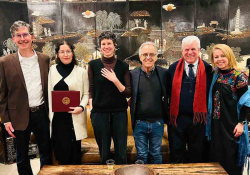
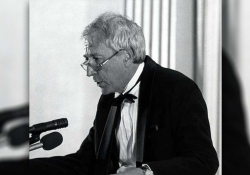
Claudio Guillén (1924–2007) was a Spanish writer and scholar of comparative literature who lived in exile following the Spanish Civil War and served the Allied cause in World War II.
Guillén was elected to the Real Academia Española in 2003.